

A product priced below competitors is not automatically competitive, just as a higher price does not always mean a retailer is losing customers. Price performance depends on the product being compared, the customer segment, promotional conditions, availability and the margin left after discounts and operating costs.
Retailers need to understand not only what competitors charge, but also where price differences matter to customers and whether changing prices would improve commercial performance.
Compare Like With Like
Price comparisons become unreliable when products differ in size, specifications, pack quantity, quality or included services. A smaller pack may have a lower shelf price but a higher cost per unit. A discounted listing may also be out of stock, restricted to loyalty members or available only for a short period.
Build a comparable product set using consistent identifiers such as brand, model, size, pack quantity and product specifications. For private-label products, compare relevant attributes and customer use rather than assuming that products in the same broad category are interchangeable.
The National Institute of Standards and Technology’s 2025 unit-pricing guide emphasises consistent unit-price information to help consumers compare products across package sizes and retail formats. The same principle is useful in competitive pricing analysis: standardise the comparison before drawing conclusions. <Cite refs={[“turn787703search11”]} />
Understand The Price Position
A price index can show how a retailer’s price compares with a defined competitor set. But the benchmark must be clear. Comparing a premium retailer with discount outlets may identify a difference without showing whether it is commercially relevant.
Effective retail price intelligence strategy links competitor prices and promotions to product availability, customer response and the retailer’s own cost and margin structure. It should answer three questions: where are we overpriced or underpriced, which products influence customer choice, and which changes are likely to improve total profitability?
Track the following:
- Everyday prices: Compare regular prices across a consistent basket of products.
- Promotional depth: Record discounts, multi-buy offers, loyalty pricing and campaign duration.
- Availability: Distinguish a genuine competitive price from a listing that cannot be purchased.
- Price changes: Track when competitors change prices and whether those changes persist.
- Commercial outcomes: Connect price movements with units sold, revenue, gross margin and stock levels.
Public price data can help with context, but direct competitor monitoring must follow applicable terms, privacy requirements and data-access rules. Internal transaction and promotion data are needed to understand whether a price change actually affected demand.
Protect Margin While Responding
Not every price gap needs a response. Matching a competitor on a highly visible staple may protect customer perception, while copying a discount across an entire assortment can unnecessarily erode margins.
Retailers should classify products by their role. Traffic-driving products may justify tighter price positioning; differentiated or less directly comparable items may support stronger margins. Price tests should measure unit sales and gross profit together, while controlling for seasonality, stock availability, advertising and other concurrent changes.
A discount that raises volume but reduces total contribution may not be successful. Conversely, a modest price increase can improve profitability if demand is relatively stable and the offer remains credible to customers.
Retail Pricing Strategy Framework
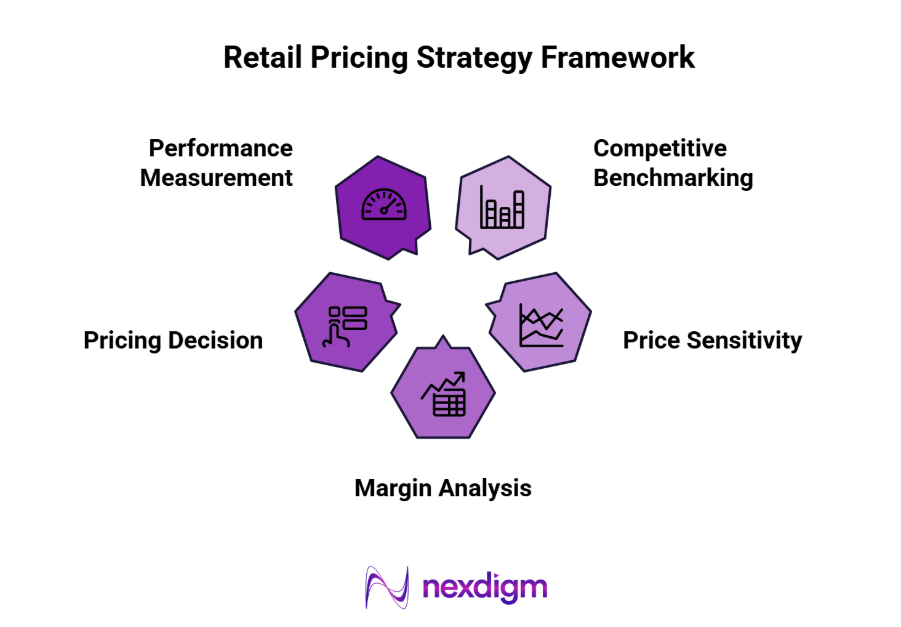
- Competitive Price Benchmarking: Compare equivalent products across relevant competitors.
- Customer Price Sensitivity: Identify products and categories where price differences influence purchasing.
- Margin Analysis: Evaluate product costs, discounts and gross margin exposure.
- Pricing Decision: Determine where to maintain, increase, reduce or promote prices.
- Performance Measurement: Track changes in sales, profitability and customer response.
Case Study: Correcting Price Gaps
A homewares retailer reviewed 120 comparable products across four competitors. It found that several high-visibility items were priced above local alternatives while other products were being discounted without a clear sales response. The retailer adjusted selected prices and tracked unit sales and gross margin over the following six weeks.
To take the next step, simply visit our Request a Consultation page and share your requirements with us.
Harsh Mittal
+91-8422857704