

In an increasingly competitive retail environment, improving operational efficiency is essential for sustaining margins and growth. Retail business process benchmarking enables organizations to compare internal workflows against industry standards and top-performing competitors.
Linked to competitive intelligence, this approach provides insights into how leading retailers optimize staffing, inventory, and supply chain processes. By leveraging external benchmarks alongside internal data, retailers can identify performance gaps, adopt best practices, and drive measurable efficiency improvements across store networks.
Industry data indicates that retail business process benchmarking can drive operational efficiency improvements of 10–15% by identifying gaps in labor productivity, inventory handling, and supply chain processes. Standardized workflows can reduce operational costs by up to 12%, while best-in-class retailers achieve 20–30% higher productivity through process optimization. Additionally, benchmarking-led inventory improvements can lower stockholding costs by 10–20%, further enhancing overall efficiency.
How Does Competitive Intelligence Improve Retail Process Benchmarking?
Competitive intelligence enhances retail process benchmarking by providing insights into competitor workflows, performance metrics, and best practices, enabling retailers to identify gaps, adopt efficient processes, and improve operational performance.
-
Competitor Workflow Analysis
Examines competitor processes to identify efficiency gaps, enabling retailers to redesign workflows and improve overall operational effectiveness across functions.
-
Performance Metric Benchmarking
Compares key performance indicators with competitors to highlight underperformance areas and set realistic, data-driven improvement targets.
-
Operational Gap Assessment
Uses competitive insights to detect inefficiencies in staffing, inventory, and logistics, enabling targeted process improvements.
-
Process Standardization
Aligns internal workflows with industry benchmarks, reducing variability, improving consistency, and enhancing operational scalability across store networks.
-
Continuous Improvement Monitoring
Leverages ongoing competitor tracking to refine processes regularly, ensuring sustained efficiency gains and adaptability to market changes.
Nexdigm’s Retail Process Gap Assessment and Performance Optimisation
Nexdigm’s retail process gap assessment and performance optimization approach evaluates existing workflows against industry benchmarks to identify inefficiencies across operations, supply chain, and store execution.
By combining competitive intelligence with data analytics, it prioritizes high-impact improvements, streamlines processes, and implements standardized practices, enabling retailers to enhance productivity, reduce costs, and achieve sustainable operational efficiency gains.
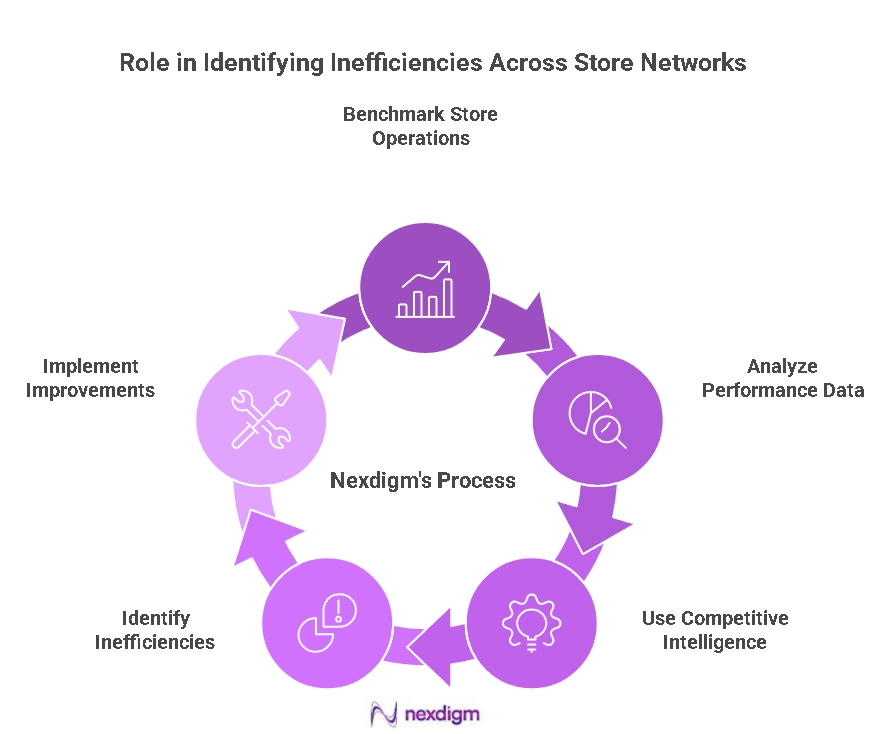
Nexdigm’s Role in Identifying Process Inefficiencies Across Store Networks
Nexdigm identifies process inefficiencies by benchmarking store operations, analyzing performance data, and using competitive intelligence to uncover gaps in workflows, staffing, inventory, and supply chain execution:
-
Store-Level Performance Analysis
Evaluates individual store metrics to identify inefficiencies in sales, staffing, and operations, enabling targeted improvements across underperforming locations.
-
Workflow and Process Mapping
Analyzes end-to-end processes to detect bottlenecks, redundancies, and delays, helping streamline operations and improve execution efficiency.
-
Labor Productivity Assessment
Assesses workforce utilization and scheduling to identify gaps, optimize staffing levels, and improve overall productivity across store networks.
-
Inventory Handling Evaluation
Examines stock management practices to reduce overstock, minimize stockouts, and improve inventory flow and turnover rates.
-
Supply Chain Efficiency
Identifies delays and inefficiencies in procurement and logistics, enabling faster replenishment and smoother product movement.
Nexdigm’s case:
Nexdigm demonstrates how process benchmarking and automation can drive measurable efficiency gains. In one engagement, the firm enabled up to 45% improvement in process efficiency and achieved near 100% accuracy in reporting through automation, reflecting how structured benchmarking and standardized workflows can significantly enhance operational performance and decision-making across business functions.
To take the next step, simply visit our Request a Consultation page and share your requirements with us.
Harsh Mittal
+91-8422857704