

Retail procurement influences more than purchasing costs. Supplier decisions affect product availability, inventory levels, store operations, customer experience, and profitability. A supplier offering the lowest unit price may create higher costs through delayed deliveries, inconsistent quality, or frequent stock shortages.
Retailers therefore need a procurement approach that balances commercial terms with operational reliability. The objective is to secure the right products, at the right cost, in the quantities and timelines required across stores and distribution centres.
Understand Demand Across Store Formats
Procurement requirements vary by store size, location, product category, and customer profile. A high-volume urban store may require frequent replenishment, while a smaller outlet may need lower order quantities and greater flexibility.
Historical sales, seasonal fluctuations, promotional calendars, inventory records, and stockout frequency can help forecast purchasing requirements. These inputs should be assessed at the category and location levels to avoid overstocking slow-moving products while essential items remain unavailable.
Evaluate Total Procurement Cost
Unit price is only one part of the purchasing decision. Freight, handling, storage, minimum order quantities, payment terms, defects, returns, and emergency replenishment can materially change the cost of sourcing.
Retailers should compare suppliers using the total cost of ownership rather than quotations alone. This also helps identify where a slightly higher purchase price may be justified by better delivery performance, lower wastage, or reduced inventory requirements.
Balance Supplier Performance With Risk
Supplier performance should be measured consistently across delivery reliability, product quality, responsiveness, order accuracy, and issue resolution. Risk assessment should also consider dependence on individual suppliers, production capacity, geographic exposure, and the availability of substitutes.
For retail procurement strategies, this means connecting commercial negotiations with store-level requirements. A supplier’s performance should be judged by whether it supports availability and service standards, not simply whether it meets contractual pricing.
Retail Procurement Optimisation Framework
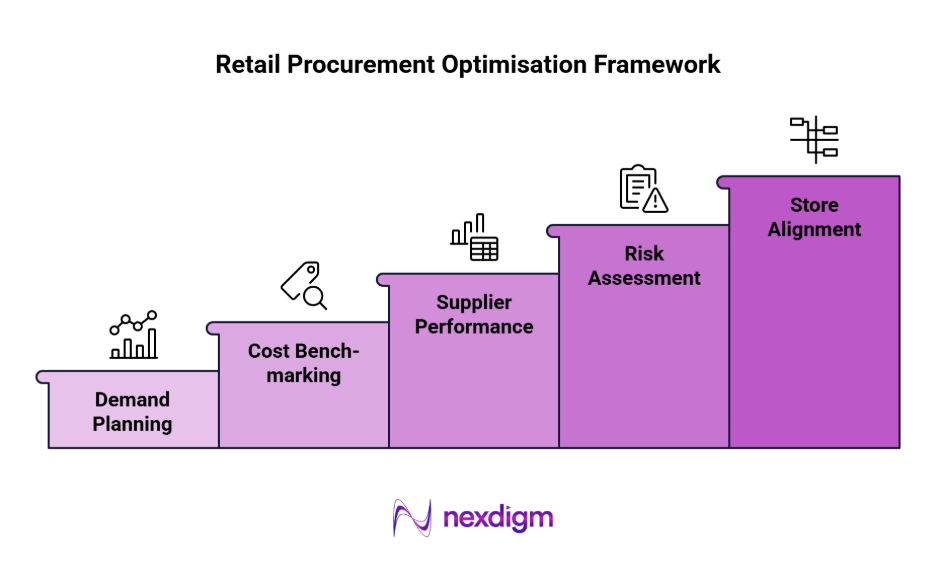
- Demand Planning: Analyse sales history, seasonality, promotional activity, and store-level consumption to estimate order quantities and reduce unnecessary inventory.
- Cost Benchmarking: Compare quoted prices alongside freight, handling, payment terms, minimum order quantities, defects, and replenishment expenses to identify the most economical supply option.
- Supplier Performance: Track delivery-in-full, on-time delivery, order accuracy, quality issues, and response times using consistent measures across suppliers and product categories.
- Risk Assessment: Identify single-source dependencies, capacity constraints, geographic exposure, and products without viable substitutes, then prioritise categories requiring backup suppliers or additional inventory protection.
- Store Alignment: Translate store formats, shelf requirements, delivery windows, storage limits, and promotional plans into clear purchasing specifications and supplier service expectations.
Make Procurement Decisions That Support Store Performance
Retail procurement works best when purchasing, merchandising, inventory planning, and store operations share the same priorities. Cost reductions that increase stockouts or create additional handling requirements can undermine the original savings.
A structured process allows retailers to negotiate more effectively, allocate orders according to supplier capability, and address supply risks before they affect store availability.
Nexdigm’s Case Study
A multi-store retailer reviewed procurement across 120 outlets and identified recurring emergency orders in three high-volume categories. Analysis of order frequency, supplier lead times, and stockout records supported revised reorder levels and supplier allocation. A targeted pilot reduced emergency orders by 18% over three months, subject to validation against the retailer’s baseline records.
To take the next step, simply visit our Request a Consultation page and share your requirements with us.
Harsh Mittal
+91-8422857704