

Retail product pricing benchmarking consulting helps businesses compare prices, promotions, assortments, and value propositions across competing brands and categories. Combined with Pricing Analysis, competitor intelligence, price elasticity, customer segmentation, and market positioning, benchmarking reveals pricing gaps that may vary.
These insights help retailers identify underpriced products, correct uncompetitive offers, protect margins, and improve category performance. A structured approach also supports faster repricing, stronger promotional planning, clearer value communication, and better revenue decisions across stores, ecommerce platforms, marketplaces, regions, and diverse, rapidly changing global retail environments.
Studies have found that 69% of consumers say price comparison significantly influences brand engagement. This behavior shows how product benchmarking and Pricing Analysis can reveal competitive gaps, improve price confidence, and support profitable growth across retail categories worldwide.
Pricing Analysis Strategy Strengthening Product Price Positioning
Pricing Analysis Strategy Strengthening Price Positioning helps retailers align product prices with market demand, competitor benchmarks, customer expectations, and profitability to improve competitiveness, margins, and sustainable category performance. Its major strategies are:
- Assortment Price Mapping: Retailers map prices across product families, pack sizes, and feature levels to identify gaps, overlaps, and inconsistent relationships within the broader product assortment.
- Competitive Cluster Analysis: Comparable products are grouped by brand strength, quality, features, and price to determine where each item should compete within the target retail market.
- Pack and Feature Alignment: Prices are adjusted according to pack size, functionality, quality, and service benefits to create clearer value differences and stronger product positioning for customers.
- Ongoing Repositioning: Retailers use updated sales, customer, competitor, and margin data to reposition products when market conditions, demand patterns, or category dynamics change significantly.
Nexdigm’s Pricing Analysis Support for Better Product Positioning
Nexdigm’s Pricing Analysis Support for Product Positioning helps retailers strengthen competitive advantage through advanced Pricing Analysis Services, retail product pricing benchmarking consulting, competitor price analysis, customer value assessment, price elasticity analysis, and market positioning. By leveraging data-driven pricing strategies, category benchmarking, demand forecasting, and pricing optimization, Nexdigm enables improved product differentiation, stronger price competitiveness, higher margins, enhanced customer value, and sustainable retail growth.
Nexdigm’s Roadmap for Competitive Product Price Optimization
Nexdigm’s Roadmap for Price Optimization combines market benchmarking, customer value insights, product economics, and performance tracking to strengthen price positioning, margins, competitiveness, and sustainable retail category growth. Its key elements focus on:
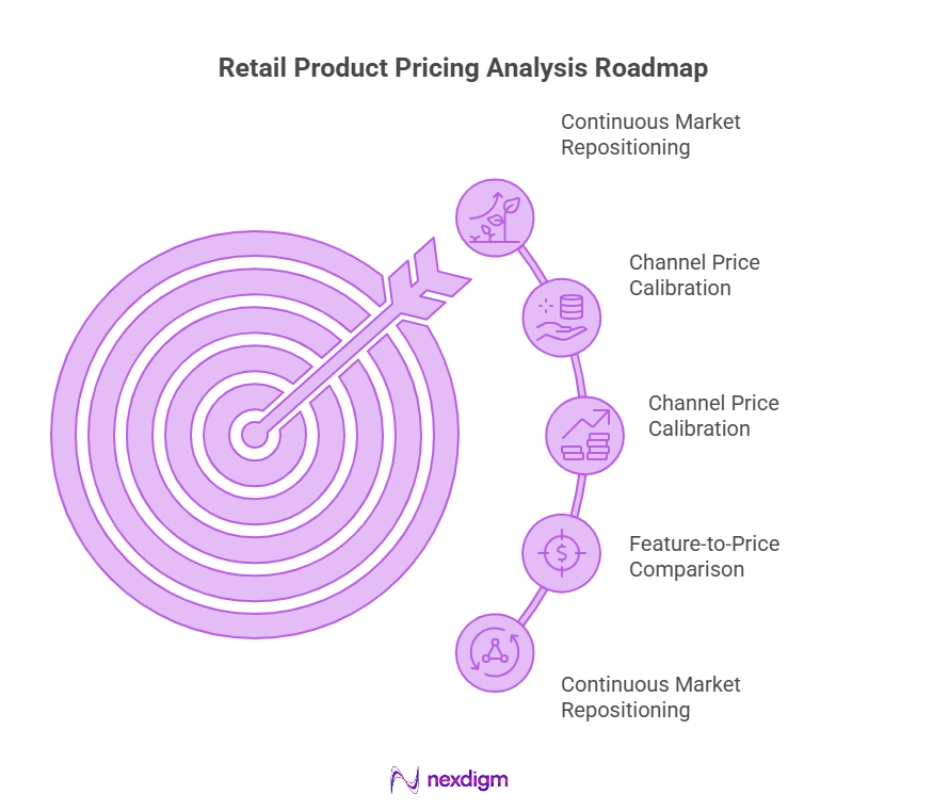
- Category Role Mapping: Products are classified as traffic builders, profit generators, premium choices, or convenience items, helping retailers apply different pricing objectives across the portfolio.
- Affordability Band Analysis: Customer budgets, spending patterns, and acceptable price ranges are reviewed to ensure products remain accessible while supporting margin and positioning objectives across segments.
- Feature-to-Price Comparison: Product features, pack sizes, service levels, and quality are compared with prices to identify inconsistencies and strengthen perceived value against competing offers.
- Channel Price Calibration: Prices are reviewed across stores, ecommerce platforms, and marketplaces to maintain consistency while accounting for channel costs, demand, and competitive conditions.
- Continuous Market Repositioning: Pricing is updated using new competitor activity, customer response, cost changes, and category trends to maintain relevance as retail market conditions evolve.
Nexdigm’s Case
Nexdigm supported a retail organization with product pricing benchmarking and competitive pricing analysis. The engagement improved category sales by 11%, increased price realization by 13%, reduced benchmark pricing gaps, and enhanced gross margin performance across key product lines.
To take the next step, simply visit our Request a Consultation page and share your requirements with us.
Harsh Mittal
+91-8422857704