

Choosing a new retail location involves more than finding a busy street or an affordable lease. A site can attract substantial foot traffic without reaching the right customers, while a less prominent location may serve a concentrated catchment with stronger spending potential and fewer direct competitors. The decision depends on how customer access, local demand, competition and operating costs interact.
Map The Real Catchment
A store’s catchment is the area from which it can realistically attract customers. Straight-line distance offers only a rough estimate. Road connectivity, public transport, pedestrian access, parking, barriers and travel time all affect whether people will visit.
Retailers should map potential customers by realistic travel time, then compare the catchment with the store’s intended audience. A convenience store may depend on nearby residents and daily movement, while a destination furniture store may draw from a much wider area.
Useful inputs include:
- Population and household composition.
- Household income and spending patterns.
- Employment centres, schools and transport hubs.
- Road access, public transport and pedestrian flows.
- Existing stores and complementary retail destinations.
Demographic data estimates who lives or works nearby. Footfall and mobility data help establish who passes through the area. Neither alone proves that people will enter and purchase.
Measure Competition and Spending Potential
The next step is to assess how much relevant demand the proposed store could capture. A catchment with high household spending may already be served by several established competitors. A lower-income area may still be attractive for a retailer with suitable price points, strong product availability and convenient access.
The US Bureau of Labor Statistics reported average annual household expenditure of US$78,535 in 2024, with spending patterns differing substantially by category. Such national benchmarks provide context, but local spending estimates are more useful for comparing individual store locations.
Competition mapping should include direct rivals, substitute formats and online alternatives. Record their distance, assortment, price positioning, opening hours and visible customer activity. Also identify complementary destinations that may generate shared visits, such as supermarkets near pharmacies or apparel stores near transit hubs.
Turn Location Data into A Store Decision
Effective retail store location intelligence combines catchment demographics, travel-time accessibility, competitor coverage, observed footfall and category-level spending into a comparable view of each candidate site.
A useful assessment separates three questions:
- Is there enough relevant demand within a realistic travel area?
- Can the store reach that demand more effectively than existing alternatives?
- Can expected sales support rent, staffing, inventory and operating costs?
Sales forecasts should account for cannibalisation.
A new branch may shift existing customers from a nearby store rather than generate new demand for the business.
Test scenarios using conservative conversion rates and realistic opening-period sales, not just the most optimistic catchment estimate.
Nexdigm’s Store Location Strategy Framework
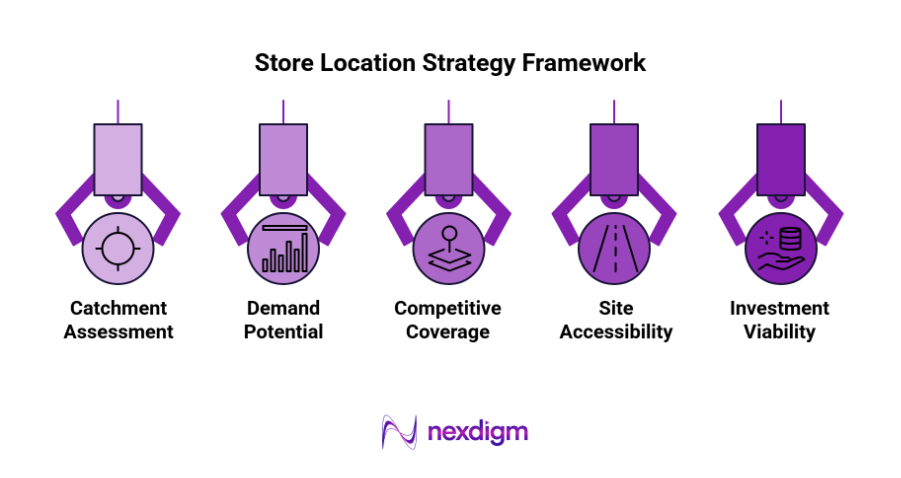
- Catchment Assessment: Define realistic travel zones and the customer base within reach.
- Demand Potential: Evaluate local demographics, spending patterns and category demand.
- Competitive Coverage: Assess rival locations, market saturation and underserved areas.
- Site Accessibility: Compare footfall, transport links, visibility and convenience.
- Investment Viability: Test sales potential against rent, operating costs and cannibalisation.
Nexdigm’s Case Study: Comparing Three Retail Sites
A specialty retailer compared three proposed locations using 15-minute travel zones, pedestrian counts, competitor mapping and estimated household spending. One high-footfall site was rejected because of rent and direct competition. The retailer prioritised a smaller catchment with better category fit and lower fixed costs.
To take the next step, simply visit our Request a Consultation page and share your requirements with us.
Harsh Mittal
+91-8422857704