

In the omnichannel retail environment, companies must manage inventory and fulfilment across physical stores, e-commerce platforms, and third-party channels efficiently. Optimizing product availability, delivery speed, and cost-effectiveness is critical to maintaining customer satisfaction and profitability.
Leveraging retail supply chain benchmarking provides essential competitive intelligence, enabling businesses to compare operational performance, monitor rivals’ inventory strategies, and identify best practices. By analyzing demand forecasting, replenishment cycles, and fulfilment efficiency, organizations can make data-driven decisions to enhance supply chain resilience, reduce costs, and gain a competitive edge in dynamic retail markets.
The global retail logistics market was estimated at over USD 285 billion, with projections to exceed USD 850 billion by 2033 at a 12.9 % CAGR as omnichannel retailing and e‑commerce expand. About 80% of retailers prioritise integrated logistics solutions to achieve higher inventory visibility and reduce fulfilment times. Internal logistics inefficiencies in India alone cost organised retailers over ₹2,000 crore annually.
Leveraging Competitive Intelligence in Retail Inventory Management
Leveraging Competitive Intelligence in Retail Inventory Management involves analyzing competitors’ inventory strategies, benchmarking stock levels, and monitoring replenishment practices to optimize multi-channel fulfilment, reduce stockouts, and improve overall supply chain efficiency:
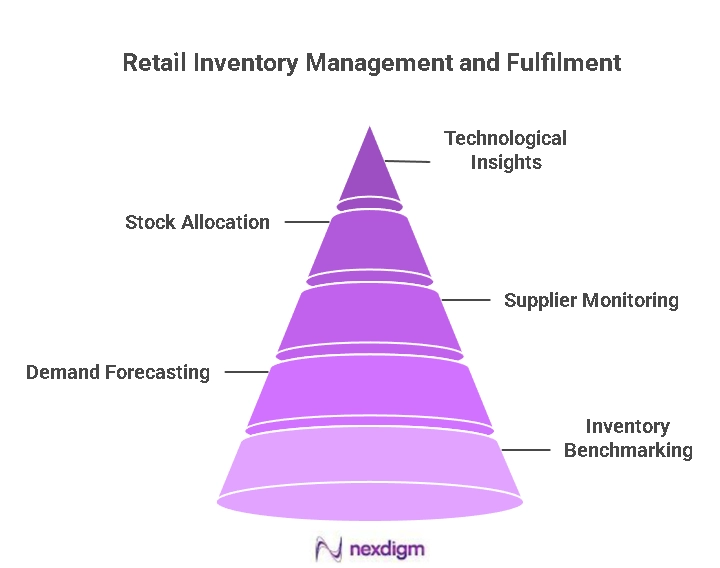
- Inventory Level Benchmarking – Compare stock quantities, safety stock, and reorder points against competitors to maintain optimal inventory and reduce carrying costs.
- Demand Forecasting Analysis – Analyze competitor sales trends, seasonality, and promotions to improve forecasting accuracy and prevent stockouts or overstocking.
- Supplier Performance Monitoring – Evaluate vendor reliability, lead times, and fulfillment rates relative to peers to optimize supply chain efficiency.
- Multi-Channel Stock Allocation – Assess how competitors distribute inventory across stores, e-commerce, and third-party channels for strategic allocation improvements.
- Technology and Automation Insights – Benchmark adoption of warehouse management systems, AI forecasting, and automated replenishment tools for operational advantage.
Nexdigm Multi-Channel Fulfilment Network Design Services
Nexdigm Multi-Channel Fulfilment Network Design Services helps retailers optimize inventory and delivery across physical stores, e-commerce platforms, and third-party channels. By analyzing demand patterns, warehouse locations, and transport routes, Nexdigm designs scalable, efficient networks that reduce fulfilment times, minimize stockouts, and lower operational costs. These services enhance service reliability, support omnichannel strategies, and provide data-driven insights for continuous supply chain improvement.
Nexdigm’s KPI Tracking and Benchmarking Solutions to Optimize Retail Supply Chains
Nexdigm KPI Tracking and Benchmarking Solutions enable retailers to monitor inventory, fulfilment, and operational metrics, benchmark performance against industry standards, identify gaps, and implement data-driven improvements for efficient multi-channel supply chains.
- Performance Metric Definition – Identify critical KPIs such as inventory turnover, order accuracy, and fulfilment lead times for multi-channel retail benchmarking.
- Data Collection and Integration – Aggregate operational data from stores, warehouses, e-commerce platforms, and logistics partners to ensure comprehensive performance tracking.
- Benchmarking Against Industry Standards – Compare performance metrics with competitors and best practices to highlight gaps and improvement opportunities.
- Real-Time Monitoring Dashboards – Implement dashboards for instant visibility into stock levels, delivery efficiency, and operational bottlenecks across channels.
- Predictive Analytics for Supply Chain Optimization – Use historical data and AI to forecast demand, prevent stockouts, and optimize inventory allocation.
Nexdigm’s case:
Nexdigm helped a large Indian apparel retailer struggling with stock imbalances and slow fulfilment across online and offline channels. Through retail supply chain benchmarking and KPI tracking, Nexdigm redesigned inventory allocation and fulfilment processes. The project helped the client cut excess inventory by 18 %, improve order fulfilment speed by 22 %, and reduce stockouts by 15 %, resulting in higher customer satisfaction and better competitive positioning.
To take the next step, simply visit our Request a Consultation page and share your requirements with us.
Harsh Mittal
+91-8422857704