

Retail supply chains are becoming more complex as businesses source products across countries, manage multiple suppliers, and serve customers through stores, marketplaces, and direct channels. The global logistics market continues to expand alongside this complexity.
In 2025, global container shipping volumes reached approximately 1.2 billion TEUs, while disruptions across major maritime routes continued to affect transit times and costs. At the retail level, inventory distortion remains significant, with IHL estimating approximately US$1.7 trillion in annual global impact from overstocks and stockouts.
These conditions make visibility across procurement, sourcing, logistics, inventory, and distribution increasingly important. Retailers need to understand not only where products originate, but how supply moves through the network and where disruptions can affect availability, cost, and customer service.
Supply Chain Visibility Extends Beyond Suppliers
Knowing who supplies a product is only one part of supply-chain visibility. Retailers also need to understand supplier concentration, sourcing origins, manufacturing locations, shipment patterns, lead times, logistics routes, inventory positions, and downstream distribution. Visibility across these interconnected stages can help businesses identify dependencies and determine where supply may be vulnerable to disruption.
From Supply Movement to Shelf Availability
Products can face delays or cost pressures at several points between production and the final customer. External supply signals can therefore provide useful context for procurement and inventory planning.
- Upstream Visibility: Mapping suppliers, origins, production, shipments, and sourcing concentration helps identify dependencies before they affect replenishment.
- Downstream Visibility: Tracking distribution, inventory, channels, and product availability helps connect supply movements with potential customer-facing impacts.
Nexdigm’s Role in Assessing Supply Chain Movements
Nexdigm combines retail-sector expertise with supply-chain intelligence, trade analysis, market research, competitive intelligence, pricing assessment, and supplier research to provide a broader view of retail supply networks.
Our retail supply chain intelligence approach can connect information across the journey from supplier and origin to shipment, distribution, inventory, channel, and shelf availability. This enables businesses to understand:
- Where Supply Is Concentrated: Identify key suppliers, sourcing origins, manufacturing clusters, and trade routes that may create dependency or disruption exposure.
- How Supply Patterns Are Changing: Track shipment activity, supplier participation, trade flows, pricing, and sourcing shifts to identify emerging supply or cost pressures.
- Where Alternatives Exist: Identify potential suppliers, sourcing origins, routes, and procurement options that can strengthen supply continuity and reduce concentration.
Together, these insights provide the foundation for a structured retail supply chain intelligence assessment, helping businesses move from visibility into supply movements toward identifying risks, alternatives, and actionable supply-chain priorities.
Nexdigm’s Retail Supply Chain Intelligence Assessment
Nexdigm’s assessment examines the supply chain as an interconnected system rather than a collection of individual suppliers or logistics activities. The objective is to identify dependencies, bottlenecks, cost pressures, supply alternatives, and areas where external changes could affect retail operations through:
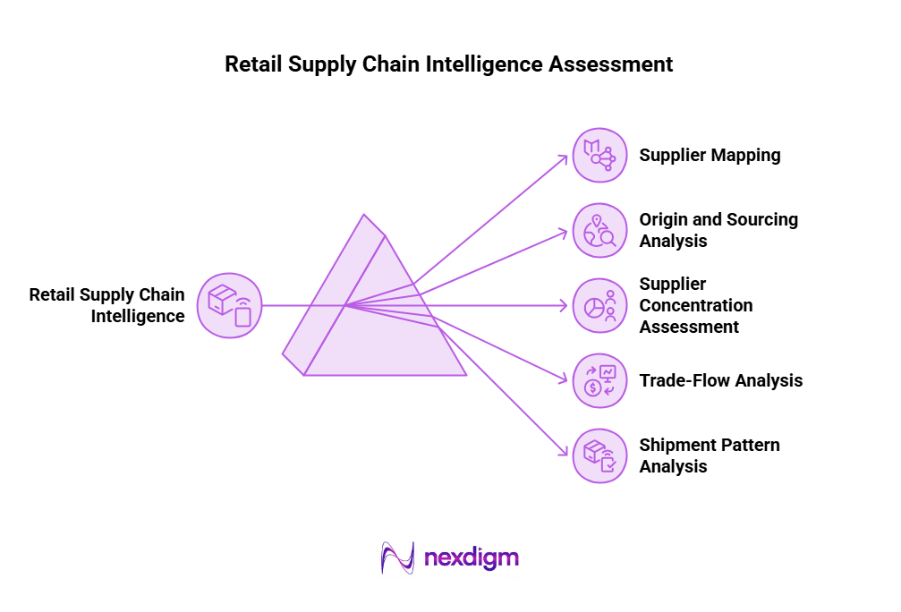
- Supplier Mapping: Nexdigm identifies manufacturers, suppliers, exporters, distributors, and other participants across relevant product categories and sourcing markets.
- Origin and Sourcing Analysis: The assessment evaluates where products originate and how sourcing is distributed across countries, regions, and supplier groups.
- Supplier Concentration: Nexdigm assesses dependency on individual suppliers, countries, manufacturing clusters, or geographic regions to identify concentration risks.
- Trade-Flow Analysis: Import and export data can be examined by product, origin, destination, supplier, buyer, shipment, value, and volume to understand movements across the supply network.
- Shipment Pattern Analysis: Nexdigm evaluates shipment frequency and changes in trade activity to identify potential shifts in supply availability or sourcing behaviour.
Applications of Nexdigm’s Retail Supply Chain Intelligence
Retail supply-chain intelligence can support decisions across procurement, sourcing, inventory, logistics, and network resilience. By connecting supplier activity with trade flows, pricing, shipment patterns, and market developments, businesses get assistance in:
- Supplier Diversification: Businesses can identify alternative suppliers and sourcing origins when procurement is concentrated among a limited number of suppliers, countries, or manufacturing locations. This can reduce dependency and create greater flexibility when existing sources face capacity, cost, or disruption challenges.
- Supply-Risk Monitoring: Monitoring supplier activity, shipment frequency, trade routes, country exposure, and sourcing changes can help businesses identify emerging risks. Changes in these indicators may signal potential constraints before they translate into significant inventory or availability issues.
Nexdigm’s Case
Nexdigm supported a retail client evaluating supplier and procurement exposure across multiple product categories. By combining trade-flow analysis, supplier mapping, pricing benchmarks, and sourcing concentration, the assessment identified alternative supply markets and highlighted 8–12% pricing gaps across comparable sourcing options. The findings supported supplier diversification and procurement discussions, helping strengthen the client’s approach to cost management and supply continuity.
To take the next step, simply visit our Request a Consultation page and share your requirements with us.
Harsh Mittal
+91-8422857704