

Retail expansion increasingly depends on understanding where customers live, work, shop, and how far they are willing to travel for different products and experiences. The U.S. National Retail Federation forecasts 2026 retail sales at US$5.6 trillion, representing 4.4% growth over 2025. Its September 2026 Retail Monitor recorded US$453.1 billion in core retail sales, up 3.73% year-on-year. At the same time, consumers increasingly move between physical and digital channels rather than following a single shopping journey.
For retailers, this makes physical location decisions more nuanced. A store may attract customers from a wider area if it offers differentiated products, strong value, convenience, or a compelling experience. Conversely, everyday categories may depend heavily on nearby customers. Retail trade area analysis helps businesses understand these differences by examining customer distribution, accessibility, competition, mobility, spending potential, and existing store performance.
Customer Travel Varies by Retail Mission
The distance customers are willing to travel depends heavily on what they are buying. Routine purchases tend to favour convenience and proximity, while specialty, premium, entertainment, and high-consideration purchases can draw customers from much wider areas. Understanding these differences helps retailers define realistic catchments and avoid applying the same trade-area assumptions to every store format or category.
Catchments Change as Markets Evolve
A store’s trade area can expand or contract as new competitors open, transport links improve, residential communities develop, or consumer preferences change. Existing customer patterns therefore provide useful evidence, but they should be combined with current market conditions and future development indicators when evaluating whether a location can continue attracting sufficient demand.
How Nexdigm’s Expertise Helps Retail Trading Industries
Nexdigm brings together retail expertise, location intelligence, market research, consumer insights, and competitive analysis to evaluate the factors that influence retail performance. This broader perspective helps businesses understand how customer demand, accessibility, competition, and local market characteristics interact when assessing existing or potential store locations.
Nexdigm’s Retail Trade Area Intelligence Approach
Nexdigm brings together retail expertise, location intelligence, consumer research, demographic analysis, competitive intelligence, and mobility assessment to:
- Understand Customer Reach: Nexdigm analyses customer profiles, geographic distribution, travel patterns, accessibility, and spending potential to estimate realistic store catchments.
- Evaluate Local Competition: Competitor locations, formats, positioning, and overlapping catchments are assessed to understand how much demand a proposed or existing store can realistically capture.
- Identify Location Potential: Demand, accessibility, competition, market development, and existing store performance are combined to identify attractive expansion areas and potential network gaps.
This approach allows businesses to look beyond simple distance-based catchments and understand which customers a location can reach, how effectively it can serve them, and where expansion opportunities exist.
Nexdigm’s Retail Trade Area Analysis Framework
Experts at Nexdigm structure retail trade area analysis through four connected stages to understand the market around a location and determine its commercial potential. This involves the following steps:
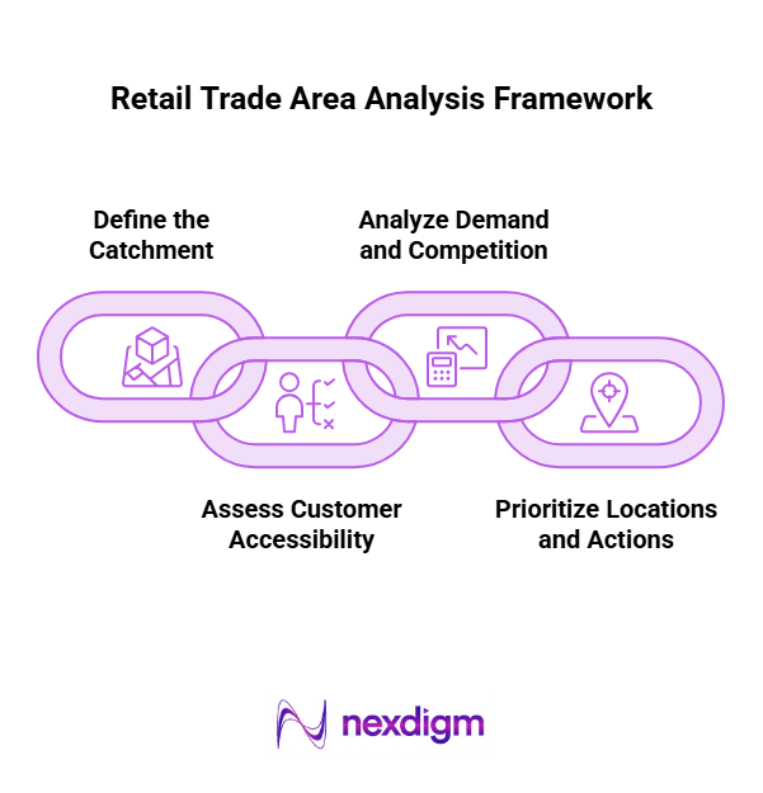
- Define the Catchment: Identify the relevant geographic area and customer groups using population, household characteristics, income, spending potential, and retail behaviour. This establishes the potential customer base around an existing or proposed location.
- Assess Customer Accessibility: Evaluate travel times, road connectivity, public transport, traffic, parking, and mobility patterns to understand how easily customers can reach the location and how far they are realistically likely to travel.
- Analyze Demand and Competition: Assess local demand alongside competitor locations, store formats, market positioning, existing store performance, and catchment overlap. This helps determine how much potential demand a location can capture.
- Prioritize Locations and Actions: Combine customer reach, demand, accessibility, competition, and market development indicators to rank locations and identify the most appropriate actions for expansion, network optimization, or local market development.
Through Nexdigm’s structured evaluation process of catchments and market potential, organizations can prioritize high-opportunity locations, optimize retail networks, and develop targeted growth strategies that improve commercial performance and long-term market presence.
How the Nexdigm’s Retail Trade Analysis Insights Help Businesses
Nexdigm’s Retail Trade Analysis combines customer, market, and location intelligence to help retailers evaluate opportunities, optimize networks, and make data-driven expansion decisions in the following ways:
- Improve Site Selection: Compare potential locations using consistent customer, market, accessibility, and competitive criteria.
- Identify Untapped Markets: Find areas with attractive customer demand but limited retail coverage.
- Optimize Store Networks: Identify overlapping catchments, coverage gaps, and potential cannibalization.
- Understand Customer Reach: Determine which customer groups a location can realistically attract.
- Strengthen Local Marketing: Identify priority customer clusters and geographic areas for targeted campaigns.
By translating location and customer insights into actionable strategies, Nexdigm helps businesses improve retail performance, enhance coverage, and unlock sustainable growth opportunities.
Nexdigm’s Case
Nexdigm evaluated the Indian furniture market across four cities, conducting 70+ stakeholder interviews and profiling 15 key players. The assessment compared customer preferences, price sensitivity, market access, competition, and supply chains. The analysis identified Tier 1 cities as viable entry markets, supporting a focused market-entry and location strategy.
To take the next step, simply visit our Request a Consultation page and share your requirements with us.
Harsh Mittal
+91-8422857704