

Retail procurement spans several supplier markets, from merchandise manufacturers and packaging converters to POS providers, logistics partners, maintenance contractors, and store fixture specialists. These vendors differ in how they price services, manage capacity, demonstrate quality, and support retail operations.
A single sourcing approach rarely works across all categories. Retailers need a structured way to identify relevant suppliers, understand market alternatives, and shortlist vendors against the commercial and operational requirements of each purchase.
Map the Supplier Market
Supplier identification should begin with the category and its supply structure. A retailer sourcing private-label products needs to distinguish manufacturers from trading companies and distributors. A technology procurement exercise must assess software providers, implementation partners, and hardware vendors. Facilities sourcing requires attention to local service coverage and workforce availability.
Market mapping should establish where suppliers operate, which products or services they offer, their production or delivery capabilities, and whether they serve comparable retail businesses. Trade directories, industry exhibitions, company disclosures, product catalogues, tender records, and relevant trade data can help build the initial longlist.
Verify Commercial and Operational Fit
A supplier’s stated capabilities need to be tested against actual requirements. Relevant evidence may include manufacturing capacity, product specifications, customer references, delivery records, service coverage, certifications, and support arrangements.
For retail vendor identification, the key is to separate a broad market longlist from a qualified shortlist. A vendor may offer attractive pricing but fail to meet minimum order requirements, regional delivery needs, technical compatibility, or required service levels. These mismatches should be identified before detailed commercial negotiations.
Understand Market and Supply Risks
Supplier availability does not guarantee supply resilience. Several vendors may depend on the same manufacturer, logistics route, technology platform, or raw material source. Apparent diversification can therefore conceal a shared point of failure.
Retailers should assess concentration, replacement lead times, geographical exposure, capacity constraints, and the difficulty of qualifying alternatives. For technology vendors, interoperability and data portability may be important; for products, quality consistency and manufacturing capacity may be decisive.
Retail Vendor Identification Framework
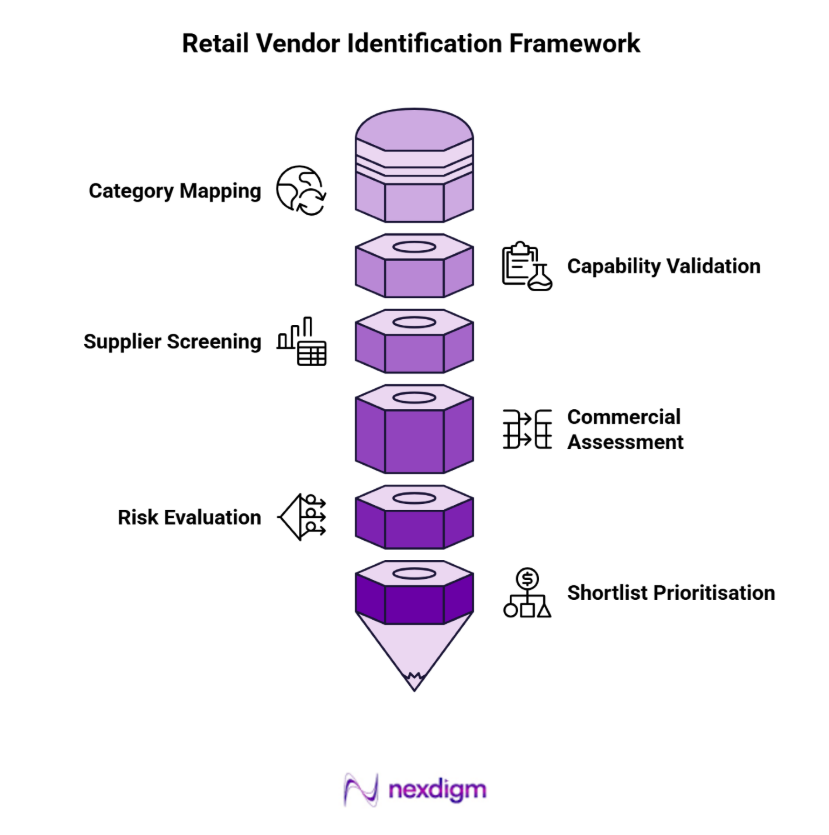
- Category Mapping: Define the required product or service, identify relevant supplier types, and map manufacturers, distributors, specialists, and integrated providers across target markets.
- Supplier Screening: Verify supplier identity, product range, location, operating capabilities, customer segments, and relevant credentials using consistent evidence-based criteria.
- Capability Validation: Assess capacity, quality controls, delivery coverage, technical compatibility, service support, and the supplier’s ability to meet the retailer’s operating requirements.
- Commercial Assessment: Compare quotations, minimum order quantities, payment terms, lead times, total delivered costs, contract conditions, and the flexibility to respond to demand changes.
- Risk Evaluation: Identify supplier concentration, shared dependencies, regulatory exposure, replacement difficulty, and backup options before making a sourcing recommendation.
- Shortlist Prioritisation: Rank qualified suppliers by category-specific fit, commercial value, performance evidence, risk, and implementation effort, then validate finalists through samples, demonstrations, or pilots.
Turn Research Into a Sourcing Decision
The output should be more than a list of potential vendors. A useful supplier assessment records why each candidate qualifies, where it is commercially competitive, what risks remain, and what evidence is still required.
This approach helps retailers direct negotiations toward the strongest candidates, avoid unsuitable suppliers early, and build a sourcing portfolio that reflects both cost objectives and operational priorities.
Nexdigm’s Case Study
A multi-format retailer assessed 60 potential suppliers across merchandise, technology, and store services. Screening against capability, coverage, commercial terms, and risk reduced the pool to 14 qualified candidates. The structured shortlist helped focus due diligence and supplier discussions on options aligned with the retailer’s operating requirements.
To take the next step, simply visit our Request a Consultation page and share your requirements with us.
Harsh Mittal
+91-8422857704