

Rice sourcing decisions are shaped by production trends, export availability, price movements, and differences in supplier capabilities. The FAO’s November 2026 outlook forecasts global rice production at 552 million tonnes, a 2.5% decline from the previous season, while global rice trade is projected to recover by 2.9% to 61.6 million tonnes in 2027.
In India, the Reserve Bank of India reported rice export earnings of ₹1,02,031 crore in 2025–26. These developments underline the scale and changing dynamics of the rice trade. Rice supplier benchmarking helps buyers compare suppliers beyond quoted prices and identify businesses capable of meeting their quality, volume, and delivery requirements.
Understanding the Differences Between Rice Supply Markets
Rice suppliers operate across markets with different crop profiles, processing capabilities, and export specializations. India, Thailand, Vietnam, and Pakistan serve varied demand segments, from aromatic and premium varieties to bulk non-basmati rice. Buyers need to understand these distinctions alongside production conditions, export policies, and regional price movements. This market context helps establish relevant sourcing origins before individual suppliers are evaluated.
Turning Rice Quality Requirements into Measurable Criteria
Rice quality is determined by several product characteristics that influence suitability for retail, food processing, and institutional procurement. Buyers commonly examine:
- Variety and Grain Characteristics: Assess basmati, non-basmati, parboiled, and other varieties by grain length, aroma, texture, shape, and cooking performance.
- Physical Quality and Consistency: Compare broken grain percentage, moisture levels, foreign matter, damaged grains, and batch-to-batch uniformity.
- Milling and Processing Requirements: Review polishing, grading, sorting, packaging, inspection procedures, and compliance with relevant buyer specifications.
Establishing these parameters makes supplier comparisons more objective and reduces the risk of evaluating products against inconsistent standards.
Why Supplier Selection Extends Beyond Product Quality
A supplier may offer the required rice variety but lack the capacity, processing flexibility, or export infrastructure to fulfil an order consistently. Buyers must therefore consider production volumes, procurement networks, quality-control systems, delivery performance, and commercial terms alongside grain specifications. Experts of Nexdigm conduct a broader evaluation that helps distinguish suppliers that can meet immediate requirements from those that may support sustained procurement.
Nexdigm’s Supplier Intelligence: Identifying the Right Participants in the Rice Market
Our experts help organizations understand the supplier ecosystem across selected rice-producing and exporting markets. Our rice supplier benchmarking identifies relevant rice millers, processors, merchant exporters, integrated producers, and bulk suppliers. Rather than limiting the exercise to a list of company names, we develop supplier profiles that capture their operating locations, product focus, market presence, business activities, and visible supply capabilities. This benchmarking gives procurement teams an organized view of the market and helps identify suppliers that warrant closer assessment based on their sourcing needs.
Nexdigm’s Expertise in Assessing Supplier Operational Capabilities
Supplier capabilities are often shaped by the infrastructure and processes behind the finished product. Our benchmarking services can examine the operational factors that influence a supplier’s ability to deliver consistent rice quality and required volumes. These factors are:
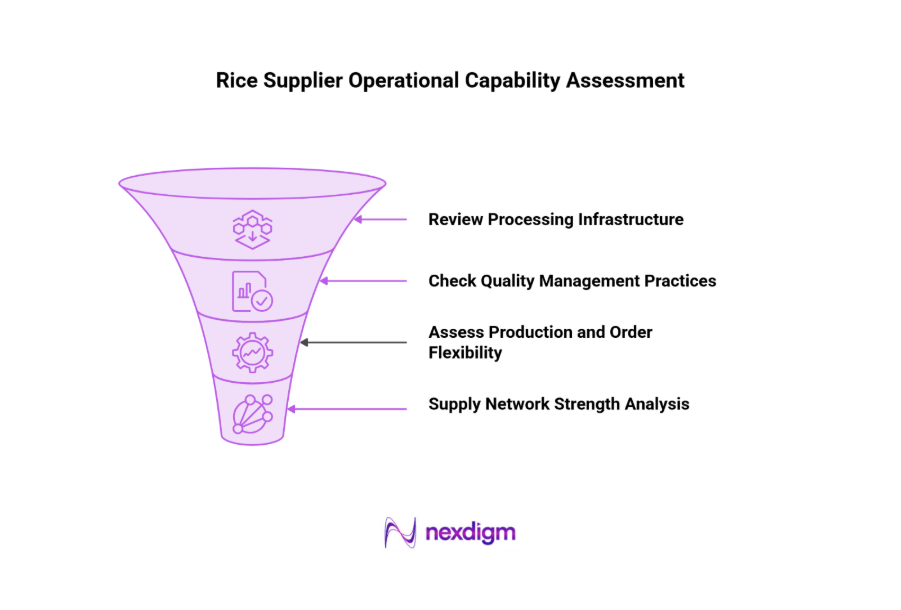
- Processing Infrastructure: Review milling facilities, installed capacity, grading and sorting equipment, polishing systems, and packaging capabilities.
- Quality Management Practices: Examine available quality certifications, testing procedures, inspection arrangements, and documentation practices.
- Production and Order Flexibility: Assess the supplier’s ability to handle different varieties, grades, order sizes, and customized specifications.
- Supply Network Strength: Understand procurement arrangements, sourcing locations, storage infrastructure, and access to raw paddy supplies.
This operational view helps buyers identify capability differences that may not be apparent from product catalogues or initial quotations.
How Nexdigm Compares and Shortlist Potential Rice Suppliers
Price comparisons can be misleading when suppliers quote for different rice varieties, grades, broken percentages, processing levels, or delivery terms. Our experts help businesses establish a more consistent basis for commercial evaluation by examining quoted prices alongside product specifications and order conditions. This can help compare minimum order quantities, packaging formats, payment terms, delivery arrangements, and relevant cost components. It enables procurement teams to distinguish competitive quotations from offers that may involve additional costs or limitations.
Nexdigm’s Case
A rice importer needed suppliers capable of meeting separate requirements for premium long-grain basmati and bulk parboiled rice. Nexdigm evaluated 29 suppliers across variety specialization, milling standards, processing flexibility, and export capacity. The assessment identified that 31% lacked the required variety range, while 24% had limited capacity for customized milling specifications. The importer developed separate supplier shortlists for each product category.
To take the next step, simply visit our Request a Consultation page and share your requirements with us.
Harsh Mittal
+91-8422857704