

Ride-sharing platforms are expanding rapidly across urban markets as cities face rising mobility demand, congestion, and changing consumer travel preferences. This growth reflects how digital transport services are reshaping the automotive ecosystem by offering flexible, app-based alternatives to traditional vehicle ownership. For companies entering new cities, a strong market entry strategy is essential to address local regulations, pricing expectations, driver availability, and customer adoption.
A successful ride sharing platform automotive entry strategy must combine technology, partnerships, competitive positioning, and operational scalability. As urban populations grow, ride-sharing firms can capture demand by aligning convenience, affordability, and sustainable mobility solutions.
The ride-sharing sector shows strong growth potential, with one estimate valuing the global ride sharing market at USD 42.9 billion in 2024 and projecting it to reach USD 96.9 billion by 2030 at a 13.7% CAGR. Another forecast expects the ride hailing market to rise from USD 163.55 billion in 2025 to USD 252.14 billion by 2030. These figures highlight rising urban mobility demand and support the need for a data-driven market entry strategy.
Developing a Market Entry Strategy for Ride-Sharing Platforms in High-Demand Urban Mobility Markets
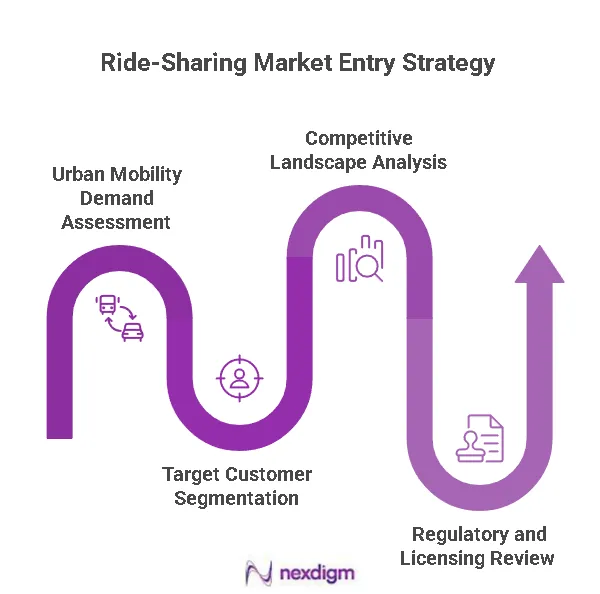
This heading focuses on how ride-sharing companies can enter fast-growing urban markets by assessing demand, competition, regulations, customer needs, pricing, and partnerships to build a scalable market entry strategy:
-
Urban Mobility Demand Assessment
Analyze traffic congestion, commuter behavior, public transport gaps, and population density to identify cities with strong ride-sharing adoption potential.
-
Target Customer Segmentation
Define key users such as daily commuters, students, office workers, tourists, and occasional riders based on travel patterns and affordability.
-
Competitive Landscape Analysis
Study existing ride-sharing platforms, taxi operators, pricing models, service quality, and market gaps to create differentiated positioning.
-
Regulatory and Licensing Review
Examine local transport laws, permits, driver requirements, insurance rules, and compliance risks before launching operations in new cities.
Nexdigm’s Urban Mobility Market Assessment to Identify Demand Potential, Growth and Expansion Opportunities
Nexdigm’s Urban Mobility Market Assessment to Identify Demand Potential, Growth Pockets, and Expansion Opportunities focuses on analyzing city-level mobility trends, commuter behavior, traffic congestion, public transport gaps, and ride-sharing adoption potential. It helps ride-sharing platforms evaluate attractive urban markets, prioritize expansion locations, understand customer needs, and identify growth pockets where demand, infrastructure, and market readiness support successful entry.
How Nexdigm Identifies High-Potential Markets for Ride-Sharing Platform Entry?
Nexdigm identifies high-potential markets by analyzing urban mobility demand, commuter behavior, competition, regulatory readiness, pricing trends, and infrastructure gaps to help ride-sharing platforms choose cities with strong entry potential.
-
Infrastructure and Connectivity Evaluation
Nexdigm assesses road networks, public transport gaps, digital payment adoption, and smartphone penetration to measure operational feasibility.
-
Pricing and Revenue Potential
Nexdigm benchmarks fare levels, customer willingness to pay, driver earnings, and incentive requirements to estimate commercial viability.
-
Driver and Fleet Availability
Nexdigm examines driver supply, fleet operator presence, vehicle availability, and automotive partnerships needed for scalable ride-sharing operations.
-
City Prioritization Framework
Nexdigm ranks target cities using demand, competition, regulation, infrastructure, and profitability indicators to support informed expansion decisions.
Nexdigm’s case:
Nexdigm helped a ride-sharing platform identify high-potential urban markets for entry by analyzing commuter density, public transport gaps, competitor presence, pricing levels, and driver availability across 10 cities. The assessment found that 3 cities offered the strongest entry potential, with daily commuter volumes above 1 million, ride-sharing demand expected to grow 12–15% annually, and public transport coverage gaps of nearly 30%. Based on Nexdigm’s recommendations, the company prioritized phased expansion, optimized launch pricing, and identified fleet partners to support faster market entry.
To take the next step, simply visit our Request a Consultation page and share your requirements with us.
Harsh Mittal
+91-8422857704