

In the competitive logistics industry, road freight competitor benchmarking has emerged as a critical tool for enhancing cost efficiency, especially in segments that handle inland cargo. By systematically comparing operational costs, fleet utilization, and service performance against industry peers, companies gain actionable insights that inform strategic decisions.
This approach, combined with competitive intelligence, enables logistics providers to identify inefficiencies, optimize routes, and negotiate better contracts, ultimately strengthening their market position while controlling expenses. Road freight competitor benchmarking thus serves as a data-driven mechanism to improve operational efficiency and maintain a competitive edge in the inland transport sector.
Road transport dominates inland freight movement, accounting for over 70% of total cargo in many regions, significantly surpassing rail and inland waterways combined. In several large markets, nearly 70–77% of all freight tonnage is moved by road, even though alternative modes may be more cost-efficient over long distances.
These figures highlight why road freight competitor benchmarking in this segment can yield substantial improvements in operational efficiency and cost management.
Applying Competitive Intelligence to Enhance Logistics Decision-Making
Applying competitive intelligence in logistics involves analyzing competitor strategies, costs, and performance data to make informed decisions, optimize operations, reduce costs, and improve service efficiency, ultimately strengthening market competitiveness.
- Competitor Cost Analysis – Examine competitor freight rates, operational costs, and pricing strategies to identify cost-saving opportunities and improve budgeting.
- Operational Performance Benchmarking – Compare delivery times, fleet utilization, and route efficiency against peers to highlight inefficiencies and best practices.
- Market Trend Monitoring – Track shifts in cargo demand, emerging routes, and competitor expansions to inform proactive logistics planning.
- Strategic Route Optimization – Use competitor data to identify underutilized routes, reduce empty runs, and enhance overall transport efficiency.
- Negotiation and Contract Insights – Leverage competitor pricing and service benchmarks to strengthen negotiations with carriers and suppliers.
Nexdigm Insights for Identifying Cost Drivers and Optimizing Margin in Road Freight Benchmarking
Nexdigm leverages detailed road freight benchmarking to identify key cost drivers, including fuel, labor, maintenance, and route inefficiencies. By analyzing competitor performance and industry standards, Nexdigm provides actionable insights to optimize margins, reduce unnecessary expenses, and enhance overall operational efficiency. This data-driven approach enables logistics providers to make informed decisions, improve profitability, and maintain a competitive edge in inland freight.
Applying Nexdigm Data Analytics to Make Informed Decisions in Road Freight Cost Management
Nexdigm leverages data analytics to analyze road freight costs, identify inefficiencies, and provide actionable insights, enabling informed decisions that optimize expenses, improve operational efficiency, and enhance overall cost management:
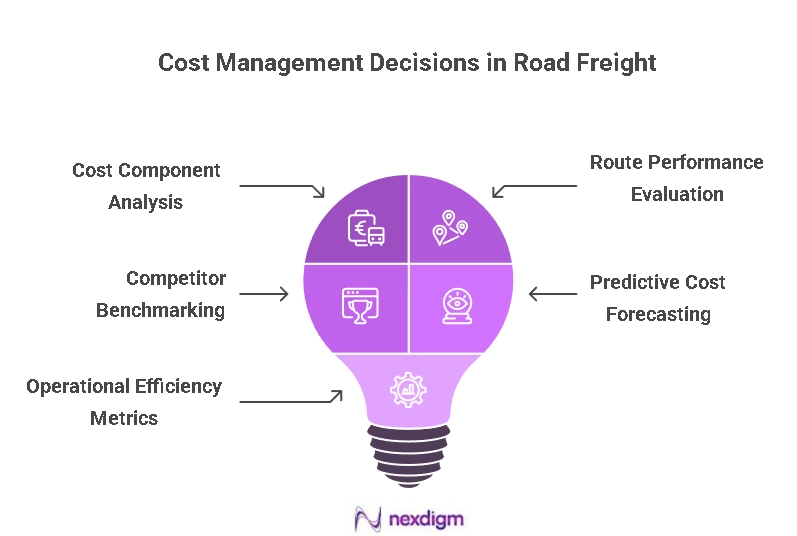
- Cost Component Analysis – Nexdigm examines fuel, labor, maintenance, and toll costs to pinpoint major expense areas for effective cost control.
- Route Performance Evaluation – Analyze delivery routes to identify inefficiencies, reduce empty runs, and improve fleet utilization using Nexdigm analytics.
- Competitor Benchmarking Insights – Compare costs and performance against peers to uncover best practices and maintain competitive advantage.
- Predictive Cost Forecasting – Nexdigm uses historical data to anticipate future expenses and guide proactive budgeting and resource allocation.
- Operational Efficiency Metrics – Track KPIs such as load factor, on-time deliveries, and turnaround time to optimize overall road freight operations.
Nexdigm’s case:
Nexdigm helped reduce logistics partner costs by over AUD 0.8 million annually and achieved a 33 % reduction in annual LSP costs, significantly improving cost efficiency and operational performance in inland freight operations. As well as Nexdigm conducted a detailed operational and cost review for a logistics client managing 100+ fleet vehicles and identified clear opportunities for optimization. By implementing data‑driven analysis and benchmarking.
To take the next step, simply visit our Request a Consultation page and share your requirements with us.
Harsh Mittal
+91-8422857704