
Road freight remains the backbone of India’s domestic goods movement. In 2025, road accounted for 66% of India’s freight transport demand, equivalent to around 3,095 billion tonne-kilometres. The road freight market was estimated at $153.9 billion in 2025 and is projected to reach $255.9 billion by 2031.
The opportunity, however, cannot be assessed through market size alone. Truck availability, utilisation, freight rates, backhaul potential, and corridor density determine whether additional capacity can generate attractive returns.
Truck Demand Is Growing, but Capacity Is Not Uniformly Available
India’s road freight demand is expected to keep expanding with manufacturing, consumption, infrastructure development, and e-commerce. NITI Aayog estimates that road freight demand could rise from around 2.2 trillion tonne-km today to 9.6 trillion tonne-km by 2050, requiring the number of trucks on Indian roads to increase from approximately 4 million in 2022 to 17 million.
Driver availability remains a constraint. Current industry estimates put India’s shortage of skilled truck drivers at approximately 2.2 million, with only around 55–60 drivers available for every 100 trucks. This can reduce fleet utilisation and create capacity volatility, particularly on long-haul routes.
For fleet operators, the opportunity therefore depends on whether demand growth can be converted into reliably operated vehicle capacity.
Utilisation Can Matter More Than Fleet Size
A truck generates revenue only when it is moving productive freight.
Low load factors, empty return journeys, waiting time, and poor scheduling can erode margins even when freight demand appears strong. Network density becomes particularly important here. A corridor with substantial outbound demand but weak backhaul opportunities can produce very different economics from a balanced two-way lane.
Consolidation can improve the equation. Full-truckload movements remain dominant, accounting for around 80% of India’s road freight transport market in 2025, while LTL is expected to grow faster as shipments become more fragmented across secondary cities.
The commercial question is therefore not simply how many trucks a market needs. It is how much of each truck’s available capacity can be monetised.
Freight Rates Reflect More Than Fuel Costs
Rates are influenced by diesel prices, vehicle availability, demand cycles, lane balance, tolls, seasonality, and competitive intensity.
Recent data illustrates how quickly rates can move. Average truck freight rates from Delhi to major Indian cities were 7% higher in May 2026 than in February 2026, following an increase in diesel prices of approximately 8.3% during the period.
However, operators cannot necessarily pass every cost increase to customers. Competition and excess capacity in some segments can constrain pricing power, forcing carriers to protect utilisation rather than margins.
This makes lane-level rate analysis more useful than relying on an average national freight rate.
Network Density Determines Where the Opportunity Is Strongest
Road freight has a structural advantage because trucks can provide direct origin-to-destination connectivity without requiring a fixed terminal network.
But this advantage becomes more valuable where shipment density is high. Industrial corridors linking manufacturing clusters, ports, distribution centres, and consumption markets can generate the recurring volumes required for strong fleet utilisation.
India’s expanding highway network is also changing corridor economics. The national highway network reached approximately 146,560 km in 2025, while improved highways and expressways are supporting longer and more predictable truck runs.
However, road speed alone does not determine productivity. Recent government findings indicate that loading and unloading delays at factories, warehouses, and logistics hubs continue to dilute the benefits of faster highways.
Where Is the Real Road Freight Opportunity?
The most attractive opportunities tend to combine sustained freight demand with high shipment density and favourable operating conditions.
A corridor becomes particularly interesting when it has:
- Strong industrial or consumption-driven freight volumes
- High truck utilisation and consistent load factors
- Balanced inbound and outbound flows
- Limited reliable capacity during peak periods
- Competitive but sustainable freight rates
- Efficient highway and terminal connectivity
- Scope for organised fleet or 3PL penetration
This helps distinguish genuine capacity gaps from markets where additional trucks would simply intensify price competition.
How Nexdigm Identifies Attractive Road Freight Corridors
Nexdigm’s road freight market opportunity analysis evaluates both demand and the operating economics required to serve it.
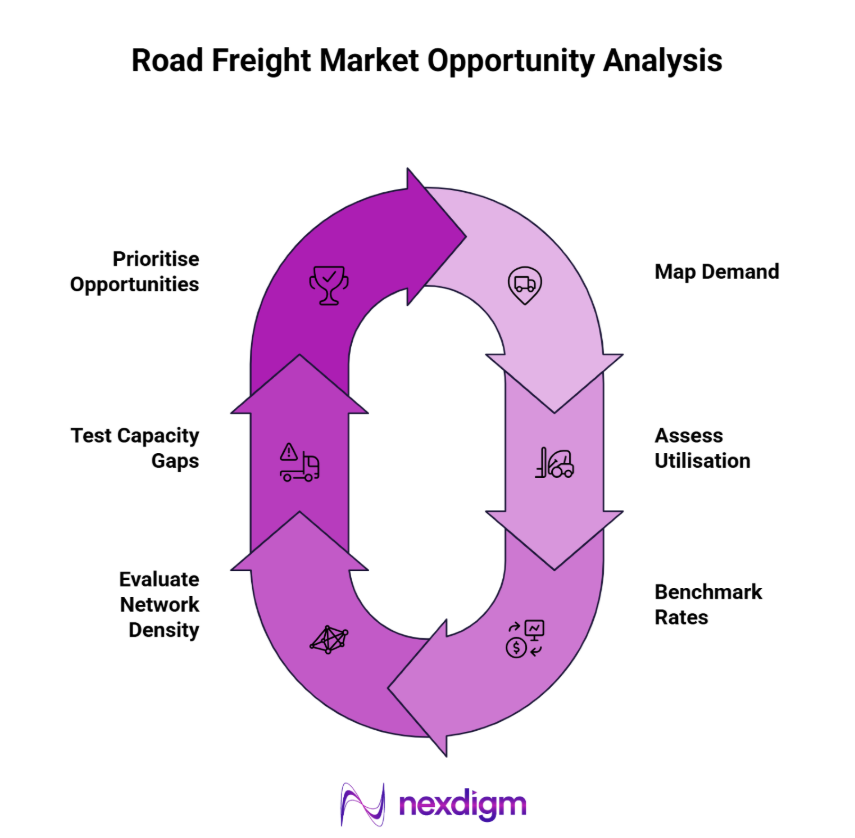
- Map truck demand: Estimate freight volumes by commodity, origin, destination, shipment size, and frequency to identify the corridors generating recurring demand.
- Assess utilisation: Measure load factors, empty kilometres, waiting time, turnaround time, and backhaul availability to determine productive fleet capacity.
- Benchmark rates: Compare freight rates by corridor, vehicle type, distance, season, fuel exposure, and service requirements.
- Evaluate network density: Identify industrial clusters, ports, warehouses, consumption centres, and route overlaps that can support higher vehicle utilisation.
- Test capacity gaps: Assess whether apparent shortages are structural, seasonal, or caused by driver, infrastructure, or scheduling constraints.
- Prioritise opportunities: Rank corridors by demand depth, achievable utilisation, pricing potential, competitive intensity, and investment requirements.
How Nexdigm Identified the Corridors Worth Expanding Into
A 3PL was considering adding 600 trucks across 14 interstate corridors. Nexdigm analysed shipment density, lane rates, utilisation, empty kilometres, and backhaul availability and found that only six corridors offered sufficient two-way demand. Concentrating 420 trucks on those lanes increased average utilisation from 68% to 82%, reduced empty kilometres by 21%, and improved projected fleet EBITDA margin by 4.3 percentage points.
To take the next step, simply visit our Request a Consultation page and share your requirements with us.
Harsh Mittal
+91-8422857704