

Road transportation remains an important component of domestic distribution and regional supply chains. Manufacturers, retailers, distributors and e-commerce businesses depend on road transport providers to move goods between factories, warehouses, distribution centres and customers.
However, selecting a road transport supplier based solely on freight rates can create operational problems. Limited fleet availability, inconsistent delivery schedules, inadequate geographical coverage and poor shipment visibility can increase overall logistics costs.
A structured supplier benchmarking exercise allows procurement teams to compare transport providers across operational performance, capacity and commercial value.
Why Road Transport Supplier Evaluation Matters
Road transport requirements vary considerably across industries. A manufacturer moving bulk industrial materials may prioritise vehicle capacity and route reliability, while an e-commerce business may place greater emphasis on delivery frequency and last-mile coverage.
The supplier evaluation process must therefore account for the nature of the goods, delivery schedules and distribution network.
Important assessment parameters include:
- Fleet capacity: Number and availability of vehicles, vehicle types, load capacity and fleet ownership structure.
- Route coverage: Geographic reach, regional operating presence and access to major industrial and commercial centres.
- Service quality: On-time delivery, shipment condition, communication and claims resolution.
- Cost efficiency: Freight rates, fuel surcharges, tolls, waiting charges and additional handling expenses.
- Operational flexibility: Ability to accommodate seasonal demand, urgent shipments and changes in delivery schedules.
Evaluating Fleet Capacity and Route Coverage
Fleet capacity should be assessed in relation to actual transportation requirements rather than the total number of vehicles claimed by a supplier.
Procurement teams should distinguish between owned fleets, leased vehicles and subcontracted transportation arrangements. Although asset-light operating models can provide flexibility, excessive subcontracting may reduce direct control over service quality.
Vehicle suitability is another important consideration. Different cargo categories require different vehicle configurations, including refrigerated trucks, flatbeds, container carriers and enclosed commercial vehicles.
Route coverage should be examined at the operational level.
Questions worth asking include:
- Does the supplier operate consistently across required routes?
- Are vehicles available at both origin and destination locations?
- Does the provider have established regional partners?
- Can it support return-load arrangements?
- How does it manage route disruptions and alternative transportation arrangements?
A supplier with a large fleet but limited availability on critical routes may not be the strongest procurement choice.
Comparing Service Quality and Transportation Costs
Service quality should be measured through consistent performance indicators.
Useful indicators include:
- On-time pickup and delivery percentages.
- Average transit time by route.
- Vehicle breakdown frequency.
- Shipment damage and loss rates.
- Proof-of-delivery turnaround time.
- Complaint resolution timelines.
- Shipment tracking availability.
Cost benchmarking should consider the total cost of transportation rather than the quoted freight rate alone.
For example, a supplier charging a lower per-kilometre rate may generate additional expenses through longer transit times, vehicle waiting periods, inefficient routing or repeated delivery attempts.
Procurement teams should compare costs using common shipment profiles, vehicle specifications, loading conditions and delivery distances. This creates a more reliable basis for supplier comparison.
Road Transport Supplier Benchmarking Framework
A road transport supplier benchmarking exercise should combine fleet assessment, route-level performance and commercial evaluation.
A practical framework includes:
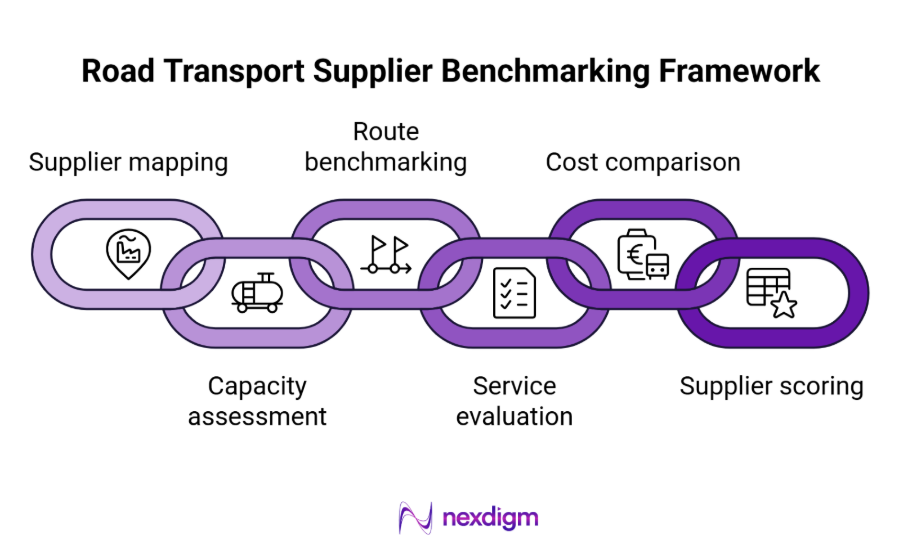
- Supplier mapping: Identify providers based on operating geography, fleet composition and transportation specialisation.
- Capacity assessment: Review owned and contracted fleet availability, vehicle specifications and peak-period capacity.
- Route benchmarking: Compare transit times, route frequency, geographical coverage and alternative routes.
- Service evaluation: Measure delivery reliability, shipment condition, tracking and complaint resolution.
- Cost comparison: Analyse freight rates, fuel adjustments, tolls, detention charges and other additional costs.
- Supplier scoring: Apply weighted scores based on delivery criticality, service requirements and commercial priorities.
Nexdigm can support procurement teams through supplier market research, transport provider benchmarking, commercial comparisons and operational due diligence. These assessments help businesses identify suitable providers, understand cost differences and improve transportation supplier selection.
Nexdigm’s Case Study
Nexdigm benchmarked 14 road transport suppliers across 6 distribution regions, assessing fleet capacity, route coverage, delivery performance and freight costs. The analysis identified a 12% cost variation across comparable routes and helped the client prioritise 5 suppliers against standardised service-level and pricing benchmarks.
To take the next step, simply visit our Request a Consultation page and share your requirements with us.
Harsh Mittal
+91-8422857704