

Robo-advisory expansion is accelerating as automated investing becomes a mainstream wealth management option for both new and experienced investors. These platforms use algorithms, data analytics, and digital onboarding to offer low-cost portfolio management, goal-based investing, and personalized financial guidance. As demand grows for accessible and technology-driven investment solutions, firms must develop a strong market entry strategy to compete effectively, address regulatory requirements, and build investor trust.
A well-planned Robo advisory market entry strategy helps companies identify target segments, pricing models, distribution channels, and partnership opportunities while scaling automated investment services across competitive financial markets.
The global robo-advisory market is expanding rapidly, with estimates placing its value at USD 6.61 billion in 2023 and projecting it to reach USD 41.83 billion by 2030, at a CAGR of 30.5%. Another forecast estimates the market could grow from USD 14.08 billion in 2026 to USD 102.03 billion by 2034, reflecting strong adoption of automated investing and digital wealth solutions.
Assessing Market Potential for Robo-Advisory Platform Entry
Assessing Market Potential for Robo-Advisory Platform Entry involves evaluating market size, investor adoption, digital readiness, competitor presence, regulatory conditions, and growth opportunities to support a successful entry strategy:
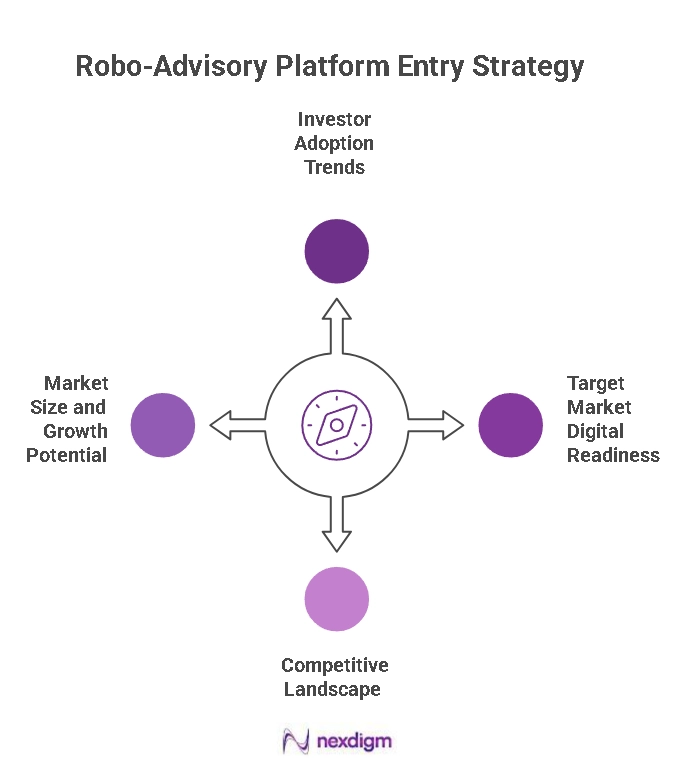
- Market Size and Growth Potential: Evaluate current market value, forecasted growth, investor participation, and long-term demand for robo-advisory services.
- Investor Adoption Trends: Analyze how retail investors, millennials, and first-time investors are adopting automated investing and digital wealth solutions.
- Digital Readiness of Target Market: Assess internet penetration, smartphone usage, fintech adoption, and comfort with app-based financial services.
- Competitive Landscape Assessment: Review existing robo-advisory platforms, pricing models, investment products, features, and service gaps.
Nexdigm’s Program Management Support for Launching Robo-Advisory Services
Nexdigm’s Program Management Support for Launching Robo-Advisory Services helps firms coordinate market entry activities, regulatory timelines, technology implementation, vendor management, and launch milestones. Nexdigm supports structured execution by aligning business, compliance, product, and operational teams, enabling smoother rollout of automated investment services across target markets.
Nexdigm’s Market Research and Investor Adoption Assessment for Automated Investing
Nexdigm’s Market Research and Investor Adoption Assessment for Automated Investing helps firms evaluate market demand, investor behavior, digital readiness, adoption barriers, competitor activity, and growth opportunities for robo-advisory services.
- Adoption Barrier Evaluation: Nexdigm examines trust concerns, financial literacy gaps, regulatory complexity, data privacy issues, and resistance to automated investment advice.
- Market Growth Opportunity Review: Nexdigm analyzes market size, growth forecasts, investor participation, and expansion potential for automated investing services.
- Investor Preference Mapping: Nexdigm studies preferences for goal-based investing, portfolio customization, advisory support, transparent fees, and hybrid human-digital assistance.
- Market Insight Development: Nexdigm converts research findings into actionable insights for positioning, pricing, customer acquisition, and robo-advisory market entry planning.
Nexdigm’s case:
Nexdigm assisted a global robo-advisory company to assess investor adoption before entering the Indian automated investing market. Nexdigm evaluated over 12 competitors, surveyed 1,500 potential investors, analyzed 6 customer segments, and identified 4 high-growth urban markets.
The study found that 68% of digitally active investors preferred low-cost automated portfolios, while 54% valued goal-based investing features. These insights helped the company refine its Robo advisory market entry strategy, reduce launch planning time by 25%, and target 30% user growth in the first year.
To take the next step, simply visit our Request a Consultation page and share your requirements with us.
Harsh Mittal
+91-8422857704