

Robo-advisory has traditionally appealed to investors looking for low-cost, automated portfolio management. But the model is increasingly evolving beyond simple fee competition. Platforms are adding personalization, financial planning, tax-aware investing, human advice, and broader wealth-management capabilities.
The opportunity is significant. Statista estimates that assets under management in the global robo-advisor market could reach approximately $2.06 trillion in 2026, with the number of users expected to exceed 80 million.
Yet scale depends on more than attracting price-sensitive investors. Higher-value customers often demand greater personalization, sophisticated advice, broader product access, and stronger trust.
For wealth managers, banks, fintechs, investment platforms, and investors, the strategic question is whether robo-advisory can evolve into a broader proposition capable of attracting and retaining customers across wealth segments.
A Robo advisory market feasibility study helps evaluate customer demand, technology readiness, pricing, competitive positioning, advisory preferences, operating economics, and scalability. Nexdigm connects these factors to determine where robo-advisory can move beyond low-cost investing and become a sustainable wealth-management model.
How Robo-Advisory Is Evolving
The original robo-advisory proposition was relatively simple use technology to automate portfolio construction and management while reducing the cost of investment advice.
That proposition remains relevant, particularly for investors who want convenience and lower fees.
However, the market is becoming more modernized. Platforms are adding financial planning, personalized recommendations, tax optimization, human advisers, alternative investments, and broader wealth-management services.
This evolution raises an important question: Can automation become the foundation of a broader advisory relationship rather than simply a cheaper alternative to traditional wealth management?
Understanding the Emerging Opportunities in Robo-Advisory
As robo-advisory platforms expand beyond automated portfolio management, new growth opportunities are emerging across customer segments, service models, and product offerings. The shift toward more personalized, holistic wealth-management experiences is creating opportunities for providers. These can be:
- Hybrid Advisory Models: Combining digital automation with human expertise can improve trust, engagement, and service quality.
- Personalized Investment Experiences: Investors increasingly expect recommendations tailored to their financial goals, risk profiles, and life stages.
- Financial Planning Services: Demand is growing for goal-based planning, retirement solutions, and broader wealth-management support.
As robo-advisory platforms evolve, opportunities are emerging beyond automated investing, enabling providers to deliver more comprehensive wealth-management experiences and strengthen long-term customer relationships.
Robo-Advisory Market Assessment with Nexdigm
As robo-advisory platforms evolve beyond automated portfolio management, firms must assess whether emerging opportunities are commercially viable, scalable, and aligned with investor expectations. Through a comprehensive robo-advisory market feasibility study, Nexdigm evaluates market to identify high growth opportunities through:
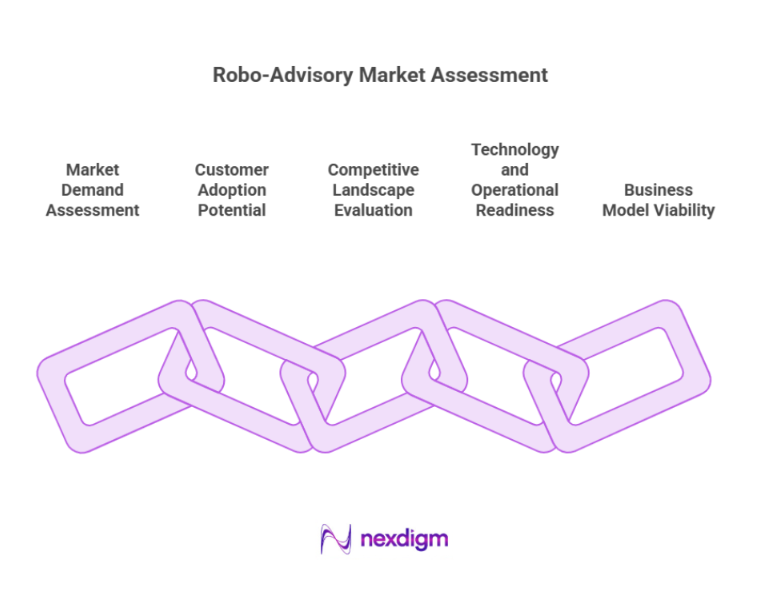
- Market Demand Assessment: Nexdigm evaluates investor interest in automated and hybrid advisory solutions across different customer segments.
- Customer Adoption Potential: Analysis of investor behavior, digital engagement, and trust factors helps estimate adoption rates and growth prospects.
- Competitive Landscape Evaluation: Existing market participants, service offerings, and differentiation opportunities are assessed to identify market gaps.
- Technology and Operational Readiness: Nexdigm examines platform capabilities, scalability, integration requirements, and operational feasibility.
- Business Model Viability: Revenue streams, pricing structures, customer acquisition costs, and profitability potential are evaluated.
With this study, Nexdigm helps organizations assess commercial viability, reduce investment risk, and prioritize opportunities that offer sustainable growth and long-term competitive advantage.
How Nexdigm Provides a Competitive Edge
As more firms enter the robo-advisory market, differentiation becomes increasingly important. Nexdigm helps organizations understand how their offerings compare with competitors and where opportunities exist to create a distinctive value proposition. This takes place through:
- Competitor capability assessment: Nexdigm analyzes competitors’ features, technology capabilities, customer offerings, and service models to identify competitive strengths and market gaps.
- Product and service benchmarking: Comparing products and services against market standards helps identify improvement areas and opportunities for meaningful differentiation.
- Pricing model evaluation: Nexdigm assesses pricing structures, fee models, and value propositions to ensure competitiveness while supporting profitability.
- Positioning opportunities: Market and customer insights help identify unique positioning strategies that differentiate robo-advisory offerings from competitors.
Through competitive analysis, Nexdigm helps organizations identify areas of differentiation and strengthen their position in the evolving robo-advisory ecosystem.
How Businesses Can Maximize Value Through Nexdigm’s Competitive Insights
Understanding competitors is only one part of building a successful business strategy. Nexdigm helps organizations leverage competitive insights to drive informed strategic decisions, enhance profitability potential, strengthen market positioning, improve investment outcomes, and reduce growth risks.
By evaluating market dynamics, competitor actions, customer expectations, and emerging trends, Nexdigm enables organizations to make data-driven decisions that improve commercial performance and unlock greater value from market opportunities.
Nexdigm’s Case
A wealth platform used Nexdigm’s Robo advisory market feasibility study to identify affluent segments suited to hybrid advice. Within 12 months, active investors increased 33%, assets under management grew 25%, premium-plan adoption rose 28%, and customer retention improved 19%, strengthening engagement, scalability, and revenue potential.
To take the next step, simply visit our Request a Consultation page and share your requirements with us.
Harsh Mittal
+91-8422857704