

Bringing a great product to market is only the first step. The real challenge lies in getting it into the hands of the right customers efficiently, consistently, and profitably. Many businesses focus heavily on product development and demand generation, only to discover that an ineffective distribution model limits growth.
This is why route-to-market evaluation has become a critical component of business strategy. The right route-to-market approach helps organizations identify the most effective channels, select suitable partners, maximize market coverage, and manage cost-to-serve. At the same time, it determines how efficiently a business can reach customers while maintaining profitability.
Importance of Route-to-Market Evaluation
A product creates value only when customers can access and purchase it through the right channels. Whether a company relies on direct sales, distributors, retailers, digital platforms, strategic partners, or a combination of these approaches, the route to market directly impacts growth and profitability. This is where every route becomes a unique opportunity. A thorough route-to-market evaluation helps answer key questions:
- Which channels do customers prefer?
- Should the business adopt a direct, indirect, or hybrid model?
- Which partners can accelerate market penetration?
- How much coverage can each channel provide?
- What is the actual cost of serving customers through different routes?
Businesses that align distribution models with customer buying behavior and market dynamics are better positioned to improve customer access, reduce channel inefficiencies, and drive sustainable revenue growth.
Understanding the Customer Buying Behavior
The best route to market begins with understanding how customers prefer to research, evaluate, and purchase products. Today buyers often interact with multiple touchpoints before making a purchase. Some prefer digital self-service platforms, while others rely on distributors, channel partners, or direct consultations.
Here, Nexdigm emphasizes identifying customer access points as an essential part of route-to-market planning. Understanding where customers prefer to engage allows businesses to build channel strategies around actual buying preferences rather than assumptions. When evaluating market routes, businesses should consider:
- Customer purchasing journeys
- Preferred buying channels
- Market-specific behaviors
- Service expectations
- Digital versus offline preferences
Organizations that align channel selection with customer behavior often achieve higher conversion rates and stronger customer satisfaction.
Identifying the Right Distribution Channels
The most effective route-to-market strategy depends on the product, target audience, industry dynamics, and market maturity. Some common channel options referred by Nexdigm include:
- Direct Sales: Direct models provide greater control over customer relationships, pricing, and brand experience. They are particularly effective for complex products requiring consultation or customization.
- Distributors and Resellers: Distributors can provide rapid market access, local expertise, and established customer networks. This approach can be especially valuable when entering unfamiliar markets.
- Digital Platforms: Online marketplaces, e-commerce platforms, and digital sales channels offer scalability and convenience while reducing geographical limitations.
- Hybrid Models: Many successful businesses combine direct and indirect channels to balance reach, control, and operational efficiency.
Nexdigm’s market entry and channel strategy expertise highlights the importance of evaluating direct sales, distributors, retailers, digital platforms, and partner networks before selecting the most suitable route-to-market model.
The Strategic Role of Selecting Right Channel Partners
Partners play a much larger role in the growth of companies. The right partnerships can unlock new customer segments, provide local market knowledge, and reduce expansion risks. However, businesses must carefully evaluate partner capabilities, market reach, reputation, and long-term strategic fit.
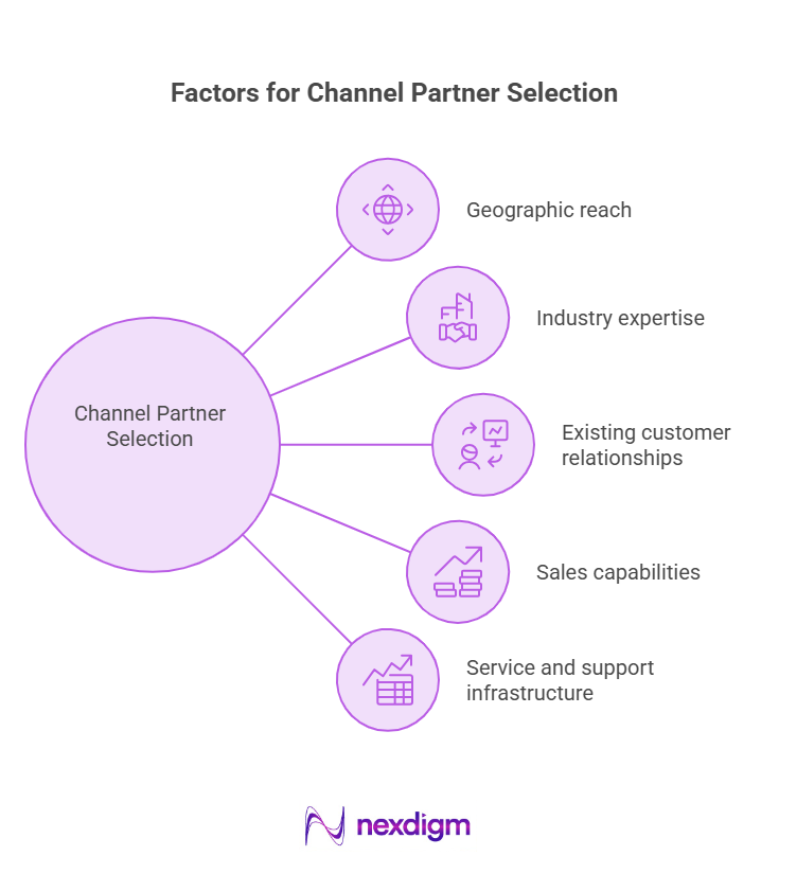
Nexdigm’s market entry strategies place significant emphasis on partnership and alliance development, partner identification, and partner-network planning to support successful market expansion. When identifying potential partners, organizations should look at:
- Geographic reach
- Industry expertise
- Existing customer relationships
- Sales capabilities
- Service and support infrastructure
- Operational reliability
By selecting partners that align with strategic objectives and customer expectations, businesses can accelerate market penetration while minimizing operational risks.
Expanding Coverage Efficiently for Channel Strategy
One of the primary goals of route-to-market evaluation is maximizing coverage. Businesses want to reach as many qualified customers as possible, but excessive channel expansion can create inefficiencies and increase operational costs. According to Nexdigm, effective route-to-market planning involves assessing geographic reach, delivery capabilities, product availability, customer access, and service support to strengthen market coverage. In such a case, businesses should evaluate:
- Regional coverage gaps
- Channel overlap
- Service availability
- Inventory accessibility
- Customer response times
Evaluating Cost-to-Serve Metric
Reaching customers is important, however, reaching them profitably is even more critical. Many organizations focus on revenue generation without fully understanding their cost-to-serve across different channels. In reality, customer acquisition, fulfillment, service delivery, logistics, partner commissions, and support costs can vary significantly between routes.
Hence, Nexdigm’s route-to-market and market-entry advisory services help organizations evaluate channel effectiveness, resource allocation, and operating models to support scalable growth while minimizing inefficiencies.
Building a Scalable Route-to-Market Strategy
A successful route-to-market strategy is about creating a system that aligns customer needs, partner capabilities, distribution coverage, and commercial objectives. Nexdigm’s market entry and go-to-market frameworks help businesses evaluate market demand, buyer segments, channel strategy, partner ecosystems, competitive positioning, and execution risks before expansion. This structured approach supports faster market penetration and sustainable growth. A scalable route-to-market strategy typically includes:
- Customer segmentation
- Channel evaluation
- Partner selection
- Coverage planning
- Pricing alignment
- Cost-to-serve analysis
- Performance monitoring
Together, these elements create a foundation for long-term market success and competitiveness in the rapidly evolving market landscape.
How Nexdigm Supports Route-to-Market Evaluation
Nexdigm brings a research-driven and data-focused perspective to route-to-market evaluation. Through a combination of market entry strategy services, channel assessments, partner identification, distribution planning, customer segmentation, and go-to-market advisory, Nexdigm helps businesses make informed decisions about how products and services should reach customers. Its approach focuses on:
- Evaluating customer buying behavior: Analyzing how customers research, compare, and purchase products helps businesses align channels with preferred buying journeys.
- Assessing channel effectiveness: Measuring channel performance, customer reach, conversion rates, and profitability helps identify the most productive sales routes.
- Identifying suitable distribution partners: Evaluating potential partners based on market presence, capabilities, credibility, and customer access supports stronger growth.
- Improving market coverage: Assessing geographic reach and distribution networks helps businesses expand customer access and reduce coverage gaps.
- Reducing channel inefficiencies: Identifying overlaps, bottlenecks, and operational challenges helps optimize distribution performance while lowering overall costs.
By combining market intelligence with strategic planning, Nexdigm enables organizations to develop route-to-market models that are both customer-centric and commercially sustainable.
Nexdigm’s Case
In one engagement, Nexdigm supported a global enterprise evaluating market-entry channels, partners, coverage, and cost-to-serve. The assessment compared four channel models and 15 potential partners, identifying an optimized route-to-market that reduced distribution costs by 24% and improved target-customer coverage by 31% within one year.
To take the next step, simply visit our Request a Consultation page and share your requirements with us.
Harsh Mittal
+91-8422857704