

Enterprise software demand is becoming increasingly connected to the work a system performs rather than simply the category it belongs to. CRM, ERP, collaboration, analytics and cybersecurity remain established software markets, but newer demand is forming around specific workflows where automation, data and AI can materially change how employees operate.
That shift matters because software categories can be too broad to explain where incremental enterprise spending is actually going.
G2’s 2026 Buyer Behavior Report found that 62% of software buyers expect their company’s software and technology spending to increase over the next 12 months. Yet 84% had consolidated at least three best-of-breed tools into all-in-one platforms, while 50% had consolidated at least five.
SaaS demand is therefore being shaped by two forces at once: continued technology spending and greater pressure to demonstrate why another application deserves a place in the stack.
Workflow intensity is becoming a useful demand signal
Software is more likely to command sustained demand when it addresses work that is frequent, expensive, difficult to standardize or exposed to compliance and operational risk.
This helps explain the continuing interest in analytics and data management, content and workflow management, cybersecurity, industry-specific applications and software that connects multiple systems.
Software Equity Group recorded 2,784 trailing-twelve-month SaaS M&A transactions through the second quarter of 2026. Vertical software accounted for 54% of SaaS M&A activity in Q2, up from 46% a year earlier, while Analytics & Data Management and Content & Workflow Management recorded 126 and 123 transactions respectively.
The transaction market does not directly measure customer demand, but it provides a useful signal about where buyers see strategic value.
The common factor is workflow embedment.
Five workflow groups are creating distinct demand pools
Rather than treating SaaS as one market, demand can be examined through the operational problems enterprises are funding.
- Revenue workflows
Sales operations, customer service, revenue intelligence, pricing and marketing automation remain closely tied to measurable commercial outcomes. Demand tends to be strongest where software can shorten sales cycles, improve conversion or increase account value. - Finance and administrative workflows
Accounts payable, procurement, expense management, compliance reporting and financial planning contain large volumes of repetitive work and structured data. Automation can create measurable labour and processing efficiencies. - Data and decision workflows
Analytics, data management, business intelligence and AI platforms increasingly sit between raw enterprise data and operational decisions. SEG’s 2026 M&A data shows the strategic interest in this layer, with analytics and data management among the most active SaaS categories. - Risk and security workflows
Cybersecurity, identity, compliance and fraud detection benefit from rising digital complexity and regulatory pressure. These workflows can also have high switching costs because they become deeply integrated into enterprise infrastructure. - Industry-specific workflows
Healthcare, financial services, government, retail and other regulated sectors contain processes that generic software cannot always address effectively. Vertical SaaS represented 54% of Q2 2026 SaaS M&A activity, reinforcing the commercial importance of specialized workflows.
Demand has to survive the buying process
A workflow may be painful without being sufficiently funded. That is why demand assessment needs to extend beyond interviews about preferences.
G2 found that evaluation is now the longest stage of the software buying journey for 40% of buyers. IT security review is the biggest source of post-selection delay at 39%, followed by budget approval at 32% and implementation planning at 25%.
This creates a second layer of SaaS demand analysis: whether the workflow problem is strong enough to overcome organizational friction.
A strong use case may still fail to generate demand if implementation is complicated, the budget owner is unclear or the expected return cannot be demonstrated within the buyer’s required timeframe.
Building a SaaS demand assessment
A structured SaaS demand assessment services approach can evaluate demand through the workflow rather than the software category.
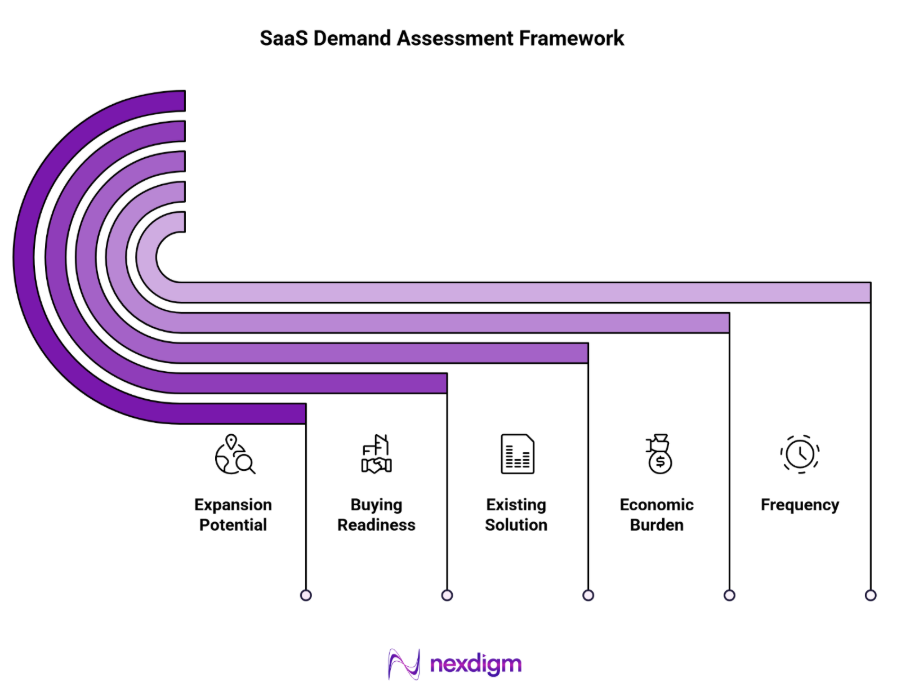
- Frequency
Measure how often the workflow occurs and how many employees, teams or locations participate in it. - Economic burden
Quantify labour costs, delays, errors, lost revenue, compliance exposure or operational inefficiencies associated with the current process. - Existing solution
Map spreadsheets, internal tools, incumbent SaaS and manual workarounds. This establishes what the new product actually needs to displace. - Buying readiness
Identify budget availability, decision-makers, security requirements, procurement friction and implementation capability. - Expansion potential
Determine whether solving the initial workflow creates demand for adjacent functions, departments or geographies.
The result is a demand map that distinguishes workflows with genuine purchasing potential from those that merely generate interest.
Why workflow-level demand matters
The SaaS market is increasingly rewarding products that become embedded in how organizations work. SEG’s 2026 research explicitly identifies durable growth, retention, workflow embedment, proprietary data and credible AI strategies as factors buyers are prioritizing.
For SaaS companies, this means demand forecasting should begin with the customer’s work rather than the vendor’s feature roadmap.
The most useful question is not simply how many companies need a particular software category. It is how many organizations experience a recurring, expensive workflow problem, what they currently spend to address it, and what conditions would cause them to replace or expand that solution.
Nexdigm Case: SaaS Workflow Demand
A workflow-software company with $9.5M ARR targeted 6 industries. Nexdigm surveyed 540 enterprise users across 14 workflows, identifying 3 high-frequency use cases with 2.4x greater purchase intent and a $74M serviceable market.
To take the next step, simply visit our Request a Consultation page and share your requirements with us.
Harsh Mittal
+91-8422857704