

The SaaS market continues to expand, but growth is becoming increasingly uneven. Buyers are scrutinizing software utilization, consolidating vendors, demanding measurable outcomes, and redirecting incremental budgets toward AI-enabled capabilities.
Gartner forecasts worldwide software spending to reach $1.468 trillion in 2026, growing 15.5% year over year. At the same time, Gartner expects public-cloud spending in India to reach $17.5 billion in 2026, up 28.1%, with SaaS spending projected at $4.64 billion, growing 18.9%.
Yet market growth does not mean every SaaS category remains equally attractive. For SaaS companies, enterprise software providers, investors, technology strategists, and market-entry teams, the key question therefore lies in the scaling SaaS categories still and which markets have strong unmet demand.
For this, a SaaS market opportunity analysis helps them evaluate these questions by mapping market size, growth, adoption, customer demand, retention, pricing, competition, product differentiation, customer economics, and commercial potential. To identify SaaS categories with sustainable growth potential.
Why SaaS Growth Is Becoming More Selective
SaaS adoption remains widespread, but customers are becoming more disciplined in evaluating software investments, with a stronger focus on the following areas:
- License Optimization: Organizations are increasingly reviewing whether purchased software is actively used and delivering expected value. Analysis of utilization trends, renewal patterns, unused licenses, and rationalization opportunities has become a key priority.
- Vendor Consolidation: Enterprises are seeking to simplify technology ecosystems by reducing the number of software vendors they manage. This trend favors broader platforms and integrated solutions, while increasing barriers for point-solution providers.
- ROI Expectations: Software investments are expected to demonstrate clear and measurable business outcomes. Buyers increasingly evaluate solutions based on their impact on productivity, revenue growth, cost efficiency, and risk reduction.
- AI Disruption: Artificial Intelligence is reshaping software capabilities and changing the economics of traditional SaaS categories. Companies must assess whether AI expands market demand, strengthens differentiation, or creates substitution risk.
How Nexdigm Helps Navigate SaaS Market Opportunities
As SaaS markets become more competitive and growth becomes increasingly selective, Nexdigm brings deep expertise in evaluating market attractiveness, customer behavior, competitive dynamics, and emerging technology trends.
Through a structured SaaS market opportunity analysis, the expert-led advisory helps stakeholders identify sustainable growth drivers, assess potential risks, evaluate competitive positioning, and uncover value creation opportunities. Such insights enable informed strategic, investment, and growth decisions across the evolving SaaS ecosystem.
Nexdigm’s Expertise in SaaS Market Opportunity Analysis
In an increasingly competitive and rapidly evolving SaaS landscape, understanding market potential requires more than evaluating growth rates alone. Success depends on a combination of customer demand, technology differentiation, and the ability to adapt to changing market dynamics.
Nexdigm brings a structured, data-driven approach to help stakeholders assess the following areas that may impact long-term value creation. These areas are:
- Growth Opportunity Identification: Identification of expansion avenues across customers, geographies, products, pricing strategies, and adjacent market segments.
- Competitive Positioning: Assessment of competitive intensity, differentiation, barriers to entry, and market share dynamics to understand sustainable advantage.
- Customer & Commercial Insights: Analysis of customer needs, adoption patterns, retention drivers, willingness to pay, and revenue growth potential.
- Technology Differentiation: Evaluation of product innovation, AI impact, technology evolution, and emerging threats that could influence future growth.
By integrating these dimensions into a comprehensive assessment framework, Nexdigm provides actionable insights that support informed strategic, investment, and growth decisions across the SaaS ecosystem.
Nexdigm’s SaaS Market Opportunity Analysis Framework
As SaaS markets become more selective and competitive, stakeholders need a structured approach to evaluate market potential, competitive dynamics, and long-term growth opportunities. Nexdigm’s experts follow structured steps of the framework:
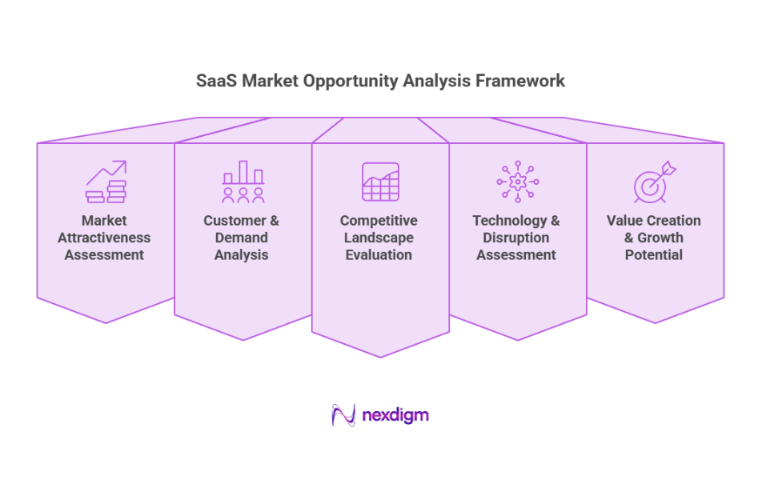
- Market Attractiveness Assessment: Evaluate market size, growth trajectory, demand drivers, customer adoption trends, and industry evolution to determine the attractiveness and long-term potential of the opportunity.
- Customer & Demand Analysis: Assess customer needs, buying behavior, adoption patterns, retention drivers, spending priorities, and willingness to pay to understand sustainable demand.
- Competitive Landscape Evaluation: Analyze market structure, competitive intensity, differentiation, barriers to entry, vendor concentration, and consolidation trends to assess positioning and advantage.
- Technology & Disruption Assessment: Evaluate product capabilities, innovation roadmap, AI readiness, emerging technologies, and disruption risks that could impact future growth and competitiveness.
- Value Creation & Growth Potential: Identify opportunities to expand revenue, improve pricing strategies, increase customer penetration, enhance profitability, and unlock sustainable long-term value.
This process provides a holistic view of market attractiveness, growth potential, competitive positioning, and value creation opportunities within the SaaS ecosystem.
Outcomes of Nexdigm’s SaaS Market Opportunity Analysis Framework
In a rapidly evolving SaaS landscape, organizations need a clear understanding of market potential, competitive dynamics, and growth drivers to make confident strategic and investment decisions. Nexdigm’s framework delivers actionable insights that support informed investment, acquisition, and capital allocation decisions through an objective assessment of market attractiveness, growth potential, and key risks.
It also helps strengthen competitive positioning by evaluating market intensity, differentiation factors, and whitespace opportunities, enabling businesses to build and sustain competitive advantage. Additionally, the framework assesses pricing effectiveness, customer demand, and monetization opportunities to drive revenue growth and enhance overall commercial performance and profitability.
Nexdigm’s Case
A global SaaS provider engaged with Nexdigm to evaluate category attractiveness across AI, cybersecurity, workflow automation, and data software. The assessment identified five high-potential segments, prioritized 10 market opportunities, and improved market-entry prioritization by 20%, enabling sharper customer targeting, product investment decisions, and expansion planning.
To take the next step, simply visit our Request a Consultation page and share your requirements with us.
Harsh Mittal
+91-8422857704