

Software markets continue to expand, but the commercial opportunity within SaaS is becoming more selective. Enterprises are increasingly scrutinizing how many tools they maintain, what each application replaces, and whether software produces measurable operational value. G2’s 2026 Buyer Behavior research found that 84% of software buyers had consolidated at least three best-of-breed tools into all-in-one platforms, while 50% had consolidated at least five.
This creates a different opportunity landscape for SaaS companies. A product can solve a real problem and still struggle to build durable commercial value if it remains one application among many competing for the same budget. The more consequential opportunity lies in identifying workflows where software can become embedded deeply enough to own processes, data, decisions, or transactions.
The SaaS opportunity is moving closer to the workflow
The shift toward consolidation does not mean enterprises are abandoning specialized software. It means specialization increasingly needs a commercial rationale.
September 2026 analysis identifies platformization as a response to changing software economics, with enterprise buyers increasingly considering solutions that combine measurable outcomes and built-in AI rather than standalone seat-based applications. Its survey of roughly 200 software and technology executives found that 55% were making significant investments in platform capabilities.
SaaS opportunity assessment therefore needs to examine where a product can move beyond a feature and become part of a customer’s operating model.
Three areas are particularly relevant:
- Vertical workflows where industry-specific requirements create complexity that horizontal platforms cannot easily absorb.
- Data-intensive processes where proprietary information, historical activity, or customer interactions improve the value of the software over time.
- Systems of execution where the platform does more than recommend an action and becomes part of how that action is completed.
This changes how an opportunity should be sized. The relevant market may be smaller than a broad software category, but the potential revenue per customer, retention and expansion can be substantially stronger.
What makes a SaaS opportunity defensible?
A large addressable market is useful, but it is not enough to establish sustainable commercial potential. The assessment needs to examine the mechanisms that can protect revenue after the initial sale.
Workflow ownership is one such mechanism. Software that sits inside a recurring operational process creates greater switching friction than an application used occasionally. Proprietary data can reinforce this position when accumulated information improves recommendations, automation or forecasting.
Integration depth matters as well. A product connected to enterprise systems, identity infrastructure, compliance processes and downstream applications becomes more expensive to replace.
AI adds another variable. G2 found that 72% of surveyed buyers consider AI either a must-have or differentiator when selecting software, but the same research shows that buyers are becoming more demanding about transparency, pricing and internal adoption.
Consequently, an AI feature should be assessed according to whether it changes the economics or effectiveness of the workflow, rather than simply whether it exists.
From market size to commercial potential
This is where a structured SaaS opportunity assessment consulting approach can distinguish an attractive category from an investable opportunity.
A useful assessment can connect five layers:
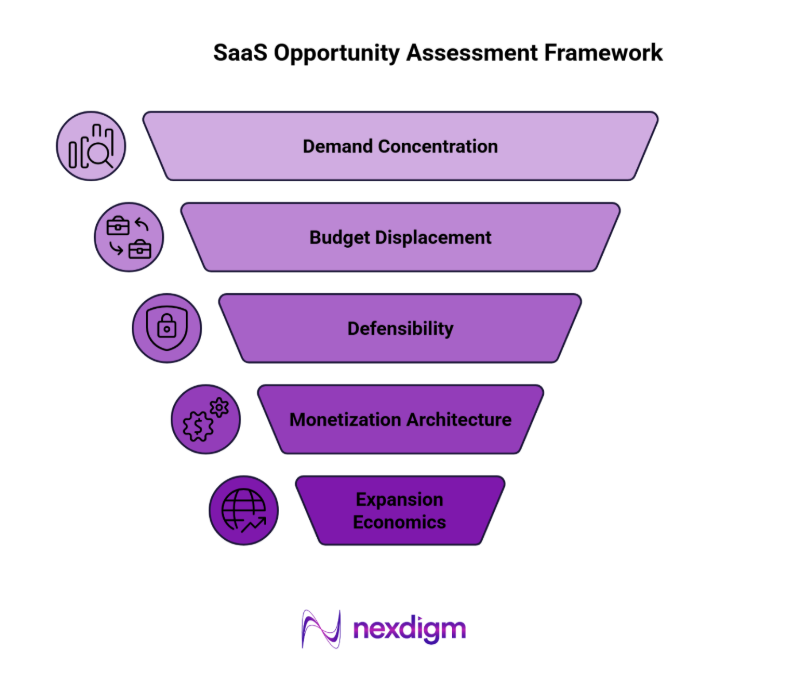
- Demand concentration
Identify the industries, customer segments and workflows where the problem occurs frequently enough to support recurring spend. Frequency matters because occasional pain rarely supports strong software economics. - Budget displacement
Determine where the money would come from. Would the product replace existing applications, consolidate several tools, reduce labour costs, or create a new technology budget? G2’s finding that buyers are actively consolidating software makes displacement particularly important. - Defensibility
Evaluate proprietary data, workflow ownership, integrations, compliance requirements, switching costs, ecosystem relationships and other mechanisms that could protect retention. - Monetization architecture
Assess whether pricing should be subscription-based, consumption-based, transaction-linked, outcome-based or hybrid. AI agents and usage-based workloads are weakening the relationship between software value and number of seats, making the pricing model part of the opportunity assessment itself. - Expansion economics
Estimate how the initial product can expand across departments, workflows, geographies or adjacent use cases. A narrow entry product can still represent a strong opportunity if it creates a credible path to broader account penetration.
Nexdigm Case: Vertical SaaS Expansion
A B2B software provider with $8M ARR across 420 customers faced 11% annual churn. Nexdigm assessed 6 workflows across 3 industries, identifying compliance automation as the strongest expansion pool. A redesigned platform strategy targeted 28% higher account value.
To take the next step, simply visit our Request a Consultation page and share your requirements with us.
Harsh Mittal
+91-8422857704