

Software-as-a-Service has changed how organisations purchase and manage business applications. Instead of investing in infrastructure and managing software installations internally, businesses can access applications through subscriptions and vendor-hosted environments. This can simplify deployment, but it also creates recurring costs and long-term dependence on the selected provider.
The range of SaaS products has expanded across finance, HR, sales, marketing, collaboration, analytics, cybersecurity and industry-specific operations. With multiple vendors competing in many of these categories, procurement teams need a consistent way to distinguish between platforms that appear similar in product demonstrations but differ considerably in usability, service quality and commercial terms.
A structured SaaS platform supplier benchmarking exercise helps buyers compare providers beyond feature lists and assess the value they deliver throughout the subscription lifecycle.
SaaS Adoption Is Broadening Across Business Functions
Cloud-based software has become a routine part of enterprise technology purchasing. Eurostat reported that 52.7% of EU enterprises used paid cloud computing services in 2025. Among enterprises using these services, 71.7% purchased cloud-based office software and 58.2% used cloud services for finance or accounting applications.
These figures illustrate the breadth of cloud software adoption. They also show why SaaS procurement increasingly involves multiple business functions rather than a single central IT decision.
As the number of subscriptions grows, organisations need greater visibility into overlapping functionality, renewal commitments, user adoption and vendor performance.
A SaaS Platform Should Be Evaluated Through the User’s Experience
Product demonstrations often emphasise features, dashboards and automation. However, a platform’s practical value depends on how effectively users can complete everyday tasks.
Procurement teams should assess:
- Ease of navigation and interface consistency.
- Onboarding requirements and learning time.
- Accessibility across devices and user groups.
- Workflow configuration and automation.
- Reporting, dashboards and customisation.
- Integration with tools employees already use.
User experience should be tested through realistic scenarios. A sales team might need to update customer records and generate pipeline reports, while a finance team may need to approve transactions and reconcile information. Testing these activities provides a better indication of usability than a standard product demonstration.
User adoption also influences the economics of SaaS procurement. A subscription may appear competitively priced, but low usage can result in recurring expenditure without corresponding business value.
Performance and Reliability: What Happens After Deployment?
SaaS performance depends on service availability, application responsiveness, infrastructure quality and the provider’s ability to manage demand.
Vendors should be compared using published service-level commitments, historical service communications where available, incident management procedures and support escalation arrangements.
Procurement teams should examine whether performance commitments apply to the entire service or only selected components. They should also identify exclusions, maintenance windows and remedies when service levels are not met.
Data handling and security are equally important. Buyers should review encryption, identity management, access controls, backup, recovery, data residency and incident notification procedures.
For business-critical platforms, integration reliability deserves particular attention. A SaaS application that performs well independently may still create operational problems if data synchronisation with enterprise systems is unreliable.
The Commercial Model: Subscriptions Can Hide More Than They Reveal
SaaS pricing is commonly based on users, modules, feature tiers, transaction volumes or consumption. Some vendors offer annual or multi-year subscriptions, while others provide usage-based arrangements.
A proper commercial comparison should consider:
- Licence structure: Are charges based on named users, active users, concurrent access or usage volumes?
- Feature availability: Which capabilities are included, and which require premium editions or add-on modules?
- Expansion costs: How do prices change when additional users, locations or business units are added?
- Renewal conditions: Are there automatic renewals, price escalation clauses or minimum commitments?
- Exit provisions: Can the organisation retrieve its data in a usable format, and what costs apply when the contract ends?
A further consideration is overlapping functionality.
Businesses may be paying for similar capabilities across several subscriptions. Consolidating tools may offer savings, although any reduction should be assessed against the impact on workflows and user requirements.
Comparing Support and Vendor Dependence
The vendor relationship does not end when the software is deployed. Organisations may need assistance with configuration, troubleshooting, integrations, security incidents and product updates.
Support should be compared according to availability, response commitments, escalation channels, technical expertise and the scope of included services.
Supplier stability and product direction also matter. Procurement teams should understand how frequently the product is updated, whether the vendor supports the required integrations and how changes to the roadmap may affect existing workflows.
Where the SaaS application becomes central to business operations, data portability and migration arrangements should be reviewed before contract award rather than after a difficult exit becomes necessary.
Nexdigm’s SaaS Platform Supplier Benchmarking Framework
To compare SaaS providers consistently, procurement teams can use six evaluation stages:
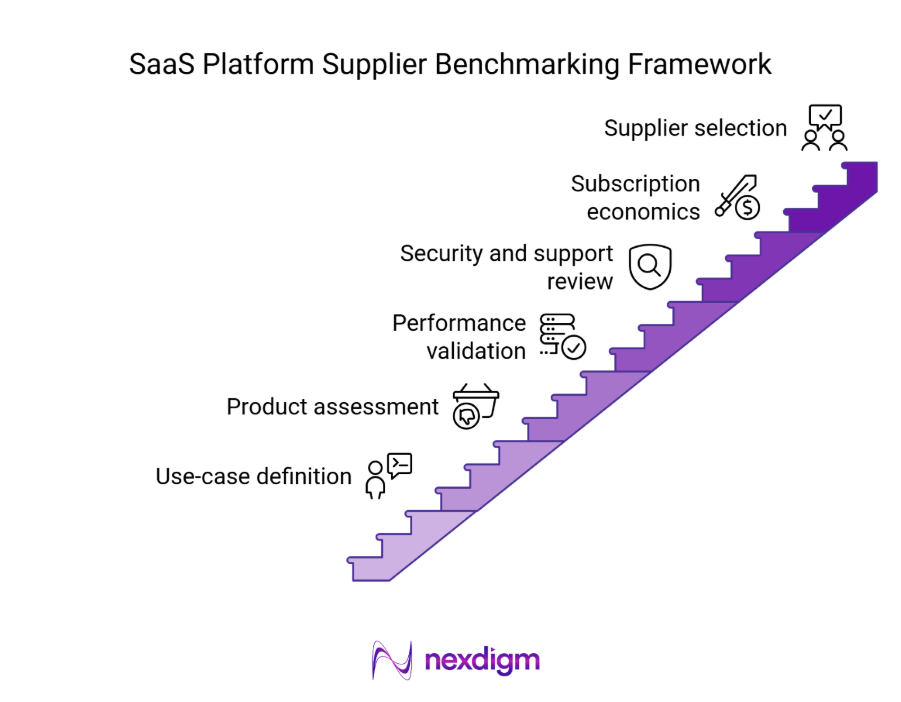
- Use-case definition: Identify user groups, workflows, business objectives and mandatory application requirements.
- Product assessment: Compare functionality, usability, configuration, automation and integration.
- Performance validation: Examine availability, responsiveness, scalability and service-level commitments.
- Security and support review: Evaluate data protection, incident response, support access and vendor stability.
- Subscription economics: Model licence tiers, user growth, add-ons, renewals, overlapping tools and exit costs.
- Supplier selection: Score providers against business priorities and validate shortlisted platforms through practical user testing.
Nexdigm can support organisations through SaaS market research, supplier benchmarking, subscription cost analysis and commercial intelligence. This helps technology buyers compare competing platforms, identify pricing differences and evaluate the long-term suitability of SaaS vendors.
Nexdigm’s Case Study: Benchmarking SaaS Platform Providers
Nexdigm compared 13 SaaS vendors across 5 application categories, assessing user experience, performance, support and subscription models. The research identified a 17% variation in comparable subscription costs, shortlisted 4 providers and established 8 supplier evaluation benchmarks.
To take the next step, simply visit our Request a Consultation page and share your requirements with us.
Harsh Mittal
+91-8422857704