

Many businesses identify attractive markets based on growth rates, customer demand, or industry trends. However, one critical question often remains unanswered: What can the market actually deliver in terms of sales potential?
A market may appear promising, but that does not automatically convert into revenue. Factors such as customer adoption, competitive pressure, pricing acceptance, distribution capabilities, and market accessibility can significantly influence actual sales outcomes.
This is why organizations need to look beyond market size and evaluate how much of the opportunity can realistically be converted into revenue. Through structured sales potential and market assessment, businesses can develop more accurate growth projections, prioritize investments, and build strategies that support long-term success.
Organizations such as Nexdigm, market intelligence, and commercial analysis are combined to help organizations understand not only the size of the opportunity but also its true revenue-generating potential.
Why Sales Potential Matters
Businesses often make strategic decisions based on market demand alone. While demand is important, sales potential provides a more practical measure of what an organization can realistically achieve within a target market. Understanding sales potential helps businesses:
- Set realistic revenue expectations
- Prioritize growth opportunities
- Improve resource allocation
- Support investment decisions
- Enhance market-entry planning
- Reduce commercial uncertainty
Through its sales potential and market assessment services, Nexdigm helps organizations translate market opportunities into achievable business outcomes.
What Can the Market Actually Deliver?
This question goes beyond understanding whether demand exists. It focuses on determining how much of that demand can realistically be captured and converted into sales. Several factors influence actual sales potential, including:
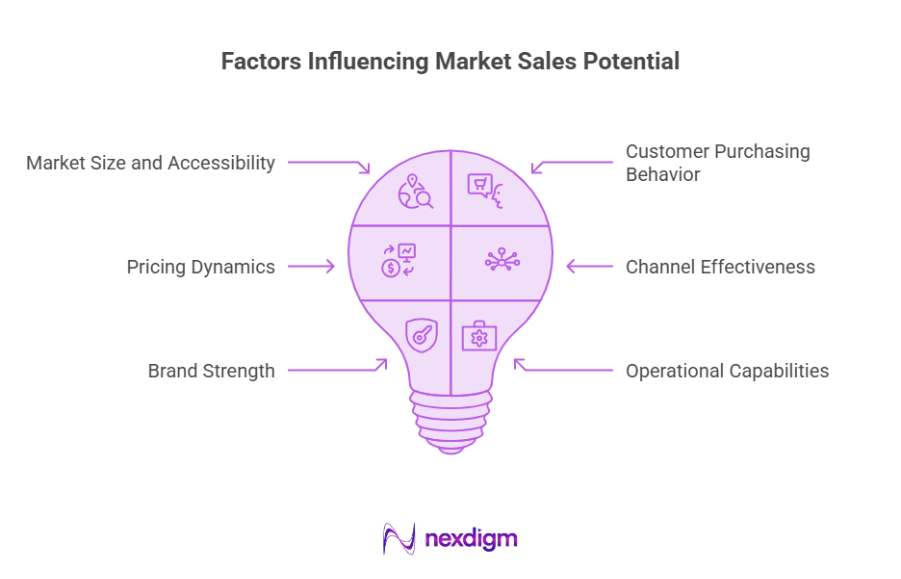
- Market size and accessibility: Evaluates the total addressable opportunity and how easily target customers can be reached through suitable geographies, locations, and channels.
- Customer purchasing behavior: Analyzes buying patterns, preferences, spending habits, and purchase frequency to understand how customers make purchasing decisions.
- Pricing dynamics: Assesses market price sensitivity, competitor pricing, and customer willingness to pay to determine optimal pricing strategies.
- Channel effectiveness: Measures the performance of sales and distribution channels in reaching customers and driving conversions efficiently.
- Brand strength: Examines brand awareness, customer trust, market reputation, and loyalty that influence purchase decisions and market acceptance.
- Operational capabilities: Evaluates supply chain efficiency, inventory management, resources, and execution capabilities required to meet market demand successfully.
Understanding these variables enables businesses to develop realistic growth plans and avoid overestimating market opportunities.
Assessing Competitive Impact on Sales Potential
Even markets with strong demand may present challenges if competition is intense. Understanding the competitive landscape helps organizations estimate the level of effort required to acquire customers and grow market share. In such a case, Nexdigm assesses:
- Market share distribution
- Competitor positioning
- Product differentiation
- Pricing strategies
- Distribution capabilities
- Customer retention trends
This analysis provides a realistic view of how competitive forces may influence future sales performance.
The Role of Pricing in Driving Sales
Pricing is one of the most significant factors affecting sales potential. Even when customer demand exists, inappropriate pricing can limit market adoption and revenue generation. Hence, it is important to consider Pricing as a driving factor for sales. This can be understood by conducting revenue assessments, to gather valuable insights about sales performance, and tailoring prices accordingly. Nexdigm helps organizations evaluate:
- Customer willingness to pay
- Price sensitivity
- Competitive pricing benchmarks
- Premium pricing opportunities
- Revenue optimization potential
By understanding the relationship between price and demand, businesses can improve both sales performance and profitability.
Converting Market Opportunity into Revenue
Market opportunities create value only when organizations can successfully convert them into measurable sales. This requires a clear understanding of the following factors:
- Customer acquisition potential: Assesses the ability to attract and convert target customers through effective marketing, brand visibility, and value-driven offerings.
- Distribution reach: Evaluates how efficiently products can be made available across target markets through distribution networks and retail channels.
- Sales channel effectiveness: Measures the performance of online, offline, and partner channels in generating sales and supporting growth objectives.
- Geographic opportunities: Identifies high-potential regions and locations where customer demand, accessibility, and market conditions support expansion efforts.
- Market penetration strategies: Analyzes approaches to increase market share by improving customer reach, brand adoption, and competitive positioning.
Nexdigm supports organizations in identifying the most effective pathways to capture market demand and accelerate revenue growth.
Forecasting Future Sales Potential
While current market conditions provide valuable insights, businesses must also anticipate future changes. Demand patterns, customer expectations, and competitive dynamics continue to evolve. With Sales Forecasting Demand Analysis, Nexdigm develops data-driven forecasts by evaluating:
- Historical performance
- Industry growth trends
- Demand drivers
- Economic indicators
- Customer adoption patterns
These forecasts help organizations plan investments, allocate resources, and prepare for future growth opportunities.
Nexdigm’s Integrated Approach to Sales Potential Assessment
Nexdigm follows a structured framework designed to connect market opportunity with commercial outcomes. By combining market intelligence, demand analysis, competitive insights, and business strategy, Nexdigm helps organizations develop a realistic view of their sales potential and growth opportunities.
The approach enables businesses to make informed decisions, prioritize investments, and build strategies that support sustainable revenue generation. The approach typically includes:
- Market sizing and opportunity assessment
- Customer demand analysis
- Competitive landscape evaluation
- Pricing and revenue assessment
- Sales forecasting
- Commercial viability analysis
- Growth strategy recommendations
This integrated methodology helps businesses understand both the scale of the market opportunity and the practical path to capturing it.
Driving Smarter Growth Decisions with Nexdigm
Businesses often face uncertainty when converting market opportunities into measurable revenue outcomes. Nexdigm helps organizations overcome this challenge by using a structured decision-making framework. This enables businesses to identify realistic growth opportunities, prioritize investments, and develop strategies that align with market realities and long-term objectives.
Nexdigm’s Case
In a recent engagement, Nexdigm supported a business client in linking market assessment with sales potential. Real-time analysis quantified revenue opportunities, improved sales forecasting accuracy by 30%, identified growth segments by 25%, and enhanced go-to-market effectiveness through actionable insights.
Nexdigm’s integrated market and sales assessment approach enabled the client to validate opportunities, optimize commercial strategies, and confidently pursue markets with measurable growth potential.
To take the next step, simply visit our Request a Consultation page and share your requirements with us.
Harsh Mittal
+91-8422857704