

Scholarships are often treated as a straightforward equation: identify students with financial need and reduce their fees.
The commercial reality is more complicated.
A student may receive a substantial tuition waiver and still be unable to enroll because accommodation, transport, books, food, or other costs remain unaffordable. Another student may receive financial aid despite already having sufficient resources to enroll.
The important question is therefore not simply who needs aid. It is where aid changes the enrollment decision.
The Funding Gap Behind the Admission Decision
The total cost of education extends beyond the published tuition fee.
For students studying away from home, room and board, transport, learning materials, and living expenses can materially change the economics of enrollment. A 50% tuition scholarship may therefore have little effect if the remaining cost still exceeds the household’s available resources.
This creates a marginal funding gap between what a student can pay and what the programme costs.
When aid closes that gap, enrollment becomes possible. When it does not, the student may defer, reject, or abandon the offer.
Who Is Actually Responsive to Aid?
Not every applicant responds to scholarships in the same way.
A financially comfortable, high-merit applicant may select an institution primarily on reputation, faculty, programme quality, or placement outcomes. A middle-income applicant may already be interested but unable to cross a particular fee threshold.
The second group can be especially important for aid strategy because a relatively targeted intervention may change the enrollment outcome without requiring a full tuition waiver.
This is where scholarship demand assessment becomes a question of elasticity rather than simply financial need.
The Economics of Targeted Aid
A university must balance three outcomes:
- Access: Does the aid enable students who would otherwise be excluded to enroll?
- Yield: Does the award change the applicant’s enrollment decision?
- Revenue: Does the institution retain sufficient net tuition to sustain the programme?
Across-the-board discounting can weaken all three if aid is allocated without understanding price sensitivity.
A more precise approach identifies the funding point at which a student becomes financially viable and concentrates assistance around that threshold.
Nexdigm’s Scholarship Demand Assessment Framework
A scholarship demand assessment services approach can identify where financial aid has the greatest enrollment impact through six dimensions:
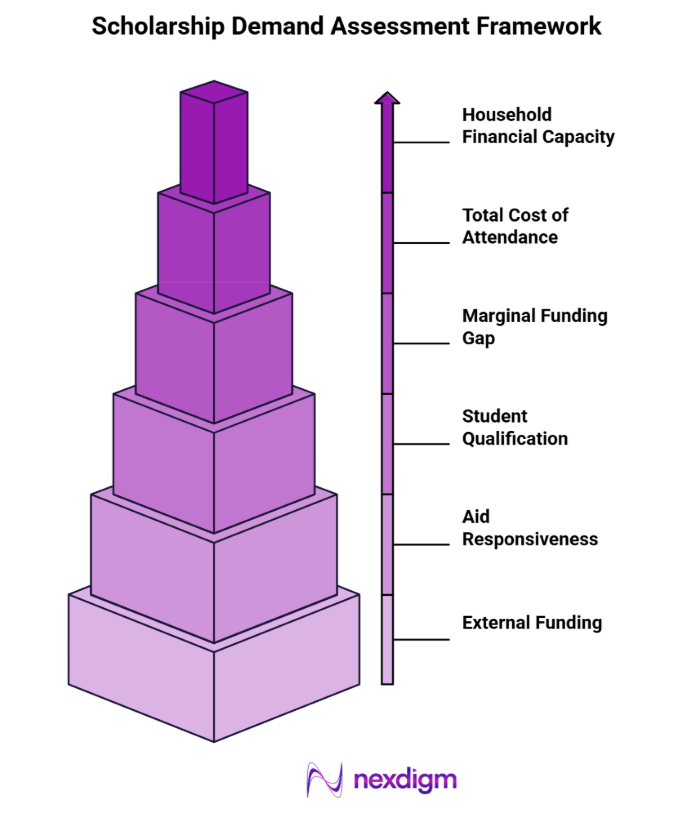
- Household Financial Capacity
Assess household income, assets, existing education expenditure, savings, and realistic contribution toward programme costs. - Total Cost of Attendance
Calculate the full financial requirement, including tuition, accommodation, food, transport, books, technology, and other recurring education expenses. - Marginal Funding Gap
Determine the specific amount separating the student’s available resources from the total cost required to enroll. - Student Qualification and Readiness
Evaluate academic preparedness, programme eligibility, and likelihood of successful progression to ensure aid supports students who can realistically complete the course. - Aid-to-Enrollment Responsiveness
Model how enrollment probability changes at different scholarship levels, identifying the point at which additional aid stops producing meaningful conversion gains. - External Funding Coordination
Account for education loans, government schemes, employer sponsorships, CSR funding, and other sources that can reduce the institution’s own funding requirement.
The framework can then segment applicants into clear groups: aid-independent, partially aid-responsive, funding-gap constrained, and financially unreachable, creating a more targeted basis for scholarship allocation.
Nexdigm’s Case Study: Calibrating Aid Around the Funding Gap
A higher education institution analysed 4,500 qualified applicants and found that full tuition waivers for the lowest-income group did not resolve living-cost barriers. Targeted 35% scholarships for middle-income applicants increased net matriculation by 28% without diluting institutional revenue.
The value of scholarship analysis lies in identifying where a financial intervention changes behaviour. For universities, foundations, and CSR programmes, that can improve both the reach of financial aid and the efficiency with which limited scholarship budgets are deployed.
To take the next step, simply visit our Request a Consultation page and share your requirements with us.
Harsh Mittal
+91-8422857704