

India’s school education system comprises 1.47 million schools and 246.9 million students from foundational to secondary levels, according to UDISE+ 2024–25. Private unaided recognized schools account for 339,583 schools and 95.9 million enrollments, highlighting the scale of private education.
Yet market size alone cannot establish whether a new school will succeed. Enrollment potential depends on the number of addressable students, household affordability, existing school capacity, competitive positioning, accessibility, and the fit between the proposed school proposition and local demand.
For education groups, school operators, and investors, the key question is therefore whether a specific campus can attract sufficient students at sustainable fee levels within its practical catchment. A School education market feasibility study can help answer this before significant investment is committed.
What Determines Whether a New School Can Work?
A viable school opportunity requires alignment between demand and supply. A growing student population may indicate potential, but existing schools could already meet local requirements. Similarly, strong household incomes may not translate into enrollment if established competitors dominate the market. Hence, it is important to evaluate these market dynamics to help stakeholders distinguish between broad demographic opportunity and commercially addressable demand.
The Growing Importance of Catchment and Fee Fitness
The proposed school must reach the right families at a price they can afford. Travel time, accessibility, household income, school fees, curriculum preferences, and competitor offerings can influence parents’ willingness to consider a new institution. Thus, it seems to be necessary to assess these factors together to determine whether the proposed location, school format, pricing, and target student segment are aligned with the local market.
Nexdigm Helping Schools Navigate Market Complexity
Understanding catchment suitability and fee affordability is only one part of evaluating a new school opportunity. Stakeholders must also assess student demand, competitive dynamics, existing capacity, and the alignment between the proposed school proposition and local market needs.
Nexdigm helps education stakeholders navigate this complexity through research-driven insights and a structured market feasibility assessment. By evaluating these interconnected factors, the framework helps identify viable opportunities, assess risks, and support informed expansion and investment decisions.
Nexdigm’s School Education Market Feasibility Assessment
Experts at Nexdigm conduct a School education market feasibility study that connects market demand with competition, affordability, catchment characteristics, and campus economics to assess whether a proposed school can achieve sustainable enrollment and commercial viability. This assessment involves assessing:
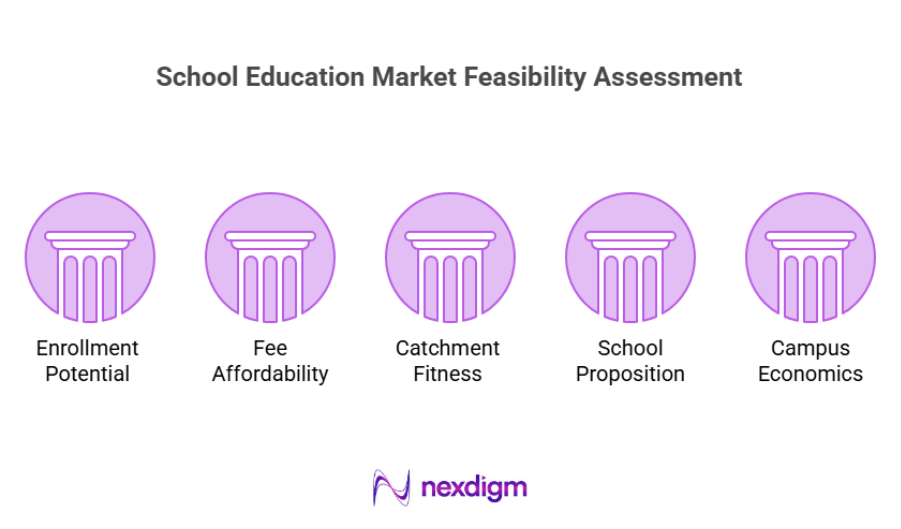
- Enrollment Potential: Estimation of addressable students using school-age demographics, existing enrollment, household profiles, migration, grade-level demand, and projected population growth across the proposed catchment.
- Fee Affordability: Nexdigm benchmarks competitor fees against household income, education spending, and willingness to pay, helping identify realistic pricing ranges and the student segments accessible at each price point.
- Catchment Fitness: Evaluation of household concentration, accessibility, travel patterns, residential development, transport considerations, and surrounding schools to establish the practical catchment and its addressable student base.
- School Proposition: Nexdigm assesses curriculum, format, facilities, positioning, and parent preferences to determine whether the proposed school offering addresses a relevant market need and can differentiate effectively.
- Campus Economics: Translation of enrollment and pricing assumptions into revenue, capacity utilization, operating requirements, investment considerations, and scenarios to assess the proposed campus’s financial sustainability.
These dimensions enable stakeholders to move from a broad market view to a more specific assessment of whether a proposed school can attract students and operate sustainably.
Nexdigm’s School Education Assessment Supporting Investment Decisions
Nexdigm’s assessment can support practical decisions throughout the school development lifecycle, in the following areas:
- New School Development: Identify locations where demand, affordability, competitive conditions, and accessibility support additional school capacity.
- Campus Capacity Planning: Determine appropriate enrollment targets and whether phased development or additional infrastructure is justified by underlying demand.
- Pricing Strategy: Establish fee positioning based on household affordability, competitor pricing, and the value proposition of the proposed school.
- Format Selection: Evaluate whether the proposed curriculum and school model align with parent expectations and the target student segment.
- Site Prioritization: Compare potential locations using consistent market, catchment, competition, and commercial criteria.
This helps education providers test assumptions before committing to a new campus or expansion. It also helps them gain an integrated view of market opportunity and commercial feasibility.
Nexdigm’s Case
Nexdigm supported an education stakeholder evaluating K-12 expansion across nine potential catchments. The assessment mapped 40+ competing schools, evaluated four school-format options, and identified three priority markets with stronger combinations of student demand, capacity gaps, and competitive opportunity. The findings helped refine the proposed expansion strategy and provided a structured basis for evaluating target markets and school formats.
To take the next step, simply visit our Request a Consultation page and share your requirements with us.
Harsh Mittal
+91-8422857704