

A school may sit inside a neighbourhood filled with children and still struggle to fill its classrooms.
That sounds contradictory until the catchment is examined properly. A population count tells a promoter how many children exist. It does not tell them how many families can afford the proposed fees, which curriculum they prefer, how many seats competitors already offer, or how far parents are willing to travel every morning.
That gap between population and enrollment is where school feasibility is actually decided.
Start With the Catchment, Then Reduce It
India’s school system is already enormous. UDISE+ 2024–25 records 24.69 crore students across 14.71 lakh schools, with private schools accounting for 41% of students and 26% of schools.
But national scale says very little about an individual campus.
A school promoter needs to move from the broadest possible population estimate toward the much smaller pool that is genuinely addressable.
The calculation can be thought of as a sequence:
School-age population → target age cohorts → fee-compatible households → curriculum-compatible families → available market after competitor capacity → reachable households → realistic enrollment
Every stage removes part of the original population.
The Six Filters Behind a Realistic Enrollment Number
- Who actually lives in the catchment?
Map children by age and grade rather than using total population. A campus serving K-12 requires a different demographic profile from a preschool or senior-secondary institution. - Who can afford the proposed fee?
Segment households by income and existing education expenditure. A large middle-class population does not automatically translate into demand for a premium school. - Which curriculum do parents want?
CBSE, ICSE, Cambridge, IB, state boards, and other formats attract different household segments. Curriculum preference can materially shrink or expand the addressable pool. - How many seats are already available?
Competitor capacity is one of the most frequently overlooked variables. A neighbourhood with several schools operating below capacity may have substantial demographic demand but limited incremental market demand. - Can families realistically reach the campus?
A theoretical seven-kilometre radius can become much smaller during peak-hour traffic. Commute time, school transport, road connectivity, and daily travel burden can determine whether a household enters the practical catchment at all. - How quickly can the campus capture students?
Enrollment rarely reaches steady state immediately. Grade-wise intake, new admissions, student attrition, sibling admissions, and natural progression all influence the ramp-up period.
The Seat Surplus Problem
Competitor occupancy provides another useful signal.
If incumbent schools in the target market operate materially below capacity, a new campus may have to win students away from existing providers rather than rely on unmet demand. That changes the commercial equation.
The entrant then needs a proposition strong enough to alter parental behaviour. Better facilities alone may not be sufficient. The relevant question is whether the differentiation is visible, valued, and worth the fee premium.
Nexdigm’s Catchment-to-Enrollment Feasibility Framework
A school enrollment demand assessment should move through six linked stages, progressively narrowing the gap between the total child population and the number of students a new campus can realistically capture.
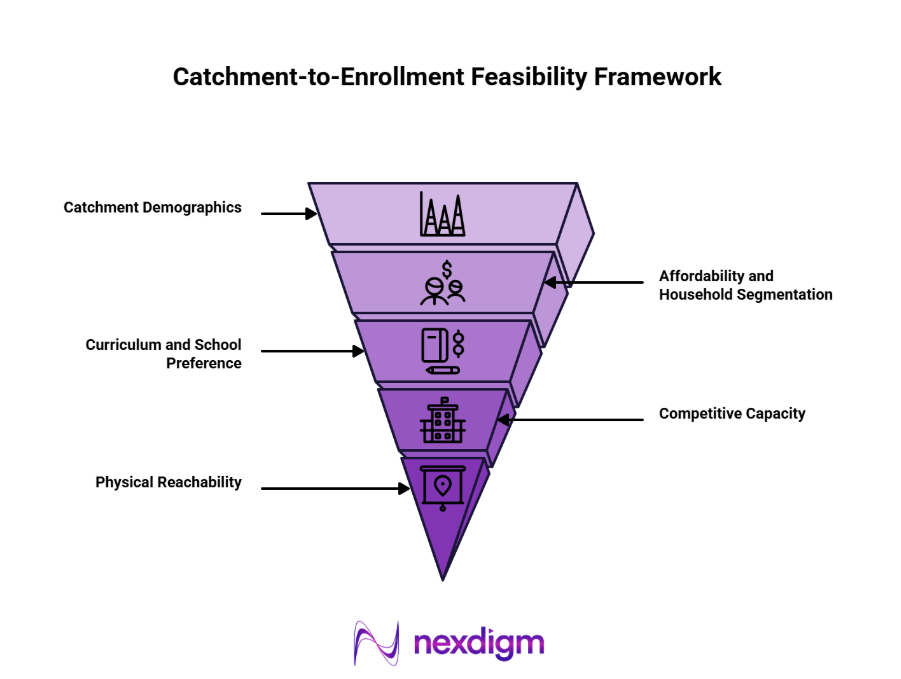
- Catchment Demographics
Define the geographic catchment and map school-age children by age, grade, and household location. This establishes the starting population and identifies where the relevant student cohorts are concentrated. - Affordability and Household Segmentation
Filter the catchment by household income, existing education expenditure, and proposed fee tolerance. The objective is to determine how much of the demographic pool represents financially addressable demand. - Curriculum and School Preference
Assess parental preferences across CBSE, ICSE, Cambridge, IB, state boards, school type, facilities, teaching approach, and other decision criteria. This identifies the portion of fee-compatible households that would actually consider the proposed school. - Competitive Capacity
Map existing schools, available seats, occupancy levels, fee structures, academic positioning, and catchment overlap. This determines how much demand is already being served and how much market share a new entrant would need to capture. - Physical Reachability
Convert the theoretical catchment into a practical one using commute times, road connectivity, school transport routes, and peak-hour accessibility. A household may fall within a geographic radius while remaining commercially unreachable. - Enrollment Capture and Ramp-Up
Model achievable student intake by grade, admission cycle, sibling progression, attrition, and competitive response. This produces a realistic enrollment trajectory rather than assuming that the entire addressable pool is immediately available.
The framework ultimately converts:
Total school-age population → addressable households → preference-aligned families → competitive opportunity → reachable demand → realistic enrollment
That final number can then inform campus capacity, land requirements, capital investment, fee positioning, and the expected time required to reach stabilized enrollment.
Case Study: When Catchment Size Overstated Campus Potential
A proposed urban K-12 campus identified 18,400 school-age children within a seven-kilometre radius. After accounting for a 35% competitor seat surplus and household fee thresholds, the addressable pool fell to 6,900 students, supporting 1,150 stabilized seats rather than the proposed 2,500.
The value of the assessment lies in making that reduction visible before capital is committed. A large catchment can create the appearance of opportunity, but the commercially relevant market is the much smaller population that can afford, prefers, reach, and ultimately choose the proposed school.
To take the next step, simply visit our Request a Consultation page and share your requirements with us.
Harsh Mittal
+91-8422857704