

India’s school education system serves a vast student population, with 246.9 million enrollments across 1.47 million schools from foundational to secondary levels in 2024–25. Private unaided recognized schools account for 95.9 million students, indicating the substantial role of private providers. At the same time, ASER 2024 reports that enrollment among children aged 6–14 remained high at 98.1%, making changes in location, household composition, and school choice increasingly important to future growth.
For school operators and education investors, the next growth opportunity may therefore depend less on overall enrollment expansion and more on where student populations are shifting and which households can afford private education. Migration, new residential development, changing household incomes, and demographic concentration can create emerging school catchments even where broader city-level trends appear moderate.
A School enrollment growth analysis can help stakeholders identify these emerging markets, assess the underlying student pool, understand affordability, and determine where additional school capacity could be commercially sustainable.
Understanding the Drivers of School Enrollment Growth
Future enrollment growth is often influenced by a combination of demographic and socioeconomic factors rather than population growth alone. Student-age population trends, migration patterns, urban expansion, household formation, and income levels can all shape the concentration of prospective students within a market. Evaluating these drivers helps identify locations where education demand is likely to strengthen over time.
Assessing the Commercial Viability of Emerging School Catchments
Not every growing catchment translates into a sustainable school opportunity. The attractiveness of a market depends on factors such as household affordability, private-school penetration, existing school capacity, competitive intensity, and accessibility. Assessing these market conditions helps stakeholders determine whether emerging demand can support additional school infrastructure and long-term enrollment growth.
Nexdigm Supporting Data-Driven School Growth Strategies
Identifying high-growth school markets requires more than tracking demographic trends alone. Stakeholders must understand how population shifts, migration patterns, household affordability, and evolving education preferences influence future enrollment demand.
Nexdigm helps education providers and investors convert these market indicators into actionable insights through structured School enrollment growth analysis and market intelligence.
By evaluating both the scale and sustainability of demand, Nexdigm enables informed decisions on school expansion, market entry, and long-term growth opportunities.
Why Education Providers Partner with Nexdigm
Education providers partner with Nexdigm to understand not only where students are today, but where the next addressable student base is likely to emerge. Nexdigm combines education-sector research, demographic analysis, market intelligence, competitive benchmarking, affordability assessment, and strategic advisory.
Its approach connects macro-level population trends with micro-level catchment dynamics, helping operators evaluate whether projected enrollment growth can translate into sustainable demand for a specific school proposition.
Nexdigm’s Approach to School Enrollment Growth Analysis
Nexdigm’s School enrollment growth analysis connects demographics, migration, household affordability, catchment dynamics, and competitive supply to identify markets with stronger potential for future school enrollment. This is done through:
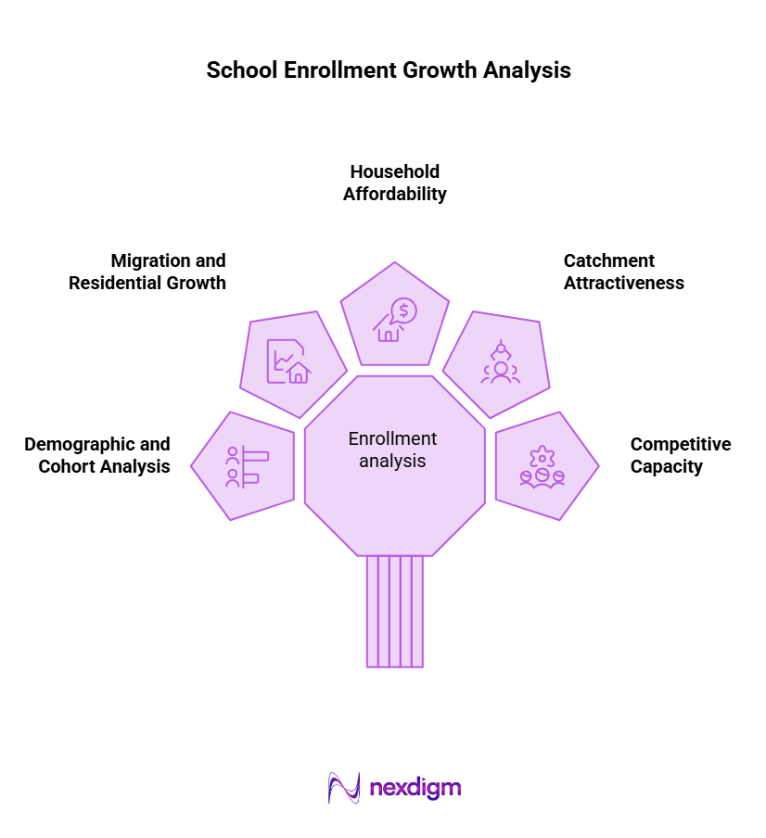
- Demographic and Cohort Analysis: Evaluation of school-age populations, age distribution, household formation, population trends, and projected demographic changes to identify catchments where the student base may expand.
- Migration and Residential Growth: Assessment of migration patterns, new housing developments, employment corridors, and urban expansion to identify locations where incoming households could create incremental demand for school capacity.
- Household Affordability: Nexdigm examines household income, education expenditure, prevailing fees, and affordability indicators to determine which student segments can realistically access private schooling within the target market.
- Catchment Attractiveness: Evaluation of accessibility, household concentration, travel patterns, residential density, and nearby developments to establish practical catchments and identify areas with stronger enrollment prospects.
- Competitive Capacity: Nexdigm maps existing schools, enrollment, available seats, utilization, curricula, and fee levels to determine whether future demand is likely to represent unmet need or increased competition.
These dimensions provide a forward-looking view of where enrollment may grow and what conditions could enable education providers to capture that growth.
Benefits of Nexdigm’s School Enrollment Growth Analysis
Nexdigm’s analysis helps education providers convert demographic and market intelligence into actionable growth decisions. Such benefits offered are:
- Identified Emerging Markets: Understanding of catchments where population growth, migration, and household formation are creating stronger future student demand.
- Improved Enrollment Forecasting: Insights of more realistic enrollment expectations by combining student demographics with affordability, competition, and catchment-level demand indicators.
- Optimized School Capacity: Assessed areas of projected student growth justifying new classrooms, campus expansion, or phased capacity additions.
- Fees Demand Assessment: Thorough understanding of household affordability and prevailing fee levels to establish pricing strategies that balance enrollment potential with commercial objectives.
By connecting demographic trends with commercial realities, Nexdigm helps education stakeholders identify where enrollment is likely to grow, which student segments are addressable, and how providers can position themselves to capture emerging demand.
Nexdigm’s Case
Nexdigm has supported education stakeholders in evaluating K-12 expansion opportunities across multiple potential catchments. In one assessment, the firm evaluated nine catchments, mapped 40+ competing schools, and assessed four school-format options, ultimately identifying three priority markets. The analysis helped refine the client’s expansion strategy and prioritize markets where future enrollment potential and competitive conditions were more favorable.
To take the next step, simply visit our Request a Consultation page and share your requirements with us.
Harsh Mittal
+91-8422857704