

Opening a school involves more than finding a suitable building and estimating the number of children living nearby. Families choose schools based on a combination of academic expectations, fees, safety, accessibility, teaching quality and confidence in the institution’s leadership. A location with a large child population may still be a poor investment if established schools already serve the catchment well or local households cannot support the proposed fee level.
A viable entry strategy brings these factors together before the institution commits to land, infrastructure, staffing and marketing.
How to Evaluate Demand for a New School
India’s school education system recorded 24.69 crore students across approximately 14.71 lakh schools in 2024–25, according to UDISE+ data. However, NITI Aayog’s 2026 analysis found that national school enrollment had declined from 26.95 crore in 2014–15. It also documented a shift in enrollment patterns, with the share attending private unaided schools rising from 31.7% to 38.8% over the same period.
These trends matter for market entry. The growth of private schooling suggests that many families seek alternatives to government schools, but it does not prove that every local market can support another private institution. Demographic changes, affordability, existing capacity and competition can produce very different conditions across neighbourhoods.
The first task is to define a realistic catchment. Travel time often matters more than straight-line distance, particularly for younger children. The assessment should consider population by age group, residential development, transport access, competing schools, fee levels and the availability of seats at different grade levels.
A new school also needs a clear position. It might serve a middle-income neighbourhood with transparent fees, offer a specialised curriculum, or differentiate through language instruction, experiential learning or student support. Trying to appeal to every household can leave the school without a distinctive reason to be chosen.
Parent Expectations and the School Choice Decision
Parents typically assess a school through a mix of measurable and experiential factors. Academic performance and curriculum are important, but families also pay attention to teacher stability, communication, safety, discipline, facilities and the way the school responds when problems arise.
Affordability extends beyond tuition. Transport, uniforms, books, technology, meals, activity charges and annual fee increases affect the total household commitment. A school that advertises a competitive tuition fee but communicates additional charges poorly can lose trust before admissions begin.
Market research should therefore examine parent preferences directly. Interviews and surveys can reveal which features drive the shortlist, while competitor visits and fee comparisons show how schools deliver on those promises. The objective is not to collect a long list of desired facilities. It is to determine which features influence enrollment enough to justify their cost.
School Market Entry Strategy Consulting: Five Decisions Before Launch
School market entry strategy consulting should connect local demand with the proposed school’s positioning, operating model and financial requirements.
- Location and Catchment: Estimate the reachable student population, likely travel patterns, residential growth and competing school capacity.
- Curriculum and Positioning: Evaluate the curriculum, language options, teaching approach and differentiators most relevant to local families.
- Pricing and Affordability: Benchmark tuition and additional charges against household purchasing power and competing schools.
- Capacity and Staffing: Phase grade-level openings, classroom capacity, teacher recruitment, facilities and support services in line with realistic enrollment.
- Admissions and Parent Communication: Define the admissions journey, information parents need, outreach channels and processes for responding to concerns.
The school should also establish how it will meet applicable recognition, affiliation, land-use, safety and building requirements. These requirements vary by board, state and location, so they must be verified for the specific project rather than treated as a generic checklist.
School Market Entry Feasibility Framework
The School Market Entry Feasibility Framework turns market evidence into a launch decision.
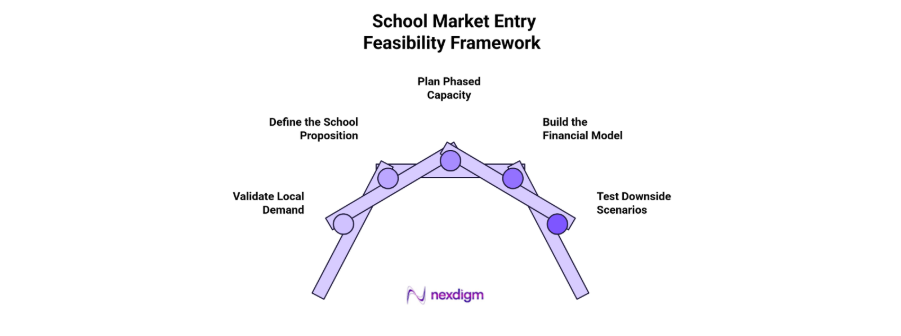
- Validate Local Demand: Estimate student cohorts, parent intent, affordability and the number of competing seats.
- Define the School Proposition: Specify the curriculum, fee segment, teaching approach and distinctive parent value.
- Plan Phased Capacity: Determine which grades open first and how enrollment growth affects classrooms, faculty and facilities.
- Build the Financial Model: Include land or lease costs, construction, salaries, marketing, maintenance, working capital and enrollment ramp-up.
- Test Downside Scenarios: Model slower admissions, higher costs, fee sensitivity and delayed approvals before committing capital.
The launch plan should link spending to enrollment milestones. Opening every grade at full capacity may create unnecessary costs; expanding too slowly can weaken the school’s proposition. The right sequence depends on catchment demand and the resources required to maintain academic quality.
Nexdigm Case Study: Evaluating a School Launch
Nexdigm assessed 3 proposed school locations, comparing catchment demographics, competitor fees, parent preferences and first-five-year operating costs. 1 site offered the strongest balance of reachable demand and affordability. The operator adopted a phased grade-level launch, with initial capacity tied to projected enrollment and additional investment linked to admissions performance.
To take the next step, simply visit our Request a Consultation page and share your requirements with us.
Harsh Mittal
+91-8422857704