

A new school can have access to a large population and still struggle to fill classrooms. The commercial viability of a school depends on a much narrower question: how many families within a realistic catchment are likely to choose the institution, at the fee level required to sustain it?
India’s school system had 24.69 crore students and 14.71 lakh schools in 2024–25. Government schools accounted for 69% of schools and 49% of students, while private schools accounted for 26% of schools and 41% of students.
Those national figures show the scale of the education system. They do not tell a school operator whether a particular catchment can support another institution.
Start With the Catchment, Not the State
School demand is inherently local. Parents typically evaluate institutions within a practical travel radius, particularly at primary and middle-school levels.
A feasibility assessment should therefore begin by defining the catchment and estimating the relevant student population within it. Population growth, household formation, age distribution and school-going populations provide the initial demand base.
The next step is to determine how much of that population is realistically addressable.
A catchment containing 20,000 school-age children does not represent 20,000 potential customers if existing schools already serve most of them, household affordability is low, or the proposed school is positioned outside the preferences of local families.
Four Numbers Matter Before Construction Begins
- Addressable student population
Estimate the number of school-age children within the practical catchment and segment them by grade and household characteristics. - Existing capacity
Map schools, seats, current enrolment and utilisation. A large population with significant unused capacity can indicate a very different opportunity from a similarly sized catchment where schools operate close to capacity. - Fee affordability
Assess household income, prevailing school fees and willingness to pay. The commercially relevant market is the portion of families able and willing to pay the proposed fee. - Competitive positioning
Examine school brands, curricula, facilities, academic outcomes, transport, extracurricular offerings and fee structures. A new school needs a credible reason for parents to switch or choose it.
These variables should be assessed together. A catchment with strong population growth may still be unattractive if competing schools have substantial spare capacity. Conversely, a smaller catchment may support expansion if existing institutions are constrained and household purchasing power is sufficient.
Capacity Is a Commercial Variable
India’s school system contains a large mix of government, aided and private institutions. Private schools serve 41% of students nationally despite accounting for 26% of schools.
This distribution matters when assessing a new private school. The relevant competitor set may include established private schools, government institutions and other alternatives that influence parents’ willingness to pay.
Capacity analysis should therefore examine both enrolment and available seats. A school market with high enrolment but significant unused capacity can have limited room for another operator.
The assessment should also consider whether existing schools are concentrated in neighbourhoods and whether transport patterns create underserved pockets within the wider catchment.
Affordability Shapes the Revenue Ceiling
The number of students a school can potentially attract is only one part of the business case. Fee levels determine whether that demand can support the institution’s operating model.
A premium school may require a smaller but more affluent customer base. A mid-market school may depend on larger enrolment volumes and careful control of teacher, infrastructure and operating costs.
This is where demographic analysis becomes financial analysis. Household income, prevailing fees, admission patterns and willingness to pay can help estimate realistic enrolment and revenue scenarios.
What a School Feasibility Assessment Should Establish
For companies considering school market sizing and feasibility research, the objective is to move from a population estimate to a defensible view of enrolment potential and operating viability.
Nexdigm’s School Feasibility Framework
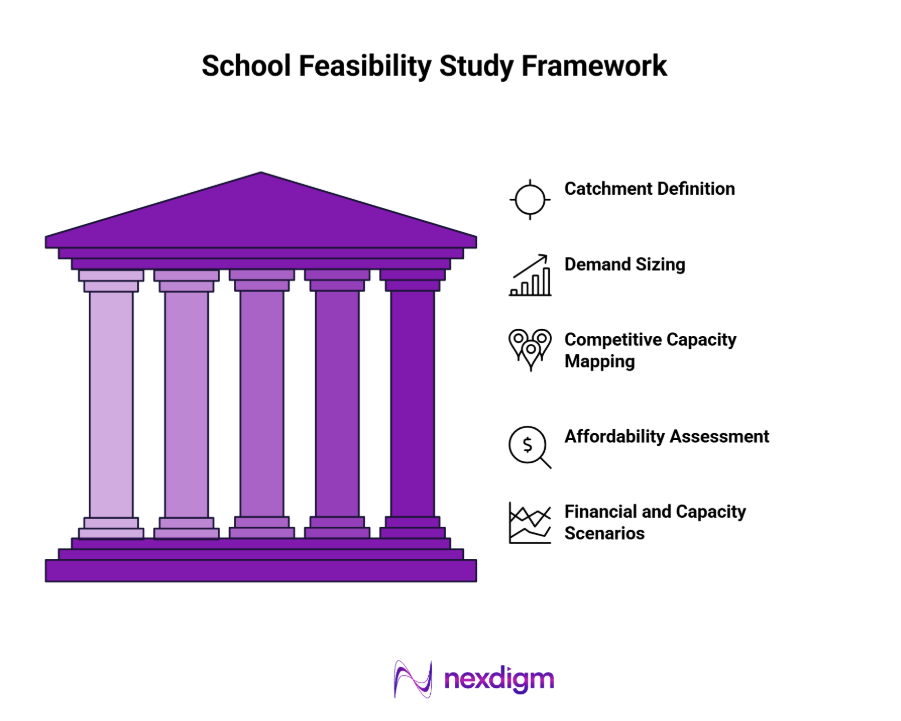
- Catchment Definition
Establish the geographic area from which the proposed school can realistically attract students. - Demand Sizing
Estimate school-age population, grade-level demand, demographic growth and potential enrolment. - Competitive Capacity Mapping
Assess nearby schools, enrolment, available seats, fees, curricula and positioning. - Affordability Assessment
Evaluate household economics and willingness to pay against the proposed fee structure. - Financial and Capacity Scenarios
Model enrolment, fee revenue, capacity utilisation and key operating assumptions under different adoption scenarios.
Nexdigm’s Case Study: Testing Catchment Viability Before Investment
Catchment evaluation for a proposed school revealed that viable commercial operation required a 68% year-one occupancy break-even, which is 15% higher than initial projections, due to a 25% competitor seat surplus and household fee-tolerance caps within a 5-km radius.
Nexdigm can support school operators and education investors with catchment analysis, market sizing, competitor research, demand assessment and feasibility modelling.
To take the next step, simply visit our Request a Consultation page and share your requirements with us.
Harsh Mittal
+91-8422857704