

Ocean freight makes competitive strategy crucial for shipping companies. Sea freight competitive analysis provides businesses with insights into pricing trends, route efficiencies, fleet utilization, and competitor performance. By leveraging competitive intelligence, companies can anticipate market shifts, optimize capacity, reduce operational costs, and make data-driven strategic decisions.
Integrating sea freight competitive analysis into logistics planning ensures organizations maintain a competitive edge, enhance service reliability, and capitalize on emerging opportunities in the dynamic and highly contested global maritime trade environment.
Maritime transport continues to dominate global trade, moving over 80 % of goods by volume across the world’s oceans, with annual seaborne trade exceeding 11 billion tonnes. Container throughput also remains robust, with global port activity handling hundreds of millions of TEUs as trade lanes expand. Asia‑Pacific ports account for over 50 % of container throughput, reflecting the region’s central role in global maritime logistics.
Strategic Decision-Making Using Sea Freight Competitive Intelligence
Strategic decision-making using sea freight competitive intelligence involves analyzing competitor routes, pricing, and capacity, enabling businesses to optimize operations, reduce costs, anticipate market shifts, and maintain a competitive advantage globally:
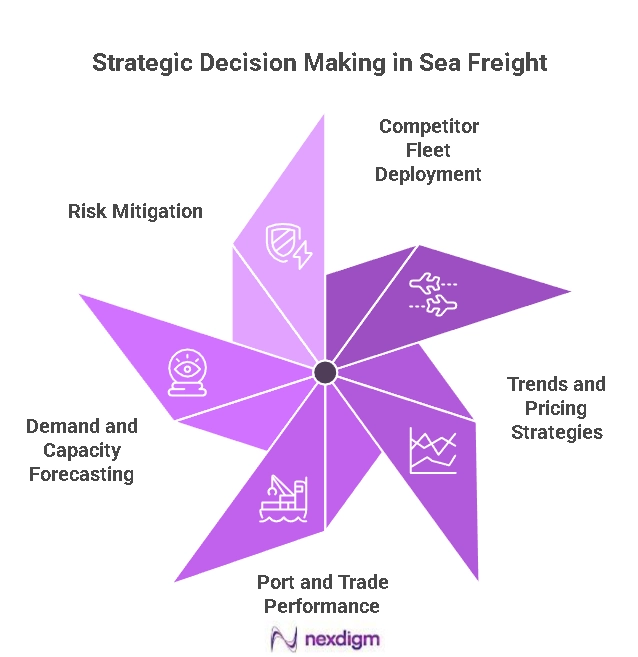
-
Monitoring Competitor Fleet Deployment
Tracking competitor vessel utilization and route choices helps anticipate capacity shifts and adjust operational planning for strategic advantage.
-
Analyzing Rate Trends and Pricing Strategies
Sea freight competitive intelligence identifies market pricing trends, enabling optimized contracts, cost management, and improved profitability.
-
Evaluating Port and Trade Lane Performance
Assessing port efficiency, congestion, and trade lane performance helps refine routing decisions and maintain reliable service levels.
-
Forecasting Demand and Capacity Needs
Predictive insights allow businesses to allocate vessels, containers, and logistics resources effectively, avoiding underutilization or bottlenecks.
-
Mitigating Operational and Market Risks
Intelligence helps identify disruptions, geopolitical impacts, or fuel fluctuations, enabling proactive risk management strategies.
Cost and Pricing Strategy Optimization through Nexdigm Services
Nexdigm’s cost and pricing strategy optimization services help ocean freight players manage volatile rates, operational expenses, and capacity costs. By leveraging competitive intelligence, market benchmarks, and predictive analytics, Nexdigm enables businesses to set optimal pricing, negotiate favorable contracts, and allocate resources efficiently. These solutions reduce costs, enhance profitability, and support informed strategic decisions in a highly competitive maritime logistics environment.
Risk and Disruption Management in Maritime Logistics with Nexdigm
Nexdigm’s risk and disruption management in maritime logistics uses competitive intelligence, predictive analytics, and scenario planning to anticipate delays, mitigate operational risks, ensure compliance, and maintain resilient, efficient ocean freight operations.
-
Identifying Operational Risks
Nexdigm evaluates port congestion, equipment failures, and capacity constraints to proactively identify risks in maritime logistics operations.
-
Scenario Planning for Disruptions
Simulating potential disruptions like weather events, strikes, or supply chain bottlenecks enables contingency strategies and operational resilience.
-
Competitive Intelligence for Risk Assessment
Analyzing competitor responses and market trends provides insights to anticipate challenges and adjust risk mitigation approaches effectively.
-
Predictive Analytics for Proactive Management
Leveraging AI and data-driven models forecasts potential delays or disruptions, allowing timely operational adjustments.
Nexdigm’s case:
Nexdigm worked with a logistics services provider managing complex warehousing and distribution across more than 90 warehouses and 30 locations to identify inefficiencies and revenue leakages. Through process redesign and vendor contract standardization, Nexdigm helped eliminate approximately ₹45 lakh in revenue leakage and improved operational efficiency across a 4.5 million sq ft logistics network, strengthening cost control and service reliability.
To take the next step, simply visit our Request a Consultation page and share your requirements with us.
Harsh Mittal
+91-8422857704