

Sea freight remains difficult to disrupt on price because incumbent carriers operate at enormous scale. A new offering therefore needs a clearer proposition than simply quoting a lower rate.
The opportunity is strongest where shippers face a persistent gap between what they pay and the service they receive. Capacity availability, schedule reliability, transit-time consistency, equipment access, and visibility can all influence whether a customer is willing to switch providers.
Global container shipping demand was expected to grow around 3.0% in 2026, while fleet capacity was forecast to grow by approximately 6.5%, creating the potential for continued pressure on freight rates if supply expands faster than cargo volumes.
Cost Advantage Alone May Not Be Enough
Ocean freight is highly price-sensitive, particularly for standardised containerised cargo. But the lowest quoted rate does not necessarily represent the lowest logistics cost.
Shippers also absorb costs from delays, storage, detention, demurrage, inventory buffers, missed production schedules, and emergency transport when vessels or equipment are unavailable.
This creates room for differentiated offerings. A provider that is slightly more expensive but consistently delivers the promised transit time may be more attractive than a cheaper service with unpredictable arrival dates.
Capacity Has Become a Commercial Differentiator
Container availability and vessel capacity can change rapidly with trade flows, congestion, blank sailings, and network disruptions.
The global container fleet reached approximately 30.3 million TEUs in early 2026, while the orderbook remained substantial. At the same time, carriers continued adjusting networks in response to changing trade patterns and geopolitical conditions.
A new service needs to determine where capacity is genuinely constrained rather than assuming that all growing trade lanes are underserved.
Equipment availability can matter just as much as vessel space. A shipper may have access to nominal capacity but still struggle to secure the right container type at the required origin.
Reliability Can Create More Value Than Another Rate Discount
Schedule reliability is becoming increasingly important as supply chains operate with tighter inventory buffers.
A vessel arriving several days late can create consequences well beyond the freight invoice. Manufacturing inputs may miss production windows, retailers can lose selling time, and importers can incur storage or demurrage charges.
For a new service, reliability therefore needs to be measurable.
Relevant indicators include:
- Actual versus promised transit time
- Schedule adherence
- Frequency of blank sailings
- Port congestion exposure
- Container availability
- Transshipment dependence
- Average delay and delay variability
A service that can offer predictable transit on a specific lane may have stronger commercial potential than a broad network competing solely on price.
The Best Opportunity May Be an Underserved Lane
A new sea freight proposition does not necessarily need to challenge the largest carriers across their entire network.
The more attractive opportunity may be a specific corridor where customers experience recurring problems: insufficient direct services, poor equipment availability, unreliable connections, limited sailing frequency, or weak service for cargo types.
The addressable market should therefore be built from actual shipper requirements rather than from the total container volume of a country or region.
Pricing Needs to Survive the Freight Cycle
A service that looks attractive during a period of high freight rates may become uncompetitive when rates fall.
The commercial model needs to account for both spot and contract pricing, fuel and bunker adjustments, terminal charges, surcharges, equipment costs, and minimum-volume commitments.
Customer willingness to pay also needs to be tested. Some shippers will pay a premium for guaranteed capacity or faster transit, while others will switch only when the price difference is substantial. A viable offering must therefore define precisely what customers are paying for and how that value remains defensible across different market conditions.
What Would Make a New Offering Commercially Viable?
A strong opportunity generally combines several conditions:
- A clearly identifiable capacity or service gap
- Sufficient recurring cargo volume
- Customers experiencing measurable pain with existing providers
- Competitive total landed cost
- Reliable access to vessels and equipment
- A defensible transit-time or service proposition
- Sufficient customer willingness to commit volumes
The assessment should also examine incumbent responses. A new entrant offering better reliability may find that established carriers can quickly match schedules or reduce rates on the same corridor.
How Nexdigm Tests the Feasibility of a New Sea Freight Offering
Nexdigm’s sea freight market feasibility study evaluates whether a proposed service can attract customers and remain economically viable across changing market conditions.
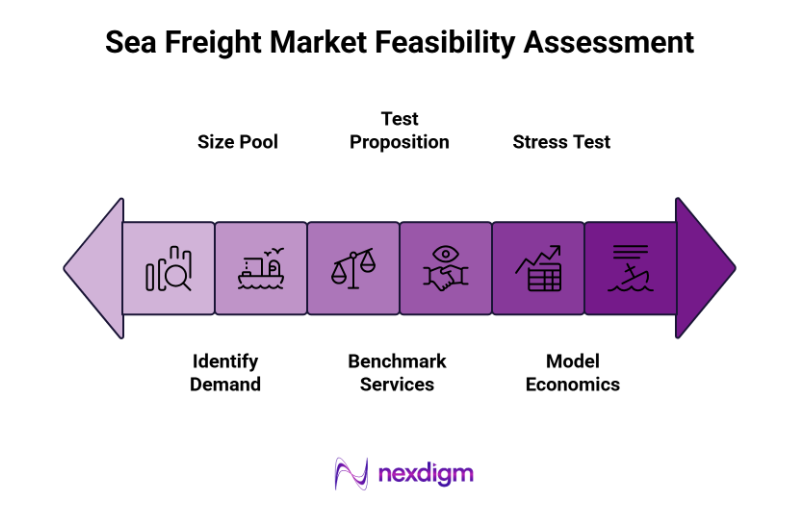
- Identify unmet demand: Interview shippers, freight forwarders, and logistics buyers to identify recurring problems with rates, capacity, equipment, transit times, or service reliability.
- Size the addressable cargo pool: Map container volumes by commodity, origin-destination pair, customer segment, and shipment frequency.
- Benchmark competing services: Compare incumbent rates, sailing frequency, transit times, equipment availability, reliability, and service coverage.
- Test the value proposition: Determine whether customers would switch for lower cost, guaranteed capacity, direct sailings, better reliability, specialised handling, or a combination of benefits.
- Model lane economics: Assess vessel capacity, port charges, handling, repositioning, fuel exposure, commissions, operating costs, and expected utilisation under different freight-rate scenarios.
- Stress-test the proposition: Model the offering under high-rate, low-rate, congestion, capacity-surplus, and demand-downturn scenarios to determine whether the business remains viable.
How Nexdigm Turns a Sea Freight Concept Into a Viable Market Proposition
A logistics provider evaluating a new Asia-Middle East service initially planned to compete primarily on freight rates. Nexdigm interviewed 68 shippers and forwarders and found that equipment availability and schedule reliability were larger pain points. The revised proposition focused on guaranteed weekly capacity and defined transit windows. Within the first year, the service secured 74% of targeted capacity commitments, while achieving a 9.2% rate premium over comparable spot services.
To take the next step, simply visit our Request a Consultation page and share your requirements with us.
Harsh Mittal
+91-8422857704