

Security operations benchmarking is an important approach for evaluating how effectively organizations detect, investigate, and respond to cyber threats in high-risk digital environments. In sectors such as finance, healthcare, government, cloud services, and critical infrastructure, security teams must operate with speed, accuracy, and resilience. By comparing key performance indicators such as threat detection time, incident response time, alert handling efficiency, automation maturity, and analyst productivity, organizations can identify gaps in their security operations.
Competitive intelligence helps businesses understand how their cybersecurity capabilities compare with industry peers, competitors, and best-in-class security models, enabling better strategic decisions, improved risk management, and stronger digital defense.
Recent cybersecurity benchmarks show why security operations benchmarking is critical. Reports state that the global average cost of a data breach reached USD 4.88 million, a 10% increase from the previous year. A report found that global median attacker dwell time rose to 11 days, showing that detection and response speed remain major challenges. These statistics highlight the need to compare SOC efficiency, automation, response time, and resilience across high-risk industries.
Trends and Insights from Security Operations Benchmarking for Competitive Intelligence
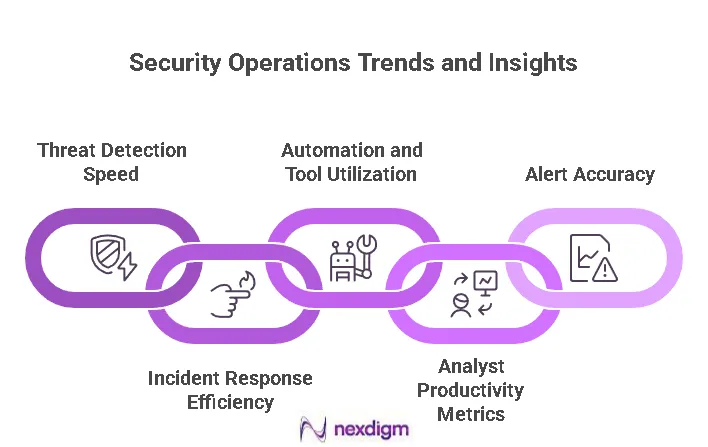
This section analyzes patterns in SOC performance such as detection speed, response efficiency, and automation providing competitive intelligence that helps organizations identify gaps, adopt best practices, and strengthen cybersecurity strategy:
-
Threat Detection Speed Trends
Analyzes improvements or delays in detecting breaches, helping benchmark SOC performance against industry peers for competitive intelligence insights.
-
Incident Response Efficiency Patterns
Examines average response times and resolution effectiveness, highlighting operational strengths and weaknesses relative to competitors.
-
Automation and Tool Utilization Insights
Reviews adoption of automated detection, orchestration, and analytics tools to optimize SOC efficiency and gain competitive advantage.
-
Analyst Productivity Metrics
Tracks workload management, alert handling, and fatigue, offering insights to improve efficiency and outperform industry peers.
-
Alert Accuracy and False Positive Trends
Measures noise reduction in SOC alerts, ensuring resources focus on real threats and enhancing competitive intelligence strategy.
Nexdigm’s Security Operations Benchmarking Framework
Nexdigm’s Security Operations Benchmarking Framework provides a structured approach to evaluate SOC efficiency in high-risk digital environments. It measures threat detection, incident response, alert management, automation, and analyst productivity. By comparing these metrics against industry peers and best practices, the framework delivers actionable insights, identifies performance gaps, and supports strategic decision-making to enhance cybersecurity resilience and competitive advantage.
Nexdigm’s Automation and Security Tool Optimization Services in Security Operations
Nexdigm’s Automation and Security Tool Optimization Services streamline SOC processes by implementing advanced automation, integrating security tools, reducing manual alerts, and enhancing detection, response efficiency, and overall operational effectiveness.
-
Automated Threat Detection and Alert Management
Uses AI-driven tools to detect threats faster, reduce manual alerts, and improve SOC response efficiency.
-
Security Orchestration and Workflow Integration
Connects multiple security tools and processes to streamline operations, enabling faster investigations and coordinated responses.
-
Advanced Analytics for Incident Prioritization
Leverages analytics to identify high-risk incidents, reduce false positives, and focus SOC resources on critical threats.
-
Tool Performance Assessment and Optimization
Evaluates existing security tools, enhances configurations, and ensures optimal efficiency and alignment with organizational security goals.
-
SOC Automation Strategy and Roadmap
Develops a phased automation plan, integrating tools and processes to maximize productivity, resilience, and operational maturity.
Nexdigm’s case:
In a recent Nexdigm engagement with a large financial services client, Nexdigm’s automation and tool optimization reduced average security alert resolution time from 18 hours to 3 hours (83% improvement) and cut false-positive alerts by 45% within six months. Enhanced orchestration increased analyst productivity by 30%, enabling the SOC to focus on critical incidents and strengthen its competitive intelligence against industry peers.
To take the next step, simply visit our Request a Consultation page and share your requirements with us.
Harsh Mittal
+91-8422857704