

The seed industry does not have a single supplier hierarchy that applies across every crop and geography. Companies may hold strong positions in hybrid maize or cotton while having a smaller presence in pulses, cereals or vegetable seeds. Public-sector organisations, private seed businesses, research institutions and regional producers also contribute to the market through different parts of the seed value chain.
For organisations planning procurement, partnerships or market entry, seed company vendor landscape research helps explain how the supplier ecosystem is structured. It identifies the companies active in relevant crop segments, examines their geographic reach and evaluates the capabilities that shape their competitive positions.
A Market Shaped by Different Supplier Models
Seed suppliers operate through several business models, and understanding these distinctions is important before comparing market positions.
Large national and multinational seed companies typically maintain broader portfolios, established research programmes and distribution networks across several regions. Their capabilities may include breeding, seed production, processing, branding and technical support.
Regional seed companies often focus on particular crops, local agro-climatic conditions or specific state markets. Their strength may lie in relationships with dealers, familiarity with regional farming practices and the ability to serve specialised demand.
Public-sector seed organisations play an important role in the production and distribution of quality seeds, particularly across food security crops and government-supported programmes. Their contribution may be significant in crops where private-sector commercial incentives are less pronounced.
Specialist and emerging suppliers may focus on vegetable seeds, forage crops, niche varieties, seed treatment or particular breeding technologies. They can be relevant partners for buyers seeking specialised product capabilities.
These categories are not rigid. Companies may operate across several segments, and their market position can change through acquisitions, licensing arrangements, new product launches and distribution partnerships.
How the Competitive Landscape Differs by Crop
The competitive structure of the seed market becomes clearer when examined crop by crop.
- Maize: Competition includes suppliers offering hybrids for different maturity periods, growing environments and end uses. Yield performance, dealer access and regional trial evidence are important differentiators.
- Cotton: The market is influenced by hybrid availability, pest-management requirements, regulatory provisions and product performance across cotton-growing regions.
- Rice and wheat: Public research institutions and government-linked seed organisations have an important role alongside private suppliers. Varietal suitability, seed replacement and local distribution are central considerations.
- Pulses and oilseeds: Supplier capabilities may differ according to crop type, regional demand, multiplication capacity and the economics of seed production.
- Vegetables: Specialist portfolios, product innovation, market preferences, seed quality and technical field support can influence supplier competitiveness.
The relevant comparison is therefore not simply which company is largest. It is which suppliers have the strongest capabilities in the specific crop and regional markets that matter to the buyer.
Mapping the Supplier Landscape in India
India’s seed sector combines public and private participation across research, multiplication, testing and distribution. The government reported in July 2026 that 229 seed hubs and 384 breeder seed production centres were engaged in seed production. It also identified 178 notified seed testing laboratories across the country.
The private sector has a particularly significant role in several high-value crop categories. Parliamentary committee reporting on 2024 seed availability indicated that private-sector agencies supplied approximately 71% of quality seed availability, while the public sector supplied the remaining 29%. These figures highlight the importance of evaluating both supplier categories when developing a sourcing strategy.
A landscape study should also consider the institutions and partnerships that influence product development. Public agricultural research organisations, state agricultural universities and private seed companies may collaborate through licensing, research agreements and seed multiplication arrangements. Such relationships can affect the availability and commercialisation of new varieties.
What Determines a Supplier’s Competitive Position?
Market presence should be assessed through multiple indicators rather than inferred from brand recognition or portfolio size. A useful supplier profile should examine:
- Crop and varietal breadth: The range of crops, hybrids and varieties offered, including relevance to target markets.
- Research and development strength: Breeding infrastructure, product pipeline, trial network and technology partnerships.
- Production and quality infrastructure: Seed multiplication capacity, processing facilities, testing arrangements and traceability.
- Regional presence: Market coverage, dealer relationships, distribution partnerships and local technical support.
- Commercial performance: Pricing, market accessibility, availability, customer relationships and product positioning.
Not every supplier will perform equally across these indicators. A specialist regional company may have stronger dealer relationships in a particular state, while a larger supplier may have greater research resources and broader production capacity.
Why Supplier Landscape Research Matters
For buyers, market mapping helps identify alternative suppliers, reduce dependence on a narrow vendor base and understand the competitive conditions within each crop segment. It can also reveal where supplier capabilities are concentrated and where regional sourcing partnerships may be more appropriate.
For seed companies and agribusiness investors, the same research can support market entry, competitor assessment, partnership identification and expansion planning. Understanding which companies control relevant product portfolios, distribution networks and research capabilities provides a clearer view of commercial opportunities.
How Nexdigm Supports Seed Company Market Research
Nexdigm provides market intelligence, competitive landscape research, supplier benchmarking and commercial analysis. Its research can help clients identify key seed companies, assess their crop portfolios, compare regional presence and understand the partnerships and market dynamics shaping the supplier ecosystem.
Seed Company Vendor Landscape Research Framework
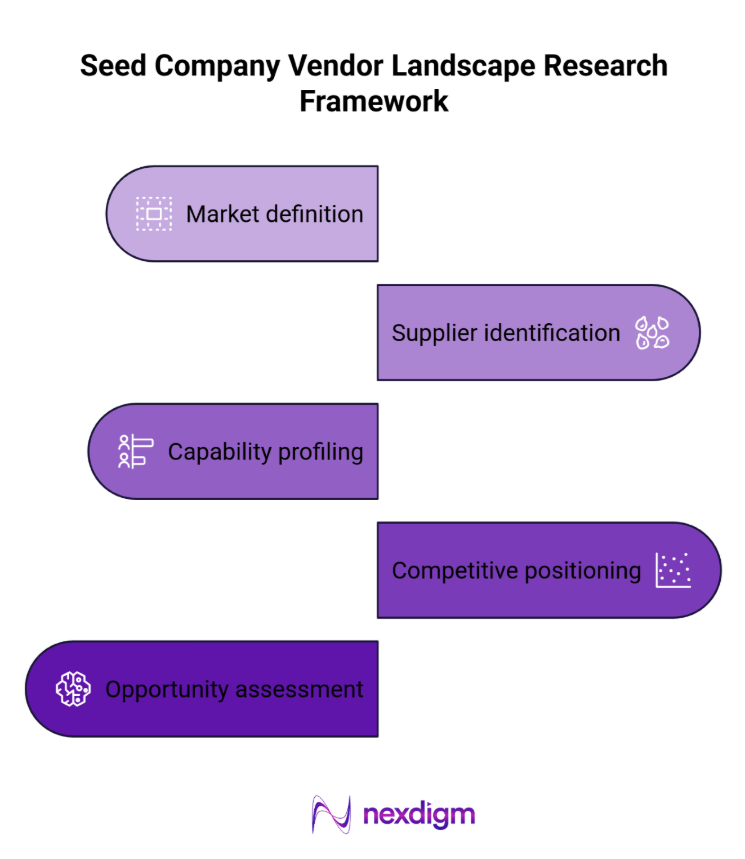
- Market definition: Establish crop categories, geographic boundaries and relevant supplier segments.
- Supplier identification: Map national, regional, multinational, public-sector and specialist providers.
- Capability profiling: Assess product portfolios, research infrastructure, production capacity and distribution.
- Competitive positioning: Compare market presence, crop specialisation, commercial reach and partnerships.
- Opportunity assessment: Identify sourcing alternatives, underserved markets, partnership opportunities and competitive gaps.
Nexdigm’s Case Study: Mapping the Seed Company Landscape
Nexdigm profiled 25 seed companies across eight crop segments, mapped their presence in 12 agricultural states and assessed 30 portfolio, production and distribution indicators. The research identified six suppliers for further commercial assessment.
To take the next step, simply visit our Request a Consultation page and share your requirements with us.
Harsh Mittal
+91-8422857704