

A seed company’s market reach is determined by more than its product portfolio. Its ability to place the right varieties with the right distributors, maintain inventory ahead of sowing periods and support dealers throughout the selling season can influence commercial performance just as strongly as product quality.
For seed manufacturers and agribusinesses, the distribution channel is a critical part of the supplier ecosystem. Seed distribution supplier intelligence helps organisations understand which channel partners can provide effective market coverage, dependable fulfilment and the local relationships needed to reach farmers.
Distribution Strength Is More Than Dealer Count
A supplier may report an extensive dealer network, but the number of registered dealers does not necessarily reflect effective market access. Some dealers may be inactive, operate in overlapping territories or carry only a limited portion of the supplier’s portfolio.
A more meaningful assessment examines the quality and productivity of the channel.
Consider a supplier with 200 registered dealers across several districts. If only a small proportion maintain stock during the main planting season, the network may be less effective than a smaller group of active dealers with strong local relationships and reliable inventory.
The evaluation should establish the number of active dealers, geographic coverage by crop-growing region, sales and order volumes by territory, dealer retention and access to remote or underserved agricultural markets. It should also examine the availability of technical and after-sales support.
These indicators help distinguish nominal distribution presence from genuine market penetration.
Inventory Reach and Seasonal Fulfilment
Seed distribution is highly sensitive to agricultural calendars. Stock that arrives after the planting window may have limited commercial value, even if the product itself meets quality specifications.
Channel partners should therefore be assessed on inventory planning, storage conditions, order fulfilment and seasonal responsiveness.
The following operational indicators are particularly useful:
- Inventory availability: Stock levels by crop, variety and location.
- Order fulfilment: Delivery lead times, order accuracy and fill rates.
- Storage management: Warehouse conditions, handling procedures and stock rotation.
- Seasonal readiness: Pre-season procurement and replenishment planning.
- Returns and replacement: Procedures for damaged, expired or non-conforming stock.
Organisations should also examine how distributors forecast demand. Poor forecasting can result in stockouts in high-demand markets and excess inventory in territories where farmer demand is weaker than expected.
Inventory intelligence should be collected at a granular level. National stock availability may conceal significant shortages in individual districts or crop segments.
Understanding the Role of Channel Partners
Seed distribution networks can involve several layers, from manufacturers and regional distributors to retailers, dealers and local agricultural input shops. Each layer performs a different function and can influence pricing, availability and customer service.
Regional distributors are important for market coverage, inventory aggregation and coordination with retailers. Their financial strength, storage infrastructure and ability to serve multiple territories can influence the reliability of the wider network.
Retail dealers provide direct access to farmers and often influence product awareness and purchasing decisions. Their portfolio mix, local reputation, technical understanding and working capital position should be assessed.
Institutional and cooperative channels may provide access to organised farmer groups, public programmes and larger procurement requirements. Their sourcing processes and administrative requirements can differ from those of conventional retail networks.
The right channel structure depends on the crop, market and buyer’s commercial objectives. A high-value vegetable seed business may require specialised dealer support, while large-volume field crop distribution may depend on broader geographic coverage and efficient inventory movement.
Evaluating Service and Strategic Fit
Distribution partners contribute more than physical movement of products. Their ability to communicate product information, support demonstrations and manage farmer enquiries can affect adoption and brand reputation.
Supplier intelligence should therefore examine dealer and farmer training programmes, demonstration plot coordination, agronomic information, product education, complaint handling, quality escalation and digital ordering capabilities.
Strategic fit matters as well. A distributor may have strong reach in one crop category but limited experience in another. Buyers should assess whether the partner’s existing portfolio complements the supplier’s products or creates potential channel conflicts.
Commercial terms require similar attention. Credit periods, dealer margins, incentive schemes, territory exclusivity and payment discipline can influence the sustainability of the relationship. A distribution partner that depends heavily on aggressive credit may create collection and working-capital risks even when sales volumes appear strong.
Building a More Resilient Seed Distribution Network
Manufacturers and large buyers should avoid relying entirely on historical sales performance when evaluating channel partners. Market demand changes with crop economics, weather conditions, farmer preferences and the introduction of new varieties.
A regular channel intelligence programme can help organisations monitor five areas:
- Market coverage: Identify regions and crop segments with strong or weak distribution presence.
- Channel productivity: Compare active dealers, sales performance, inventory turnover and retention.
- Operational reliability: Track fulfilment, stock availability, storage conditions and seasonal preparedness.
- Commercial health: Examine payment discipline, margins, working capital and contract conditions.
- Growth potential: Identify underserved markets, complementary partners and opportunities for channel expansion.
This information can support decisions about distributor appointments, territory allocation, inventory planning and channel consolidation.
How Nexdigm Supports Seed Distribution Supplier Intelligence
Nexdigm supports agribusinesses through market mapping, supplier intelligence, channel research and commercial benchmarking. Its research can help clients assess distributor networks, identify regional channel partners, compare inventory and service capabilities, and evaluate opportunities to strengthen market coverage across crop categories.
Seed Distribution Supplier Assessment Framework
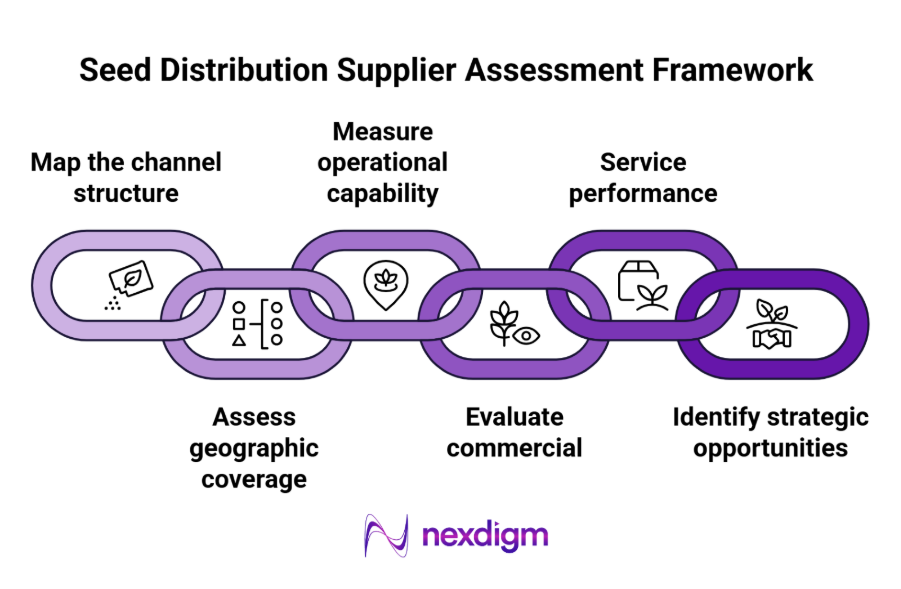
- Map the channel structure: Identify manufacturers, regional distributors, dealers, retailers and institutional channels.
- Assess geographic coverage: Evaluate active market presence, crop specialisation and access to agricultural clusters.
- Measure operational capability: Review inventory, storage, fulfilment, replenishment and seasonal readiness.
- Evaluate commercial and service performance: Compare margins, credit terms, training, technical support and complaint resolution.
- Identify strategic opportunities: Assess channel gaps, partner suitability, expansion potential and distribution concentration.
Nexdigm’s Case Study: Turning Channel Benchmarking into Network Action
Nexdigm benchmarked 19 seed distributors across eight agricultural markets on 25 channel performance indicators, identifying five regional coverage gaps to focus distributor selection and expansion where coverage was weakest.
To take the next step, simply visit our Request a Consultation page and share your requirements with us.
Harsh Mittal
+91-8422857704