

Broad agricultural acreage does not automatically create an attractive commercial seed market. Millions of cultivated hectares can remain commercially difficult where seed replacement is low, farmers routinely save seed and crop margins limit willingness to pay for improved genetics. For seed companies, the opportunity lies in identifying crop-region combinations where market size, replacement potential, farmer economics and competitive conditions align.
Crop Economics Create the First Filter
The national crop universe divides into very different commercial models.
Hybrid crops such as maize, pearl millet and cotton generate recurring commercial seed demand because harvested grain cannot simply be replanted without significant genetic segregation. Hybrid maize is particularly relevant, with its commercial seed market projected to reach approximately $500.64 million by 2031.
Self-pollinated crops present a different opportunity. Wheat, soybean, chickpea and groundnut can have much lower commercial replacement rates because farmers can retain and reuse seed. In these markets, seed companies must generate sufficient value through productivity improvements, disease resistance or other traits to overcome lower replacement frequency.
The result is that acreage should be treated as a starting point, not the final measure of market attractiveness.
Replacement Headroom Can Matter More Than Current Market Size
A crop with 80% commercial seed penetration has limited room for volume expansion through basic conversion. Another crop with 10% penetration may have a much larger theoretical opportunity, provided the economics support adoption.
Hybrid rice illustrates this tension. Its low penetration creates substantial headroom, but adoption depends on whether improved yields compensate for higher seed costs and whether varieties meet local grain and cooking preferences.
Seed companies therefore need to distinguish between theoretical headroom and economically addressable headroom.
Geography Changes the Economics
Regional screening adds another layer.
Areas with dependable irrigation, commercial cropping and higher farmer liquidity generally provide more favourable conditions for premium genetics. Northern alluvial plains have strong agricultural purchasing power, but markets such as wheat and paddy remain heavily influenced by established varietal systems.
Commercial belts across Karnataka, Telangana, Andhra Pradesh and Maharashtra offer a different combination of diversified cropping, hybrid adoption and established private distribution networks.
The attractive geography is therefore not necessarily the state with the largest cultivated area. It is the geography where crop economics, farmer purchasing behaviour and distribution infrastructure support recurring seed purchases.
Regulation Can Change the Commercial Equation
Market accessibility also depends on intellectual-property protection, seed regulation and pricing intervention.
The Protection of Plant Varieties and Farmers’ Rights framework provides intellectual-property protection, but enforcement against unauthorised propagation remains more difficult in crops where farmers can readily save seed.
Pricing policy can also affect incentives. In regulated hybrid markets, limits on seed pricing or trait-related economics can compress returns on breeding investment and encourage companies to focus R&D on segments offering greater pricing flexibility.
For a potential entrant, regulatory feasibility therefore needs to be considered alongside market size.
Five Filters for Finding the Right Crop-Region Combination
A structured seed industry market opportunity analysis can screen opportunities across several commercial dimensions:
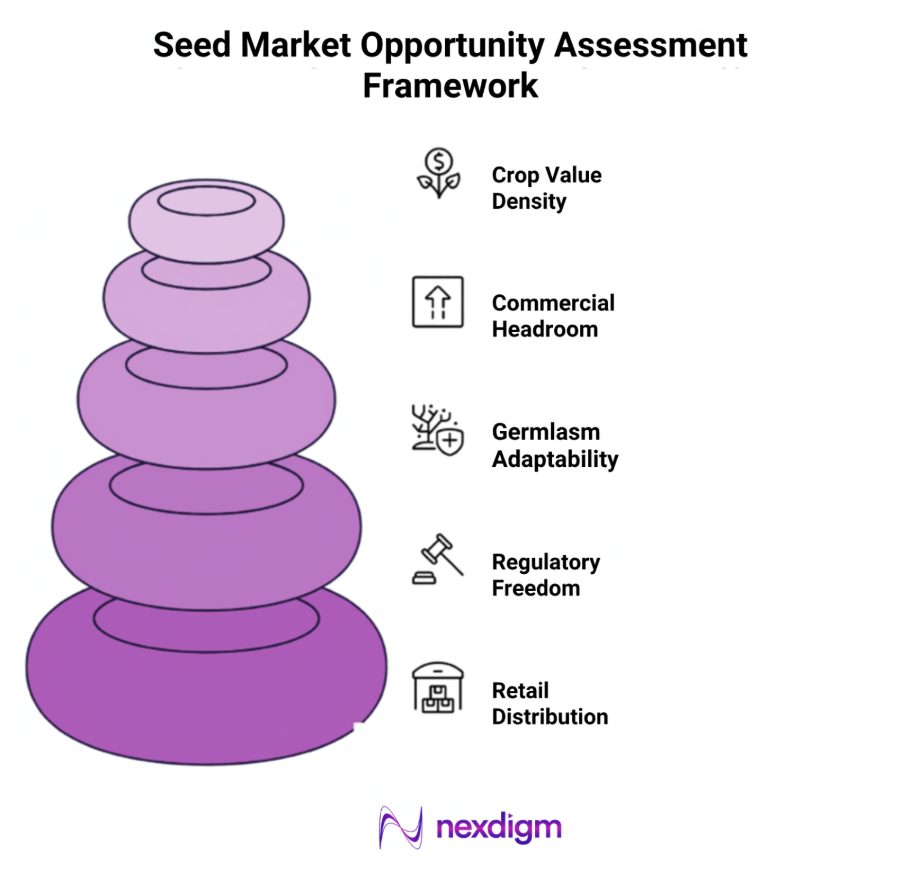
- Crop Value Density: Evaluate seed expenditure per acre against total crop value to determine how much room farmers have for premium genetics and differentiated products.
- Commercial Headroom Score: Measure the gap between current commercial seed penetration and the realistically addressable conversion opportunity, accounting for farm-saved seed practices.
- Germplasm Adaptability Index: Assess yield stability, disease resistance and tolerance to drought, heat and other local stresses across the target agro-ecological zones.
- Regulatory and Price Freedom: Examine seed registration requirements, pricing interventions, trait royalties and germplasm licensing constraints that could affect returns.
- Retail Distribution Depth: Map distributor and retailer coverage, counter-share concentration, seasonal credit exposure and channel capability across priority districts.
These filters allow companies to move from a broad national market map to a prioritised list of crop-region opportunities, while also identifying where product development, channel investment or regulatory work may be required before entry.
Case Study: Prioritising the First Market
A seed company screened 22 crop-region combinations across five Indian states, representing a combined addressable seed market of approximately $640 million. The assessment identified hybrid maize in three eastern districts as the strongest initial opportunity, with commercial penetration at 61%, estimated farmer-level yield improvement of 18% and an addressable acreage of 1.7 million acres. A targeted launch covering 12% of the addressable market was projected to generate 204,000 seed-unit-equivalent sales in the first year and INR 74 crore in annual revenue by Year 3.
To take the next step, simply visit our Request a Consultation page and share your requirements with us.
Harsh Mittal
+91-8422857704