

Seed markets span premium hybrids, certified varieties, and affordable mass-market products, each requiring distinct price positioning and value communication. Seed market competitive pricing analysis helps producers, distributors, investors, and agribusinesses compare competitor prices, genetic traits, yield performance, pack sizes, channel margins, and farmer affordability.
With structured Pricing Analysis, businesses can identify price gaps, validate premium potential, optimize portfolio tiers, and improve market-entry decisions. This evidence-led approach supports stronger brand differentiation, sustainable margins, and responsive pricing strategies across cereals, oilseeds, vegetables, pulses, and specialty seed categories in diverse agricultural markets globally.
The global seeds market is estimated to rise from US$63.44 billion in 2025 to US$67.26 billion in 2026, representing approximately 6% annual growth. This expansion supports continuous pricing analysis, competitor benchmarking, and value-based positioning across premium and mass-market seed categories worldwide today.
Segment-Based Pricing Analysis for Competitive Seed Market Growth
Segment-based pricing analysis enables seed companies to align prices with customer needs, product value, and market dynamics, strengthening competitiveness, profitability, and portfolio performance across premium and mass-market seed categories. Some important elements in focus during Pricing Analysis Process are:
- Seed Adoption Readiness: Measures farmer awareness, trial intent, switching barriers, agronomic confidence, and expected returns to align pricing with each segment’s readiness to adopt improved seeds.
- Yield-to-Price Value Index: Compares expected yield gains, input savings, crop quality, and revenue potential against seed cost to quantify value across premium and mass-market categories.
- Farm Economics Segmentation: Groups buyers by acreage, crop intensity, financing access, risk tolerance, and income cycles to develop prices that reflect differing farm-level economics.
- Trait-Based Price Analysis: Builds price tiers around drought tolerance, pest resistance, maturity duration, germination performance, and climate suitability to strengthen product differentiation and premium justification.
Nexdigm’s Strategic Pricing Advisory for Segment-Based Seed Market Growth
Nexdigm’s strategic Pricing Analysis advisory enables seed businesses to optimize prices across premium and mass-market segments through data-driven commercial insights. Nexdigm’s strategic engagement integrates seed market competitive pricing analysis, seed price benchmarking, competitive pricing strategy, customer segmentation analysis, value-based pricing, portfolio pricing optimization, market positioning, and pricing intelligence to strengthen differentiation, improve profitability, and accelerate sustainable growth across diverse agricultural seed markets.
Nexdigm’s Performance-Led Pricing Analysis Roadmap for Seeds Market
Nexdigm’s performance-led pricing roadmap connects agronomic outcomes, farmer economics, market demand, and competitive positioning to establish defensible premiums, accelerate adoption, and strengthen sustainable growth across high-value seed portfolios globally. Key steps of the roadmap are:
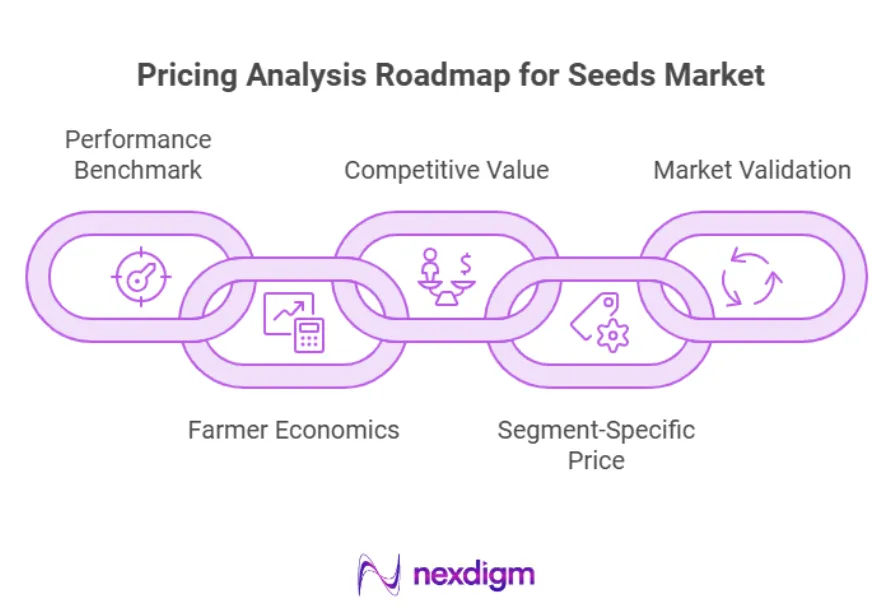
- Defining Performance Benchmark: Define measurable yield, germination, resilience, quality, and input-efficiency indicators to establish objective performance benchmarks for premium seed pricing across crops, regions, and farmer segments consistently.
- Farmer Economics Assessment: Quantify farmer returns by comparing seed premiums with yield gains, input savings, crop quality, risk reduction, and expected revenue across representative farm economics profiles carefully.
- Competitive Value Mapping: Benchmark competing varieties, trait packages, prices, pack sizes, channel incentives, and agronomic support to identify credible differentiation and defensible premium opportunity in target markets globally.
- Design Segment-Specific Price: Design segment-specific price corridors for commercial growers, progressive farmers, specialty producers, and early adopters based on affordability, value perception, purchasing behavior, and farm scale differences.
- Market Validation and Recalibration: Implement recommended prices, monitors field performance, adoption, repeat purchases, channel feedback, and realized margins, then recalibrate pricing as evidence, competition, and market conditions evolve continuously.
Nexdigm’s Case
Nexdigm supported a seed company refining performance-led pricing across premium varieties in three markets. Through agronomic benchmarking, farmer-return modelling, segment-specific pricing, and market validation, the engagement increased premium-seed adoption by 18%, improved average selling prices by 12%, accelerated repeat purchases by 15%, and strengthened portfolio profitability across priority crops.
To take the next step, simply visit our Request a Consultation page and share your requirements with us.
Harsh Mittal
+91-8422857704