

Seed procurement decisions influence agricultural productivity, input costs and the reliability of seasonal supply. For organisations sourcing seeds across multiple crops, varieties and regions, purchasing costs can become difficult to manage because products differ in genetic traits, quality parameters, treatment, packaging and commercial arrangements.
The Indian seed ecosystem is extensive and diverse. It includes public-sector institutions, private seed companies, regional producers, distributors and dealers. The market covers field crops, vegetables, horticulture and hybrid varieties, each with different demand patterns and pricing structures.
India’s availability of certified and quality seeds reached approximately 531.5 lakh quintals in 2024–25, reflecting the scale of the supply ecosystem. However, availability at the national level does not automatically translate into consistent pricing or reliable access for individual buyers. Regional distribution, crop-specific demand and supplier capabilities continue to influence procurement outcomes.
For organisations purchasing large seed volumes, seed procurement cost benchmarking services can provide visibility into price differences, supplier terms and opportunities for commercial improvement. The objective is to establish whether the organisation is paying a competitive price for equivalent seed quality and performance characteristics.
Why Seed Procurement Costs Vary
Variety and genetic characteristics affect pricing
Seed prices vary considerably according to crop type, variety, hybrid status and genetic traits. Hybrid seeds may carry different pricing structures from open-pollinated varieties, while products developed for specific disease resistance, maturity periods or environmental conditions may command a premium.
Even within the same crop category, two products may not be directly comparable. Germination rates, physical purity, genetic purity, seed treatment and certification status all influence the value of a procurement decision.
A basic price-per-kilogram comparison can therefore be misleading when the underlying product specifications differ.
Regional demand creates uneven price conditions
Seed requirements are closely linked to cropping patterns, sowing windows, climate and local agricultural practices. Demand for particular varieties can rise sharply before a seasonal planting period, placing pressure on inventory and distribution capacity.
The same variety may also be sold under different commercial conditions across regions because of differences in transportation, dealer margins, local competition and order volumes.
Organisations sourcing across several states need to understand whether these variations are justified by market conditions or reflect inconsistent procurement practices.
Commercial terms are not always visible in quoted prices
Seed procurement agreements may include volume discounts, dealer incentives, promotional schemes, credit periods, return arrangements and seasonal supply commitments.
Two suppliers offering similar base prices may therefore have very different commercial propositions. Differences in payment schedules, order minimums, replacement policies and delivery conditions can affect the actual cost of procurement.
These terms become particularly important when organisations purchase through multiple distributors or regional channels.
Quality failures can create costs beyond the purchase price
Seed quality is not simply a compliance consideration. Poor germination, inconsistent varietal characteristics, inadequate treatment or weak batch traceability can result in operational losses and reputational consequences.
Procurement teams must therefore consider supplier quality systems, testing procedures, certification and product traceability alongside price competitiveness.
A supplier offering a lower rate may create higher downstream costs if quality assurance is inconsistent or replacement support is inadequate.
Where Buyers May Be Losing Commercial Value
Several procurement practices can create avoidable expenditure:
- Comparing seed prices without standardising variety, treatment and quality specifications.
- Purchasing the same or comparable varieties at different rates across locations.
- Failing to account for discounts, incentives and credit terms.
- Maintaining excessive dependence on a limited number of seed suppliers.
- Overlooking seasonal procurement opportunities and demand consolidation.
- Evaluating suppliers primarily on price rather than quality and delivery performance.
The challenge is to distinguish between legitimate product premiums and unexplained price differences. A higher-priced variety may offer meaningful agronomic advantages, while a similar price premium without a corresponding quality or performance benefit may indicate an opportunity for renegotiation.
How Organisations Can Improve Seed Procurement Decisions
A structured cost assessment should begin by creating a standardised product and supplier database. This should capture crop, variety, hybrid status, seed treatment, pack size, quality specifications, supplier, region and transaction price.
Procurement teams should then compare actual purchase prices with supplier quotations and commercial terms. Historical pricing can help identify seasonal patterns, while external supplier research can reveal alternative sources and market positioning.
Quality assessment should remain part of the same process. Germination performance, certification, batch consistency, traceability and replacement policies need to be evaluated before a lower-priced alternative is accepted.
Nexdigm supports organisations through supplier benchmarking, market intelligence, category research and procurement cost analysis. Its research can help buyers understand supplier positioning, evaluate commercial terms and identify cost optimisation opportunities across seed procurement categories.
Seed Procurement Cost Benchmarking Framework
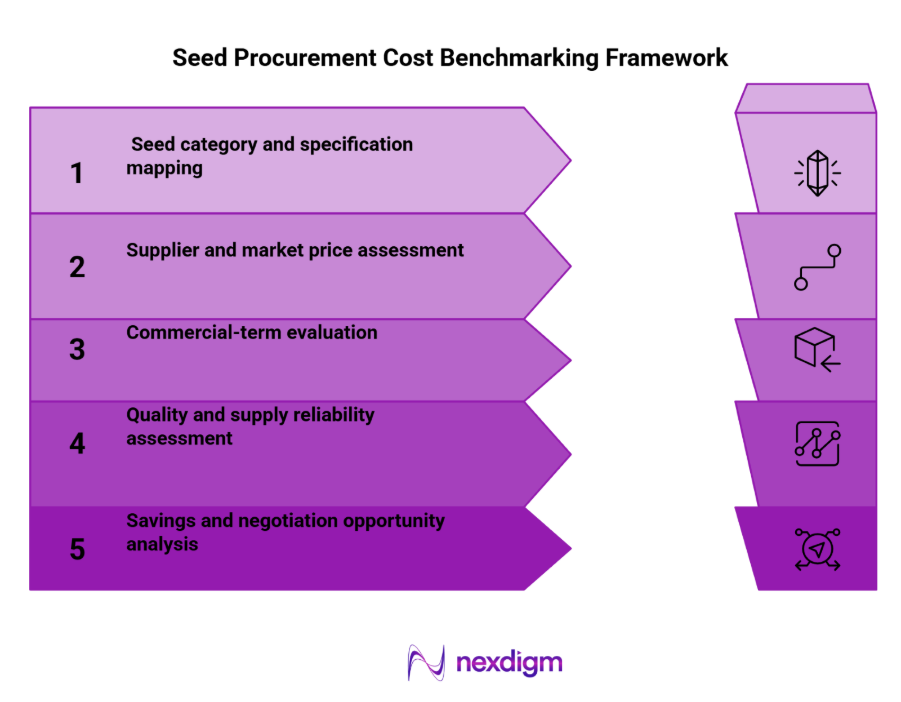
- Seed category and specification mapping
Segment procurement by crop, variety, hybrid type, treatment, pack size and quality parameters. Establish comparable product groups before evaluating price differences. - Supplier and market price assessment
Map public and private seed suppliers, regional producers and distributors. Compare prices across equivalent products while examining supplier market positioning and availability. - Commercial-term evaluation
Assess volume discounts, rebates, credit periods, seasonal incentives, minimum order quantities and replacement arrangements. Calculate the effective purchase cost after accounting for these conditions. - Quality and supply reliability assessment
Review certification, germination standards, batch traceability, testing procedures, delivery performance and quality-related claims. Consider the financial implications of inconsistent supply or product performance. - Savings and negotiation opportunity analysis
Identify categories with unexplained price variation, overlapping supplier relationships or fragmented purchasing volumes. Prioritise opportunities for consolidated sourcing, improved contract terms and competitive supplier selection.
Nexdigm’s Case Study: Identifying Seed Procurement Price Variance
Nexdigm benchmarked seed procurement across 6 crop categories, 4 regions and 15 suppliers. The assessment identified price differences of up to 11% among comparable products and developed a negotiation roadmap covering volume consolidation, commercial terms and supplier diversification.
To take the next step, simply visit our Request a Consultation page and share your requirements with us.
Harsh Mittal
+91-8422857704