

Seed procurement decisions have consequences that extend well beyond the purchasing budget. The variety selected, supplier chosen and timing of procurement can influence crop establishment, production planning and the reliability of agricultural supply chains. For organisations sourcing seeds across multiple crops and regions, the challenge is to identify suppliers that offer competitive prices without creating quality or availability risks.
The Indian seed market includes public-sector institutions, private seed companies, regional producers, distributors and dealers. Buyers may source certified seeds, hybrid varieties, open-pollinated varieties and specialised products depending on crop requirements and intended use.
These products differ in genetic characteristics, germination performance, physical purity, treatment, packaging and availability. A supplier offering the lowest quoted price may not provide the best commercial value if the seed has inconsistent quality, limited traceability or unreliable delivery performance.
Seed procurement research and benchmarking helps organisations compare sourcing options using a broader set of commercial and operational criteria. It provides visibility into supplier pricing, product quality, market alternatives and the risks associated with different procurement channels.
Why the Cheapest Seed Option May Not Be the Best
Variety and performance differences affect value
Seed prices vary according to crop type, variety, hybrid status and genetic traits. Products developed for specific maturity periods, disease resistance or environmental conditions may carry a premium.
However, a higher price does not automatically establish superior value. Buyers need to understand whether the product’s characteristics are relevant to the intended crop and growing conditions.
Comparisons should consider germination rates, physical and genetic purity, seed treatment, certification and other applicable quality specifications. Without this information, procurement teams may compare products that are not technically equivalent.
Quality inconsistencies can create downstream losses
Seed quality is central to successful crop establishment. Poor germination, contamination, inconsistent varietal characteristics or inadequate storage can affect planting outcomes and increase the need for replacement or corrective action.
The commercial impact may extend beyond the original purchase. Delays in identifying quality problems can affect sowing schedules, operational planning and relationships with distributors or end customers.
Procurement teams therefore need to evaluate quality assurance systems and batch-level documentation as part of supplier selection.
Seasonal availability can narrow sourcing choices
Seed demand is concentrated around crop-specific planting windows. Buyers that delay procurement may encounter limited availability of preferred varieties, longer delivery times or higher dependence on intermediaries.
Supplier capacity and distribution coverage are particularly important when organisations require large quantities across multiple regions. A supplier may offer an attractive price but lack the inventory or logistics network needed to fulfil orders within the required period.
Commercial terms can change the effective purchase price
Seed procurement agreements may include volume discounts, seasonal incentives, credit periods, minimum order quantities and replacement arrangements. These terms can materially influence the effective cost of procurement.
A supplier offering a lower base price may require larger advance orders or provide less favourable replacement support. Another supplier may offer a slightly higher price but provide better credit terms, delivery commitments and quality assurance.
The commercial comparison must account for the full arrangement rather than focusing on one quotation figure.
Which Procurement Options Should Buyers Evaluate?
Different sourcing channels offer different advantages and constraints.
- Direct manufacturer procurement may provide stronger access to product information, volume-based negotiations and clearer quality documentation. However, minimum order quantities and regional delivery arrangements may limit its suitability for smaller or geographically dispersed requirements.
- Authorised distributors and dealers can provide local availability, established relationships and more flexible order sizes. Their commercial offers may vary depending on regional margins, inventory and manufacturer arrangements.
- Public-sector and cooperative channels may offer access to specific seed categories and established distribution networks. Buyers should assess product suitability, availability, documentation and procurement timelines for their particular requirements.
- Regional seed producers may provide access to locally relevant varieties and shorter distribution routes. Supplier capacity, certification and quality consistency should be evaluated carefully before relying on these sources for critical volumes.
No single channel is necessarily the best option across every crop and region. A diversified sourcing approach may provide a more appropriate balance of price, quality and availability.
How to Select the Right Seed Suppliers
Organisations should begin by defining product requirements and quality thresholds for each crop category. Supplier quotations can then be compared against equivalent varieties, specifications, pack sizes and delivery locations.
The next step is to examine supplier performance and market alternatives. This includes production capacity, geographic coverage, inventory availability, certification, traceability and quality assurance practices.
Procurement teams should also assess the commercial terms associated with each sourcing option. Discounts, payment conditions, replacement policies and delivery commitments should be considered alongside the purchase price.
Nexdigm supports organisations through market research, supplier mapping, price benchmarking and commercial assessment. Its research can help buyers understand the seed supplier landscape, compare sourcing alternatives and identify procurement strategies that balance cost with supply reliability.
Seed Procurement Research and Benchmarking Framework
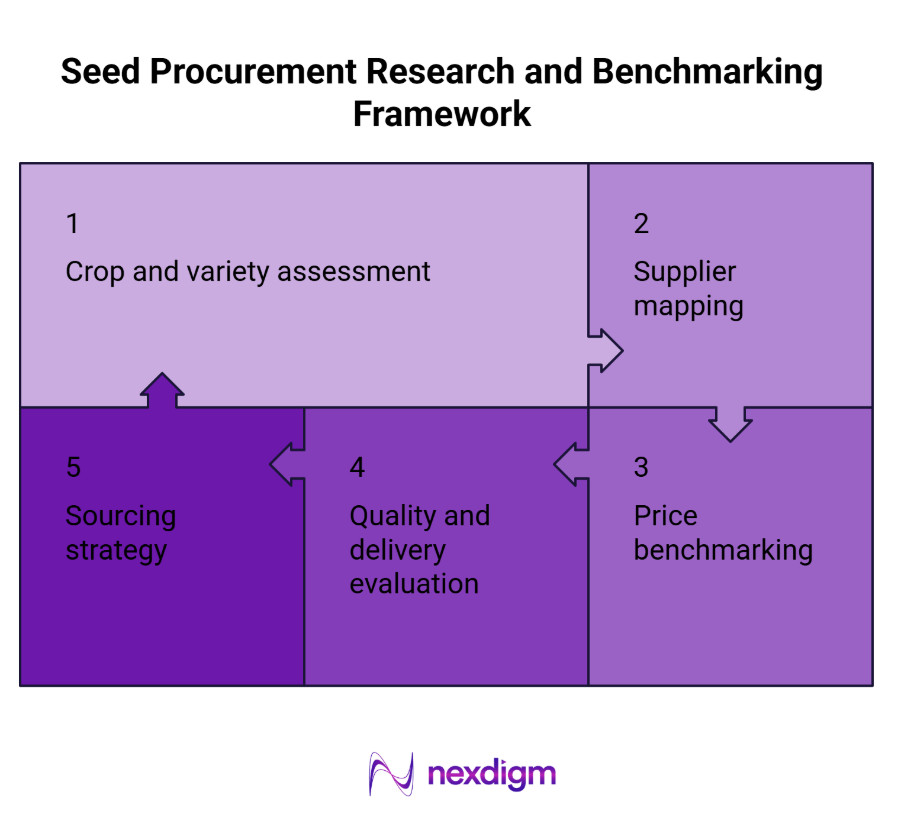
- Crop and variety requirement assessment
Define procurement requirements by crop, variety, hybrid status, seed treatment, pack size and quality specifications. Separate critical products from categories where approved alternatives may be available. - Supplier and sourcing-channel mapping
Identify manufacturers, public-sector suppliers, regional producers, distributors and authorised dealers. Assess their market presence, geographic coverage, product range and ability to meet volume requirements. - Price and commercial-term benchmarking
Compare quotations across equivalent products and include volume discounts, credit periods, seasonal incentives, minimum order quantities and replacement policies. Calculate the effective cost under each sourcing arrangement. - Quality and delivery reliability evaluation
Review certification, germination standards, purity, batch traceability, storage practices and supplier quality controls. Assess historical delivery performance and the supplier’s ability to meet seasonal requirements. - Sourcing strategy and supplier prioritisation
Rank suppliers according to cost competitiveness, product suitability, quality assurance and supply reliability. Identify opportunities for direct sourcing, regional supplier development, distributor partnerships or a diversified supplier portfolio.
Nexdigm’s Case Study: Evaluating Seed Sourcing Alternatives
Nexdigm assessed seed suppliers across 5 crop categories, 4 regions and 16 sourcing options. The research identified 3 priority supplier groups and a potential 8% procurement cost improvement through commercial renegotiation and regional sourcing alternatives.
To take the next step, simply visit our Request a Consultation page and share your requirements with us.
Harsh Mittal
+91-8422857704