

A seed supplier’s catalogue may look impressive, but catalogue size alone says little about whether its products will meet an agribusiness’s requirements. A variety suited to one agro-climatic zone may perform inconsistently in another. A supplier may offer competitive pricing but struggle to deliver enough before the sowing window.
Even where seed quality is satisfactory at dispatch, inadequate storage and handling can affect its condition before it reaches the farmer.
For seed companies, agricultural input distributors, institutional buyers and large farming operations, seed supplier analysis needs to examine the complete supply proposition. This means assessing varietal suitability, germination quality, seed availability, production capacity, distribution coverage and commercial reliability together.
Start with the Variety Portfolio
A supplier should be evaluated according to the crops and growing conditions it can support, not simply the number of varieties it offers. Portfolio breadth is valuable when buyers serve multiple regions or crop segments, but relevance matters more than volume.
For example, a supplier specialising in hybrid maize may offer strong commercial value to buyers serving high-input maize-growing regions. However, an organisation sourcing pulses, oilseeds, cereals and horticultural seeds may require a broader portfolio or a combination of specialist suppliers.
The assessment should establish crop coverage, availability of hybrids and open-pollinated varieties, maturity periods, yield characteristics and suitability for different growing conditions. Resistance or tolerance traits relevant to local pests, diseases and environmental stresses should also be examined.
Variety selection needs credible agronomic evidence. Trial results, university recommendations, field demonstrations and multi-location performance records are more useful than promotional claims alone.
India’s seed development ecosystem illustrates the scale of varietal activity. A July 2026 government update reported that 3,236 field crop varieties had been released and notified between 2014 and 2025, including 2,996 climate-resilient varieties. This growing range makes it increasingly important for buyers to distinguish between the number of varieties available and their suitability for specific production environments.
Seed Quality Must Be Verified Beyond the Label
Germination percentage is one of the most visible indicators of seed quality, but it should not be treated as a complete assessment. A batch may meet the declared germination standard while still presenting concerns relating to physical purity, moisture, seed health or storage conditions.
A supplier evaluation should examine five quality dimensions:
- Germination and vigour: Germination testing establishes the proportion of seeds capable of producing normal seedlings under prescribed conditions. Vigour testing provides additional insight into how seeds may perform under less-than-ideal field conditions.
- Physical purity: Testing should identify inert matter, weed seeds and seeds belonging to other crops or varieties.
- Moisture and storage: Excess moisture and unsuitable storage conditions can reduce seed viability. Buyers should review warehouse conditions, packaging integrity, handling procedures and stock rotation.
- Seed health: Depending on the crop, seed-borne pathogens and other biological contaminants may affect establishment and subsequent crop performance.
- Traceability: Suppliers should be able to identify seed lots, testing records, production locations, packaging dates and applicable certification details.
Procurement teams should request recent test reports and establish a sampling protocol for incoming consignments. Testing requirements should reflect applicable regulations and crop-specific standards.
Availability Is a Supply Planning Question
A supplier’s ability to meet demand at the right time can be just as important as its product quality. Seed demand is seasonal, and delayed deliveries can leave buyers with limited alternatives once planting windows begin to close.
Organisations should examine production capacity, inventory visibility, seed multiplication arrangements, processing infrastructure and the supplier’s ability to allocate stock across regions. They should also understand how the supplier manages demand fluctuations caused by weather patterns, changing crop prices or unexpected shifts in planting decisions.
India’s official seed-sector reporting indicates that certified and quality seed availability reached approximately 531.5 lakh quintals in 2024–25, against an estimated requirement of 482 lakh quintals. Aggregate national availability, however, does not guarantee that a particular crop variety will be available in the required district, quantity or delivery window. Procurement decisions therefore need to be based on local and crop-specific availability.
Distribution Reach and Commercial Reliability
A supplier with strong production capabilities may still have limited reach beyond its established markets. Buyers sourcing across several states should examine distributor networks, regional warehouses, dealer relationships and last-mile delivery arrangements.
Commercial evaluation should extend beyond the quoted price. Credit terms, minimum order quantities, replacement policies, delivery commitments and technical support can all influence the value of a supplier relationship. The supplier’s ability to support distributors after delivery also matters. Product information, agronomic guidance and complaint resolution can influence adoption and long-term channel relationships.
How Nexdigm Supports Seed Supplier Research
Nexdigm supports organisations through market research, supplier intelligence, competitive benchmarking and procurement analysis. Its research can help clients evaluate seed supplier portfolios, assess regional availability, compare commercial propositions and identify potential sourcing partners across crop categories. This enables buyers to make supplier decisions based on a broader view of quality, supply capability and market reach.
Seed Supplier Evaluation Framework
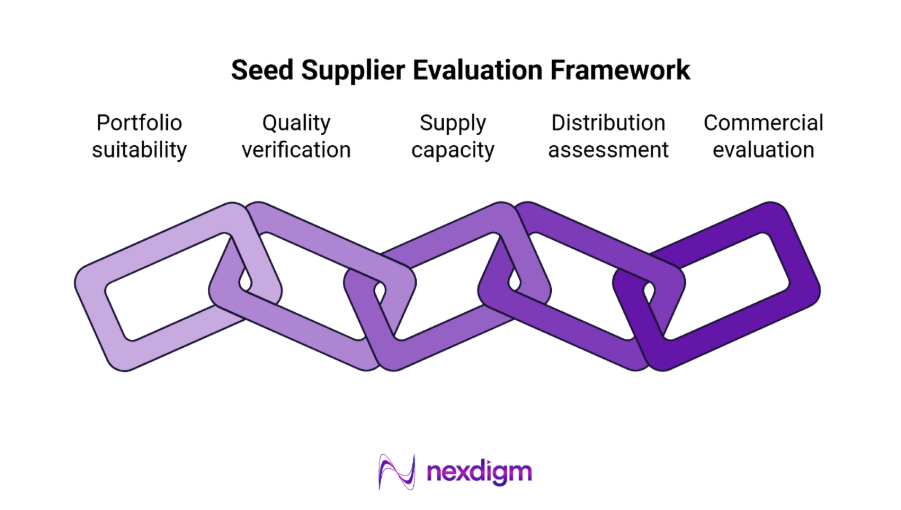
- Portfolio suitability: Compare crop coverage, varietal diversity, maturity characteristics and regional relevance.
- Quality verification: Review germination, vigour, purity, moisture, seed health and batch documentation.
- Supply capacity: Examine production arrangements, inventory availability, storage infrastructure and seasonal fulfilment.
- Distribution assessment: Evaluate dealer networks, warehouse coverage, delivery performance and technical support.
- Commercial evaluation: Compare pricing, credit terms, replacement policies and long-term supplier reliability.
Nexdigm’s Case Study: Evaluating Seed Supplier Capabilities
To help buyers move beyond national supply averages to reliable, region-specific sourcing, Nexdigm evaluated 14 seed suppliers across six crop categories and nine agricultural markets, narrowing the field to five commercially viable partners backed by a 32-parameter quality and portfolio screen.
To take the next step, simply visit our Request a Consultation page and share your requirements with us.
Harsh Mittal
+91-8422857704