

A shipping forecast built from world trade growth alone can miss the commercial variable that matters most: how much vessel time is needed to move a particular cargo mix across the routes that actually carry it. UNCTAD reported that maritime trade expanded 2.2% in 2024, while ton-miles rose about 5.9% as vessels took longer routes around disrupted chokepoints. For a carrier, those two measures describe different things. Cargo volume is the physical work presented by shippers; ton-miles approximate the transport work demanded of the fleet.
The WTO’s October 2025 outlook also illustrates why a single growth assumption is fragile. Its merchandise trade forecast moved sharply as tariff expectations, front-loading and subsequent policy changes altered ordering patterns. A forecast should therefore distinguish a brief pull-forward of containerized goods from durable trade creation, and separate value growth from tonnage. Higher-value electronics can lift trade value without adding equivalent ship load; a change in iron ore or grain flows can have the opposite effect.
Cargo Mix Changes the Vessel Equation
Container, dry-bulk and tanker demand respond to distinct commodity cycles and ship classes. Container demand is sensitive to manufactured goods, inventory cycles and the number of origin-destination pairs.
Dry bulk is tied to iron ore, coal, grains, fertilizers and bauxite, with cargo size and loading patterns affecting vessel class.
Tanker demand reflects crude and product trade, refinery location and the balance between long-haul and regional supply.
Aggregating these into one maritime growth rate conceals both the ships required and the ports they must serve.
Commodity-level analysis also captures substitution.
A steel producer switching between imported ore and scrap, a power system replacing coal with gas, or a refinery shifting crude grades can change seaborne volumes and vessel compatibility without a matching shift in GDP.
The forecast should use tonnes by commodity and lane before translating them into vessel calls, parcel sizes, and utilization.
Distance, Disruption, and Effective Supply
Capacity is not just the number of ships on the register. Longer voyages absorb days that would otherwise support another rotation. Congestion, canal restrictions, weather, speed limits and slow steaming further reduce available slot-days.
Meanwhile, deliveries, demolitions, dry-docking and fleet age change nominal supply.
UNCTAD’s 2025 maritime review recorded a global fleet of roughly 112,500 commercial vessels at the start of the year, but that total is not a direct measure of capacity available to a specific operator or lane.
A carrier should model capacity in ship-days or slot-days by vessel class and trade lane. Start with forecast cargo tonnes, convert them into suitable vessel demand, apply average voyage distance and turnaround time, then adjust for utilization and schedule reliability. A disruption case should alter route distance and port dwell time explicitly instead of hiding the effect inside a higher demand-growth rate.
Fleet orders need delivery dates and scrapping assumptions, not just announced tonnage.
A Five-Part Framework for Converting Trade Growth Into Fleet Demand
A robust shipping demand forecasting model should move through five linked decisions rather than applying one headline trade-growth rate to the fleet.
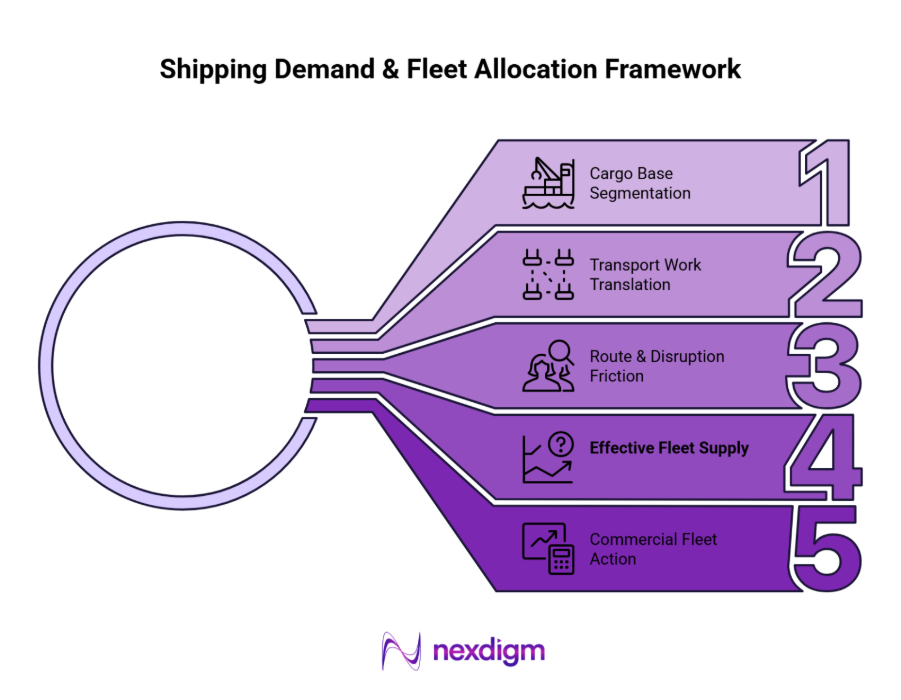
- Establish the Cargo Base
Start with tonnes rather than trade value. Segment demand by commodity, vessel type, origin-destination pair and expected growth driver. This establishes which cargo is actually generating transport demand and prevents high-value, low-weight goods from distorting the forecast. - Translate Cargo Into Transport Work
Convert cargo volumes into vessel demand using parcel sizes, average haul distances, vessel suitability and expected sailing patterns. Ton-miles provide a useful bridge between cargo growth and fleet requirements because two markets with similar volume growth can create very different capacity needs when their average voyage distances diverge. - Model the Route Effect
Test how chokepoint disruption, canal restrictions, congestion and changes in port turnaround affect vessel utilisation. The objective is to estimate the additional ship-days or slot-days created by longer voyages rather than treating disruption as an unexplained increase in demand. - Build Effective Fleet Supply
Separate nominal fleet growth from usable capacity. Account for vessel deliveries, scrapping, dry-docking, ageing, speed assumptions and schedule reliability. This reveals whether additional ships are genuinely required or whether existing assets can absorb demand through redeployment, faster turnaround or improved utilisation. - Convert the Gap Into a Fleet Action
The final output should identify the appropriate response by lane and vessel class. A small, temporary shortfall may favour time-chartering or redeployment. A persistent structural gap may support newbuilding or long-term charter commitments. Where demand is uncertain, scenario analysis can show the utilisation threshold at which each option becomes commercially preferable.
From Forecasting to a Capacity Decision
Nexdigm’s market assessment can connect trade, commodity flows and lane-level operating assumptions into a capacity decision. The useful output is not a single global number but a range: the ships and sailing frequency needed by lane, the sensitivity to rerouting, and the point at which chartering, redeployment or newbuilding becomes preferable. Management can then see whether the binding constraint is cargo growth, voyage length or effective fleet availability.
Nexdigm Case
Nexdigm assessed fleet requirements across six Asia-Europe and intra-Asia lanes for a global carrier, covering three vessel classes and multiple demand scenarios. The analysis converted commodity-level trade forecasts into slot-day requirements and incorporated vessel deliveries, retirements and port delays. It identified a 9% effective-capacity gap across two lanes, supporting short-term chartering while informing the carrier’s newbuild planning.
To take the next step, simply visit our Request a Consultation page and share your requirements with us.
Harsh Mittal
+91-8422857704