

For a shipping line entering a new market, the largest port is not necessarily the strongest commercial opportunity. Headline throughput can conceal captive cargo, entrenched carrier relationships, poor hinterland connectivity or inefficient terminal operations. The better entry point is the combination of port, trade lane and customer base that can generate contestable cargo at sustainable yields.
Start With Contestable Cargo, Not Port Throughput
Port-level cargo statistics provide scale, but they do not show how much business is actually available to a new carrier. A large gateway may handle substantial volumes from dedicated industrial facilities or long-standing carrier relationships, leaving considerably less cargo open to competitive bidding.
The first screen should therefore isolate containerized EXIM cargo that can realistically be won. Freight forwarders, manufacturers, retailers and other independent shippers provide a more useful picture of addressable demand than total port throughput.
India’s major ports handled 915.17 million tonnes of cargo in FY2025–26, up 7.06% year-on-year. That growth confirms expanding maritime activity, but it does not by itself indicate where a new liner should deploy capacity.
The Trade Lane Determines the Commercial Case
Port selection follows trade-lane economics. A route with strong export demand but limited imports can leave containers stranded at the destination and increase repositioning costs. A balanced corridor with complementary cargo flows can support better equipment utilization.
Commodity mix matters as well. Pharmaceuticals, electronics, automotive components and temperature-sensitive products may support different yields and service requirements from lower-value bulkier cargo. The assessment should therefore examine shipment volumes, commodity composition, freight rates, directional balance and competitive capacity together.
Port Efficiency Extends Beyond the Berth
A competitive port call depends on what happens before and after the vessel berths. Vessel turnaround, terminal productivity, yard congestion, gate movement and hinterland evacuation all affect schedule reliability and container velocity.
India’s average turnaround time at major ports improved to 48.84 hours in FY2025–26, from 52.87 hours in FY2021–22. But performance varies significantly by gateway. Jawaharlal Nehru Port recorded 27.43 hours in FY2025–26, while several other major ports recorded turnaround times above 55 hours.
For a shipping line, this variation affects vessel scheduling, equipment utilization and the reliability of advertised service frequencies. A port with lower headline cargo volumes can therefore become more attractive if its operating performance supports a more reliable network.
The Hinterland Can Decide the Winning Port
Container demand does not end at the terminal. The ability to move cargo efficiently into the hinterland determines how large the commercially accessible catchment really is.
Road and rail connectivity, inland container depots, freight corridors and multimodal logistics facilities can expand a port’s effective market beyond its immediate geography. This is particularly important as India’s logistics infrastructure develops around dedicated freight corridors and multimodal nodes.
The relevant question is whether a port can connect a shipping line to a sufficiently large customer base at a competitive end-to-end cost, rather than whether the port itself reports high annual throughput.
Agents Can Strengthen or Weaken Market Entry
A shipping line also enters through its commercial and agency network. Local agents influence access to freight forwarders, exporters, importers and other cargo owners, while also supporting documentation, port coordination and regulatory compliance.
Agent selection should therefore consider customer relationships, commercial capability, financial strength, compliance record, technology infrastructure and operational responsiveness. A well-connected port with weak commercial representation may generate less bookable cargo than a smaller gateway with stronger local relationships.
How Nexdigm Screens Ports, Agents and Trade Lanes
Nexdigm’s shipping line distribution entry strategy services can evaluate six areas before capacity is committed:
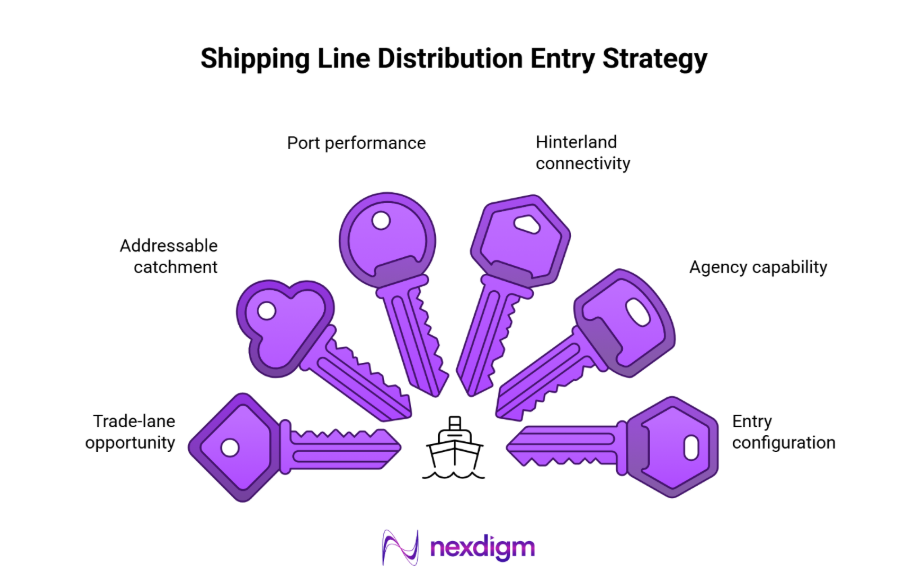
- Trade-lane opportunity: Assess container volumes, commodity mix, freight yields and directional cargo balance.
- Addressable catchment: Separate contestable EXIM cargo from captive and strategically committed volumes.
- Port and terminal performance: Evaluate turnaround, yard conditions, terminal productivity, draft and vessel-handling capabilities.
- Hinterland connectivity: Map Road, rail, ICD, DFC and multimodal connections supporting the port’s cargo catchment.
- Agency capability: Assess customer access, sales coverage, financial strength, compliance and operational capabilities of potential agents.
- Entry configuration: Determine the appropriate port, lane, service frequency, partner structure and phased capacity commitment.
The result is a prioritized entry map linking commercial cargo potential with operational feasibility.
Nexdigm Case: Screening International Freight Partners
In an international freight and network expansion engagement, Nexdigm evaluated potential partners across multiple high-growth commercial markets. The assessment screened more than 60 distributors, examined eight capability and compliance parameters, and mapped requirements across 15 cities.
The process shortlisted 12 qualified partners, providing a structured basis for international network expansion while reducing projected execution and operational risks by 30%.
For a shipping line, the same principle applies at the port and trade-lane level: the strongest entry point is the one where addressable cargo, network economics, infrastructure and local execution capability reinforce each other.
To take the next step, simply visit our Request a Consultation page and share your requirements with us.
Harsh Mittal
+91-8422857704