

International shipping remains central to global trade, with businesses relying on container shipping lines to move raw materials, components and finished goods across markets. Selecting a shipping line, however, involves more than comparing freight rates. Route availability, vessel capacity, sailing frequency, schedule reliability and port connectivity all influence the cost and predictability of international shipments.
For procurement teams, the challenge is identifying carriers that can support specific trade lanes while maintaining consistent service levels and commercially viable contracts.
Why Shipping Line Supplier Evaluation Matters
Shipping lines operate across different geographical networks, vessel categories and service models. Some carriers offer extensive global coverage, while others focus on specific trade corridors or regional markets.
UNCTAD estimates that approximately 80% of international trade in goods by volume is carried by sea. Its Review of Maritime Transport 2025 also highlights how geopolitical disruptions, port congestion and vessel rerouting have affected shipping costs and schedule reliability.
These conditions make supplier evaluation particularly important for businesses dependent on predictable shipping schedules.
Key procurement considerations include:
- Route coverage: Availability of direct services, transshipment connections and access to major commercial ports.
- Vessel capacity: Container availability, vessel size, equipment types and capacity allocation.
- Schedule reliability: Departure frequency, arrival consistency and historical delays.
- Port connectivity: Access to origin and destination ports, terminal infrastructure and inland transportation connections.
- Commercial competitiveness: Freight rates, surcharges, detention charges and contractual terms.
Comparing Vessel Capacity and Route Networks
A shipping line’s network should be assessed against the organisation’s actual trade requirements.
A carrier may have a substantial global fleet but limited direct connectivity on a particular route. Similarly, a provider offering frequent sailings may rely on transshipment hubs that increase transit time and handling complexity.
Procurement teams should compare:
- Trade lane coverage: Identify direct and connecting services across priority origin-destination pairs.
- Vessel deployment: Examine vessel sizes, service frequency and capacity allocation.
- Container availability: Assess access to standard, refrigerated, open-top and other specialised containers.
- Port access: Review terminal presence, port call frequency and congestion exposure.
- Alternative routing: Determine whether the carrier can offer alternative services during disruptions.
Vessel capacity should also be evaluated against seasonal demand. Businesses exporting agricultural products or consumer goods may experience significant fluctuations in shipping requirements during peak periods.
Assessing Schedule Reliability and Total Shipping Cost
Schedule reliability has a direct effect on inventory planning, production schedules and customer commitments.
Procurement teams should distinguish between published transit times and actual end-to-end performance. A vessel arriving at its destination port does not necessarily mean the shipment is immediately available for collection.
Relevant performance indicators include:
- On-time vessel arrival percentage.
- Average schedule deviation.
- Port waiting and turnaround times.
- Transshipment delay frequency.
- Container availability rates.
- Documentation and release turnaround time.
Commercial benchmarking should consider the total shipping cost, including base freight, bunker adjustment factors, peak season surcharges, terminal handling, documentation and detention or demurrage charges.
Comparing quotations without standardising these components can produce misleading procurement decisions.
Shipping Line Supplier Research Framework
A structured shipping line supplier research exercise should assess carrier capabilities across five dimensions:
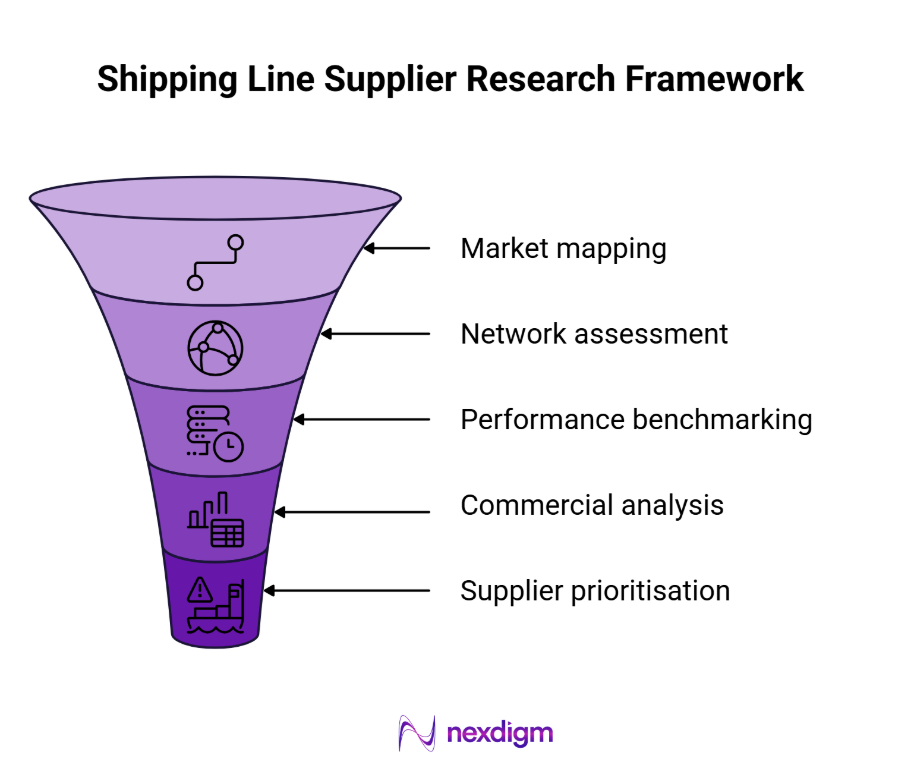
- Market mapping: Identify shipping lines operating across priority trade corridors and target ports.
- Network assessment: Compare direct connections, transshipment routes, sailing frequency and vessel deployment.
- Performance benchmarking: Evaluate schedule reliability, transit times, port delays and equipment availability.
- Commercial analysis: Compare freight rates, surcharges, contract terms and additional charges.
- Supplier prioritisation: Develop a weighted scorecard based on route criticality, service quality, capacity and total cost.
Nexdigm can support organisations through shipping market research, carrier mapping, supplier benchmarking and commercial intelligence. These assessments help procurement teams understand differences between shipping providers and identify carriers suited to their trade lane requirements.
Nexdigm’s Case Study
Nexdigm evaluated 12 shipping lines across 6 international trade lanes, comparing vessel capacity, sailing frequency, schedule reliability and freight costs. The assessment identified 4 preferred carriers, uncovered an 18% variation in comparable freight quotations and helped the client develop a lane-specific supplier allocation strategy.
To take the next step, simply visit our Request a Consultation page and share your requirements with us.
Harsh Mittal
+91-8422857704