

Entering an international shipping trade lane can create significant growth opportunities, but success depends on more than cargo volumes. Freight rates, port access, carrier competition, infrastructure, transit times, and customer demand all influence whether a route can support sustainable commercial returns.
Global maritime trade remains the backbone of international commerce, carrying more than 80% of goods traded worldwide by volume. However, UNCTAD expects maritime trade growth to slow to approximately 0.5% in 2025, highlighting the importance of carefully selecting attractive routes and markets.
For shipping companies, freight forwarders, logistics providers, exporters, importers, ports, infrastructure developers, and investors, the key question is if the trade lane is attractive enough to justify market entry.
A shipping market entry feasibility research study helps evaluate cargo potential, freight rates, customer demand, infrastructure, operating costs, and future growth to help organizations determine where entering a shipping market can create commercially viable opportunities.
Cargo Demand Driving Market Potential
Cargo demand is the foundation of any trade lane opportunity. Volume trends, commodity mix, trade flows, seasonality, customer concentration, and growth potential determine whether a route can support sustainable operations. In some markets, high-value or specialized cargo can create attractive opportunities even when volumes are relatively modest.
Freight Economics Influencing Commercial Viability
Freight rates have a direct impact on route profitability. However, rates can fluctuate due to vessel availability, fuel costs, congestion, seasonality, and changing supply-demand dynamics. Understanding whether pricing conditions are temporary or sustainable is critical when evaluating market attractiveness.
Port Infrastructure in Supporting Service Reliability
Strong cargo demand alone does not guarantee a viable opportunity. Port capacity, handling efficiency, vessel connectivity, congestion levels, and hinterland access all influence service reliability and operational performance. Infrastructure constraints can significantly limit the attractiveness of an otherwise promising trade lane.
How Nexdigm Evaluates Trade Lane Attractiveness
Nexdigm’s Shipping Market Entry Feasibility Study evaluates trade lane attractiveness through a comprehensive assessment of commercial, operational, and market factors that influence long-term success.
- Cargo Demand Assessment: Evaluates cargo volumes, commodity mix, trade flows, customer concentration, seasonality, and growth trends to determine whether sufficient demand exists to support sustainable operations.
- Freight Market Analysis: Assesses freight rate trends, pricing dynamics, market volatility, vessel availability, and supply-demand conditions to evaluate the commercial viability of a trade lane.
- Infrastructure and Port Evaluation: Reviews port capacity, handling efficiency, connectivity, congestion levels, and hinterland access to determine whether infrastructure can support reliable logistics operations.
By integrating insights across these analyses, Nexdigm provides a holistic view of trade lane attractiveness, helping organizations identify commercially viable opportunities that align with their strategic growth objectives.
Nexdigm’s Approach to Market Entry Decision-Making
Successful market entry requires balancing opportunity with operational and commercial realities. Nexdigm combines market intelligence, industry expertise, and analytical rigor to evaluate trade lanes from multiple perspectives, helping organizations move beyond assumptions and make data-driven market entry decisions.
This approach provides a structured basis for identifying attractive opportunities, assessing risks, and prioritizing investments. To deliver a comprehensive assessment of trade lane attractiveness, Nexdigm applies a structured framework that evaluates the key factors shaping market potential, commercial viability, and long-term growth prospects.
Nexdigm’s Shipping Market Entry Assessment Framework
Experts at Nexdigm refer to the framework model to conduct shipping market entry feasibility research. The research analyzes several dimensions that help organizations assess whether a trade lane can support commercially sustainable shipping operations. They are:
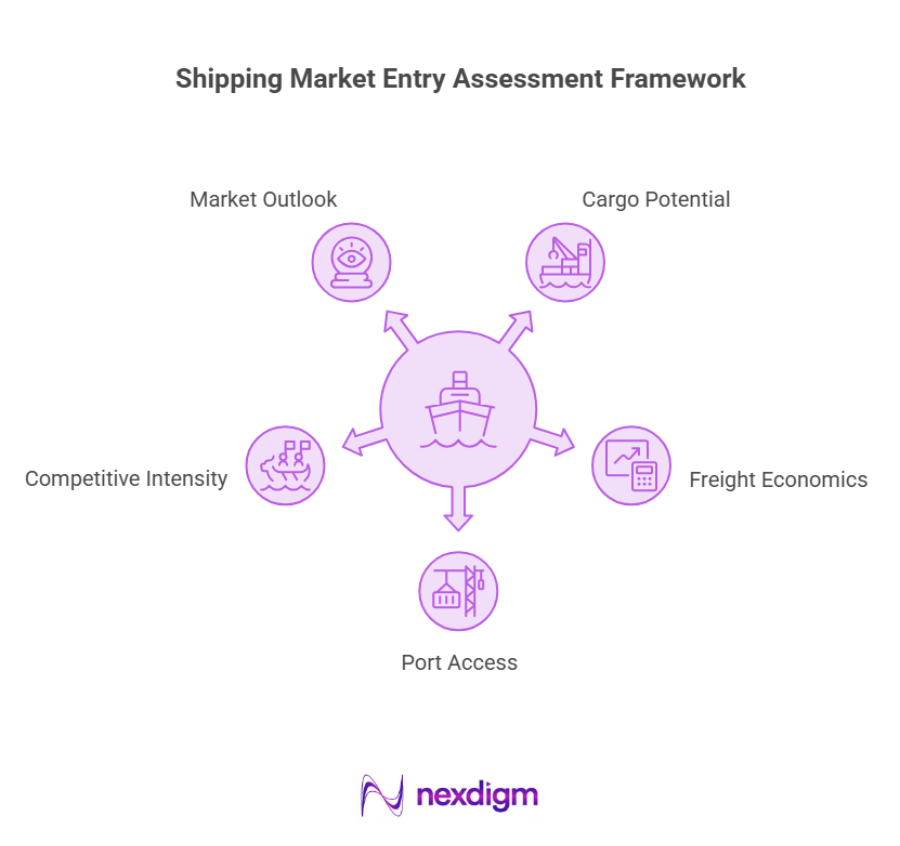
- Cargo Potential: Nexdigm analyzes cargo volumes, commodity types, trade flows, customer segments, seasonality, and growth forecasts to estimate addressable demand.
- Freight Economics: The assessment evaluates freight rates, fuel costs, port charges, operating expenses, transit times, and pricing trends to determine route profitability.
- Port Access: Nexdigm assesses port capacity, connectivity, congestion, vessel calls, handling efficiency, infrastructure quality, and expansion plans affecting route performance.
- Competitive Intensity: The framework compares carriers, service frequencies, pricing, network coverage, alliances, customer relationships, and differentiation to assess competitive pressure.
- Market Outlook: Nexdigm considers trade forecasts, industrial investment, infrastructure development, policy changes, customer demand, and emerging risks to evaluate long-term attractiveness.
The framework assesses these dimensions, helping organizations determine whether a trade lane provides sufficient opportunity for market entry.
How Nexdigm’s Assessment Framework Creates Business Value
Nexdigm’s assessment framework goes beyond evaluating trade lane attractiveness by helping organizations convert market insights into informed business decisions. The framework provides a comprehensive view of market opportunities and risks by helping organizations to:
- Prioritize high-potential markets by identifying trade lanes with the strongest demand, growth prospects, and commercial viability.
- Reduce market-entry risks through a structured evaluation of regulatory, operational, and competitive factors.
- Optimize investment decisions by directing resources toward the most attractive routes, services, and infrastructure opportunities.
- Strengthen strategic planning with data-driven insights that support expansion, partnership, and network development decisions.
Through a structured and evidence-based approach, Nexdigm’s framework helps organizations move from market assessment to strategic action, enabling smarter investments and sustainable growth in shipping and logistics markets.
Nexdigm’s Case
A shipping company engaged Nexdigm to assess cargo potential, freight rates, port access, and competitive intensity before entering a new trade lane. The analysis identified a viable market opportunity, supporting 18% higher projected capacity utilization, 12% lower operating costs, and 21% faster customer acquisition, strengthening the business for expansion.
To take the next step, simply visit our Request a Consultation page and share your requirements with us.
Harsh Mittal
+91-8422857704