

In Singapore’s fast moving consumer goods landscape, brands compete daily for attention, shelf space, and loyalty. Net Promoter Score benchmarking compares customer willingness to recommend across competitors, creating a standardized advocacy metric. It translates consumer sentiment into comparable performance indicators, helping FMCG leaders quantify loyalty, detect perception gaps, and prioritize experience improvements with measurable commercial impact.
Competition within Singapore’s consumer sector is intensifying as global and regional brands expand presence across modern trade and digital channels. According to Enterprise Singapore, the country recorded SGD 424 billion in total trade in a recent assessment, underscoring market vibrancy. In such an environment, structured NPS benchmarking becomes critical to distinguish brand advocates from passive or vulnerable buyers.
Nexdigm’s Brand NPS Benchmarking Survey for FMCG Customer Advocacy Insights
Nexdigm’s Brand NPS Benchmarking Survey for Singapore FMCG companies measures customer advocacy, brand perception, and purchase satisfaction across competitive product categories. The survey compares Net Promoter Scores with market benchmarks, identifies drivers of loyalty and dissatisfaction, and helps brands strengthen positioning, improve product experiences, and design strategies that increase customer advocacy and repeat purchases.
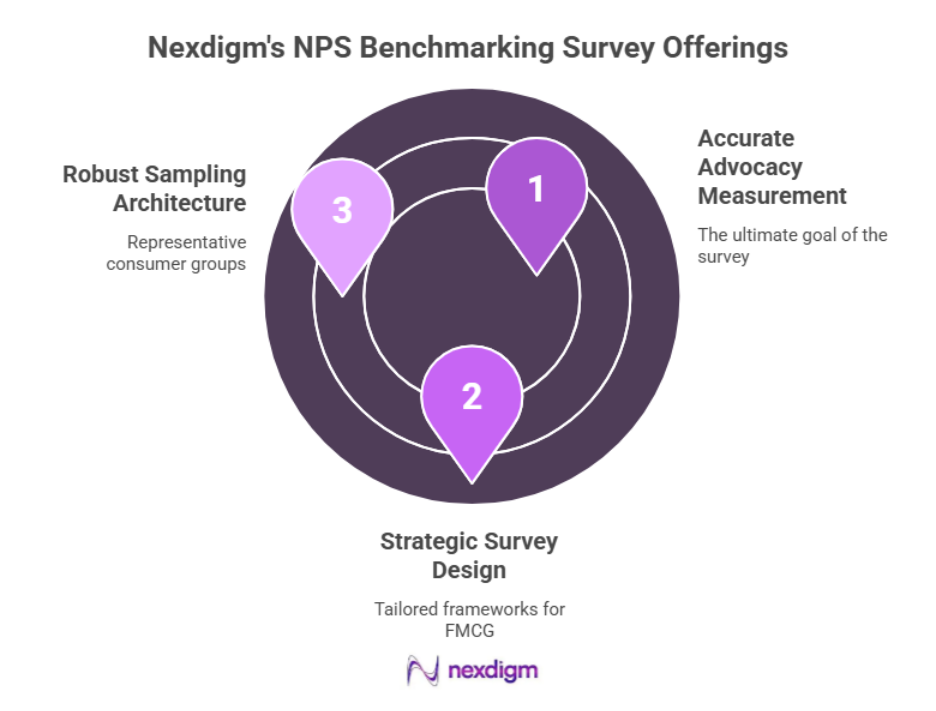
Nexdigm’s NPS Benchmarking Survey Offerings for Singapore FMCG Brands
-
Strategic Survey Design
Customized NPS frameworks aligned to FMCG categories, purchase cycles, and channel dynamics ensure accurate advocacy measurement across supermarkets, convenience formats, and ecommerce touchpoints within Singapore’s diverse consumer ecosystem.
-
Robust Sampling Architecture
Representative sampling across age, income, ethnicity, and buying frequency segments ensures statistically reliable comparisons against direct competitors and category leaders in the local consumer market.
-
Competitive Benchmark Mapping
Systematic competitor score tracking identifies advocacy gaps, brand switching triggers, and loyalty strengths, enabling FMCG brands to position performance relative to both multinational and domestic players.
-
Advanced Driver Analytics
Regression and correlation analysis isolate experience attributes influencing promoter behavior, including pricing perception, product availability, packaging appeal, and omnichannel consistency across retail environments.
-
Actionable Reporting Dashboards
Interactive dashboards translate NPS data into executive ready insights, highlighting risk segments, promoter concentration, and priority interventions for marketing, sales, and distribution teams.
-
Closed Loop Feedback Integration
Structured follow up mechanisms convert detractor feedback into corrective action plans, strengthening retention strategies and reinforcing advocacy building initiatives across product portfolios.
How NPS Benchmarking Insights Measure Advocacy in a Competitive Consumer Sector
-
Identifying Promoter Density
Quantifies the proportion of high intent recommenders within specific FMCG categories, clarifying brand strength in crowded product segments and retail formats.
-
Detecting Competitive Vulnerability
Highlights segments with low advocacy or high neutrality, signaling potential switching risk in price sensitive or promotion driven environments.
-
Linking Experience to Recommendation
Connects operational factors such as stock availability and perceived value to likelihood of recommendation, guiding targeted improvement initiatives.
-
Segment Level Advocacy Analysis
Evaluates NPS across demographic and channel cohorts, revealing where advocacy is strongest or weakest within Singapore’s multicultural consumer base.
-
Tracking Advocacy Momentum
Monitors NPS shifts over time, enabling brands to assess campaign effectiveness, product launches, and distribution expansion impact on sustained recommendation intent.
Nexdigm Case
A leading Singapore based FMCG company engaged Nexdigm to benchmark its Net Promoter Score against five direct competitors across modern trade and ecommerce channels. The study captured responses from over 1,200 consumers and revealed a 14 point NPS gap versus the category leader, driven primarily by pricing perception and stock availability. Post intervention initiatives improved promoter share by 11 points within two quarters, while repeat purchase intent increased by 9 percent, strengthening measurable brand advocacy.
To take the next step, simply visit our Request a Consultation page and share your requirements with us.
Harsh Mittal
+91-8422857704