

India’s skill development ecosystem operates at significant scale. The Ministry of Skill Development and Entrepreneurship reports that the Pradhan Mantri Kaushal Vikas Yojana (PMKVY) has trained more than 1.60 crore candidates across its different phases since its launch in 2015. PMKVY 4.0 has expanded its focus toward industry-driven and new-age skills, including AI, robotics, mechatronics, IoT, and drones.
This growing emphasis on employability and industry-aligned training is creating opportunities across vocational education, professional certification, reskilling, upskilling, and workforce development. However, learner interest alone does not guarantee a viable training proposition. Course relevance, employer requirements, pricing, delivery costs, completion, placement outcomes, and competitive intensity can determine whether a program achieves sustainable growth.
A structured Skill development market assessment helps training providers, education companies, investors, and institutions identify high-potential skill categories, understand learner and employer requirements, evaluate course economics, and determine where market demand can translate into sustainable outcomes.
Where Learner Demand Meets Industry Requirements
Skill requirements are changing as businesses adopt automation, digital technologies, AI, and new operating models. Employers increasingly need specialized capabilities, while learners seek programs that can improve employability and career progression.
Nexdigm can assess these demand-side dynamics by examining learner profiles, employer requirements, emerging skills, competing programs, certifications, and industry trends. This helps identify opportunities where training demand is supported by genuine workforce requirements.
Why Course Economics and Outcomes Matter
A training program needs to create value for learners while remaining commercially sustainable for its provider. Fees, enrollment volumes, delivery costs, faculty requirements, completion rates, placement outcomes, and employer recognition can all influence program economics.
Nexdigm can connect these factors to assess whether a course or training model can achieve the scale, pricing, and outcomes required for sustainable growth.
Nexdigm’s Industry-Skill Alignment View
Nexdigm’s market intelligence can help connect emerging industry requirements with the skills required to support them. Its research on India’s robotics sector, for example, identifies shortages in advanced capabilities such as robotics programming, machine vision, PLC integration, and predictive maintenance, highlighting the gap between technology adoption and workforce readiness.
This type of industry-level analysis can help training providers identify emerging skill categories where employer demand may outpace the availability of qualified talent.
Nexdigm’s Approach to Outcome-Led Opportunity Identification
For skill-development providers, identifying a high-demand course is only the starting point. Nexdigm can help evaluate the complete opportunity from learner acquisition and pricing to employer relevance, course delivery, competitive differentiation, and measurable outcomes.
This enables providers to assess whether a program can move beyond enrollment generation and create sustainable value for learners, employers, and the training organization.
Nexdigm’s Skill Development Market Assessment Framework
Nexdigm’s Skill development market assessment evaluates the market from learner, employer, competitive, operational, and commercial perspectives. The framework can include:
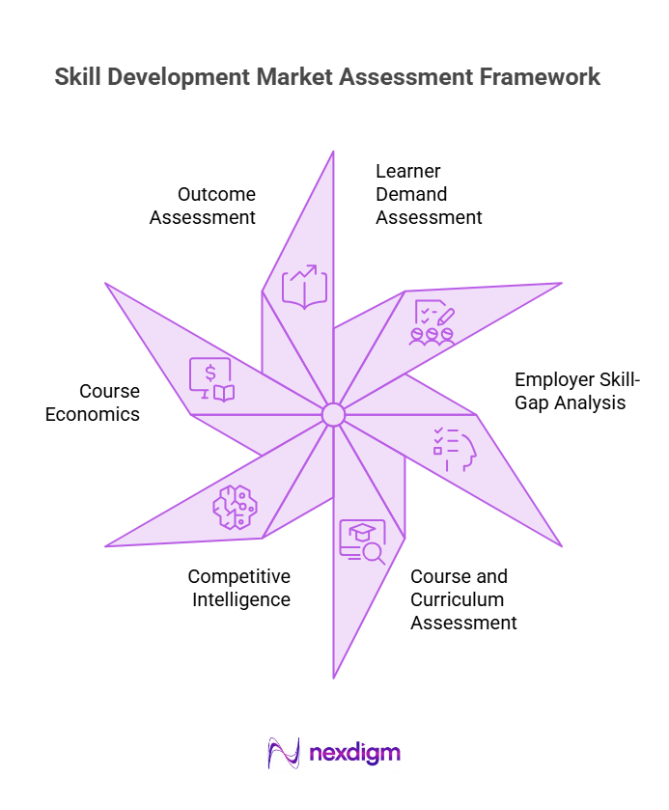
- Learner Demand Assessment: Nexdigm evaluates learner demographics, career aspirations, preferred skills, course formats, affordability, and enrollment behavior to identify high-potential learner segments and unmet training needs.
- Employer Skill-Gap Analysis: Nexdigm examines hiring requirements, emerging job roles, critical skill shortages, preferred certifications, and workforce priorities to assess alignment between training programs and employer demand.
- Course and Curriculum Assessment: Nexdigm benchmarks programs on curriculum, duration, delivery format, certification, practical exposure, faculty, and industry relevance to identify opportunities for stronger differentiation and market fit.
- Competitive Intelligence: Nexdigm maps training providers, institutions, certification bodies, and digital learning platforms across pricing, positioning, course portfolios, delivery models, and learner segments to identify market gaps.
- Course Economics: Nexdigm assesses pricing, enrollment potential, faculty and delivery costs, infrastructure requirements, and operating assumptions to determine the commercial sustainability and scalability of different training models.
- Outcome Assessment: Nexdigm evaluates placement potential, employment outcomes, certification value, learner progression, and employer recognition to understand whether programs can demonstrate measurable value.
Together, these dimensions provide a market-to-outcome view, helping stakeholders assess whether a skill-development proposition is relevant, competitive, and economically sustainable.
Benefits of Nexdigm’s Skill Development Market Assessment
Nexdigm’s assessment can translate market intelligence into practical decisions:
- Identify High-Demand Skills: Pinpoint skill categories supported by learner interest and employer requirements.
- Improve Course-Market Fit: Align curricula, certifications, delivery formats, and pricing with market expectations.
- Strengthen Course Economics: Evaluate enrollment potential, pricing, delivery costs, and scalability before launching programs.
- Prioritize Learner Segments: Identify learner groups, industries, and geographies with stronger commercial potential.
- Improve Outcome Orientation: Assess placement, employment, certification, and career-progression potential to strengthen program value.
- Support Market Entry: Evaluate competition, industry partnerships, regulatory considerations, and market gaps before entering new segments.
Nexdigm’s Case
Nexdigm supported a leading digital skilling platform across Asia by benchmarking 14 global competitors and redesigning its learner-retention model. The resulting interventions delivered a 34% increase in course completion and a 19% rise in paid conversions within five months, strengthening learner engagement and commercial performance.
To take the next step, simply visit our Request a Consultation page and share your requirements with us.
Harsh Mittal
+91-8422857704