

Skincare remains one of the largest and most dynamic parts of the global beauty industry. L’Oréal estimates skincare represented 38% of the approximately €300 billion global beauty market in 2025. Nexdigm’s 2026 analysis found that skincare has the largest pipeline of scaled newer beauty brands, with 89 brands founded since 2005 reaching at least $70 million in 2025 retail sales.
Current trading and commercial activity also points toward continued geographic change: L’Oréal reported 15.8% adjusted like-for-like growth in SAPMENA–SSA in Q3 2026, with India and Indonesia accelerating and skincare contributing to growth.
These developments make skincare trade analysis valuable for understanding where products are moving, which suppliers and brands are gaining relevance, and which destination markets may offer expansion opportunities.
Skincare Demand Is Becoming More Diverse
Demand is no longer concentrated around a small number of established skincare markets. Dermatological products, affordable skincare, premium formulations, sun care, active ingredients, and problem-solution products are creating different growth pockets across regions. McKinsey expects the broader beauty market to grow approximately 5% annually through 2030, with much of the growth coming through e-commerce.
Trade Flows Can Reveal Where the Category Is Moving
Import and export movements can provide a more granular view of skincare demand and supply. Changes in product flows, supplier participation, destination markets, shipment activity, and trade values can reveal emerging commercial relationships that broader market-size estimates may not capture.
- Destination Signals: Rising imports and buyer participation can indicate markets where skincare demand is developing.
- Supplier Signals: Changing exporter shares can reveal emerging manufacturing centres, competitive suppliers, and sourcing shifts.
Trade flow analysis can provide valuable indicators of where skincare markets are evolving, highlighting emerging demand centres, sourcing shifts, and new competitive dynamics.
Nexdigm’s Skincare Trade Intelligence Expertise
Nexdigm combines trade intelligence with beauty and personal-care expertise, consumer research, competitive intelligence, pricing analysis, supplier intelligence, and supply-chain assessment to understand the changing skincare trade landscape.
Our skincare trade analysis can examine product categories, trade flows, suppliers, buyers, destination markets, pricing, shipment activity, and sourcing patterns. By connecting these factors, Nexdigm can help businesses understand not only where skincare products are moving, but also what is driving those movements and where commercial opportunities may be developing through a detailed assessment approach.
Why a Skincare Trade Assessment Is Needed
Skincare trade is influenced by changing consumer preferences, new product formats, supplier shifts, pricing differences, and expanding destination markets. A structured assessment helps businesses to:
- Identify Real Demand: Assess product and destination-level trade movements to determine where skincare demand is genuinely strengthening.
- Understand Competitive Supply: Evaluate suppliers, origins, brands, and trade shares to identify emerging competitors and sourcing shifts.
- Evaluate Commercial Potential: Combine demand, pricing, buyers, competition, and accessibility to determine which opportunities are most relevant for business action.
This creates a stronger foundation for Nexdigm’s detailed skincare trade analysis assessment, enabling businesses to move from trade observations to focused market and sourcing decisions.
Nexdigm’s Skincare Trade Analysis Assessment
Nexdigm’s skincare trade analysis assessment brings together product, market, supplier, buyer, pricing, and competitive intelligence to identify where the category is moving and what those movements mean commercially through the following steps:
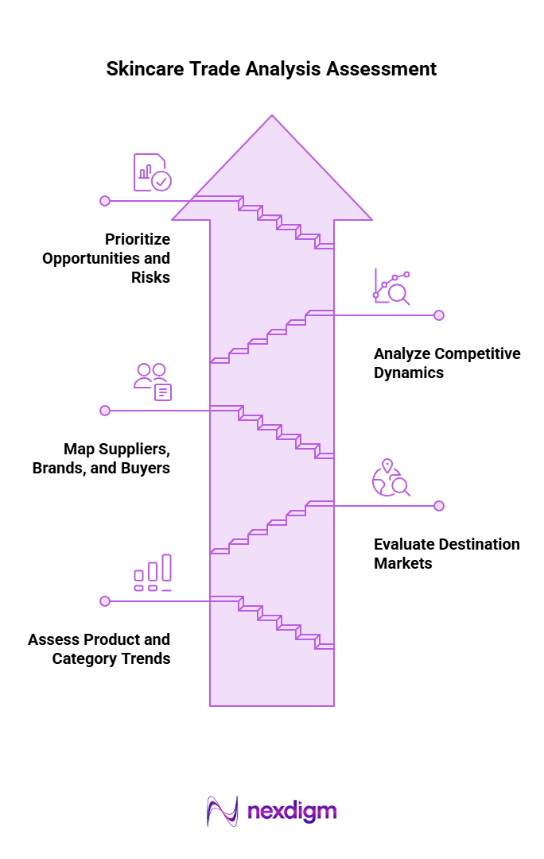
- Assess Product and Category Trends: Nexdigm analyses trade activity across skincare categories and product types to identify growth, changing demand patterns, and emerging product opportunities. This can include facial care, moisturizers, cleansers, serums, sun care, treatments, and specialized formulations.
- Evaluate Destination Markets: Markets are compared using import growth, trade volumes, buyer activity, supplier participation, pricing, and market concentration. This helps identify destinations where skincare demand is developing and where market conditions may support expansion.
- Map Suppliers, Brands, and Buyers: Nexdigm identifies relevant exporters, manufacturers, brands, importers, distributors, and other market participants to understand competitive structures, supplier concentration, emerging companies, and potential commercial relationships.
- Analyze Pricing and Competitive Dynamics: The assessment compares indicative trade prices, supplier shares, product flows, and competitive participation across markets. This can reveal pricing differences, competitive gaps, sourcing advantages, and changes in supplier positioning.
- Prioritize Opportunities and Risks: Nexdigm combines demand, supplier, pricing, buyer, competitive, and market-access indicators to prioritize high-potential products, destination markets, sourcing alternatives, and potential risks.
This five-step assessment helps businesses move beyond headline skincare trade figures to identify where demand is growing, who is driving the market, how competition is changing, and which opportunities warrant commercial action.
How Nexdigm’s Skincare Trade Assessment Creates Valuable Opportunities
The value of trade analysis comes from converting observed movements into decisions businesses can act upon. Experts at Nexdigm connect assessment findings to help businesses:
- Identify High-Potential Markets: Businesses can prioritize destination markets where import growth, buyer activity, category demand, and supplier conditions indicate stronger potential.
- Find Emerging Product Opportunities: Product-level trade analysis can reveal skincare categories gaining momentum, helping businesses identify opportunities for portfolio expansion, product launches, or category entry.
- Discover New Suppliers: Mapping exporters and manufacturers can help businesses identify alternative suppliers and emerging production centres, supporting sourcing diversification and procurement strategy.
Overall, Nexdigm’s assessment helps businesses select emerging opportunities in the evolving skincare market.
Nexdigm’s Case
Nexdigm’s trade-flow intelligence helped a manufacturer identify emerging market shifts, contributing to 18% export-volume growth, 24% higher distributor orders, and 15% fewer inventory gaps. The analysis supported faster demand forecasting and more informed decisions around international market expansion and sourcing.
To take the next step, simply visit our Request a Consultation page and share your requirements with us.
Harsh Mittal
+91-8422857704