

The adoption of digital technologies is changing how educational institutions design classrooms and deliver learning. Interactive displays, connected devices, learning management systems, classroom analytics, digital content, and hybrid-learning tools are increasingly becoming part of modern education infrastructure. In India, 949 million broadband subscriptions and 290 million 5G subscriptions by late 2024 provide a growing connectivity base for digitally enabled learning.
However, smart classroom investment involves more than purchasing digital boards or connected devices. Institutions need to consider curriculum requirements, teacher readiness, student needs, infrastructure, affordability, technology adoption, and expected utilization. The right investment therefore depends on how well technology addresses an identifiable education need.
A Smart classroom technology demand assessment can help education providers understand adoption drivers, evaluate market demand, benchmark technology offerings, and determine where smart classroom investments can create sustainable educational and commercial value.
What Is Driving Smart Classroom Adoption?
Digital classrooms are evolving from standalone technology installations toward connected learning environments. Interactive displays, digital content, collaboration platforms, automated assessments, and learning analytics can support different aspects of classroom delivery.
Demand can vary by school format, curriculum, location, fee segment, and institutional technology readiness. Understanding these differences is important for providers and technology companies seeking to identify markets where smart classroom solutions can achieve meaningful adoption.
Investment Decisions Require a Market View
Technology investments can create limited value when infrastructure is introduced without considering teacher usage, student engagement, curriculum alignment, or institutional economics. Schools also need to assess whether parents and students value technology-enabled learning enough to justify additional expenditure.
Market assessment can therefore help stakeholders understand which technologies are relevant, what competing institutions are offering, and how affordability and adoption readiness may influence investment decisions.
Nexdigm’s Role in Supporting Smart Classroom Investment Decisions
As digital learning infrastructure becomes increasingly important across education systems, stakeholders need a structured understanding of adoption drivers, market demand, and investment feasibility. Nexdigm supports these decisions through data-driven assessments that help align technology investments with educational and commercial objectives.
- Smart Classroom Demand Assessment: Nexdigm evaluates demand across school segments, curriculum types, fee categories, and geographic markets to identify where smart classroom technologies are most likely to achieve meaningful adoption and value creation.
- Education Institution Capacity Assessment: Nexdigm assesses infrastructure readiness, internet connectivity, teacher capabilities, technology integration maturity, and operational preparedness to determine an institution’s ability to successfully implement digital learning solutions.
- Technology Adoption and Competitive Intelligence: Nexdigm analyzes technology penetration, adoption trends, competitor offerings, pricing models, and implementation approaches to help stakeholders understand market dynamics and emerging opportunities.
- Learner, Parent, and Curriculum Alignment Analysis: Nexdigm examines stakeholder expectations, learning preferences, curriculum requirements, and classroom use cases to identify technology solutions that deliver practical educational benefits.
Why Education Providers Partner with Nexdigm
Education providers and EdTech companies partner with Nexdigm to combine education-market expertise with technology, consumer, and competitive intelligence. Nexdigm can evaluate both demand and supply-side factors, examining learners, institutions, competitors, infrastructure, pricing, and emerging technology trends.
Its market research capabilities help stakeholders understand changing education requirements and identify opportunities across digital learning, EdTech, AI, and technology-enabled education models.
Nexdigm’s Smart Classroom Technology Demand Assessment
Nexdigm’s Smart Classroom Technology Demand Assessment follows a structured approach to help education providers, EdTech companies, and technology vendors identify demand, evaluate adoption readiness, and prioritize investment opportunities.
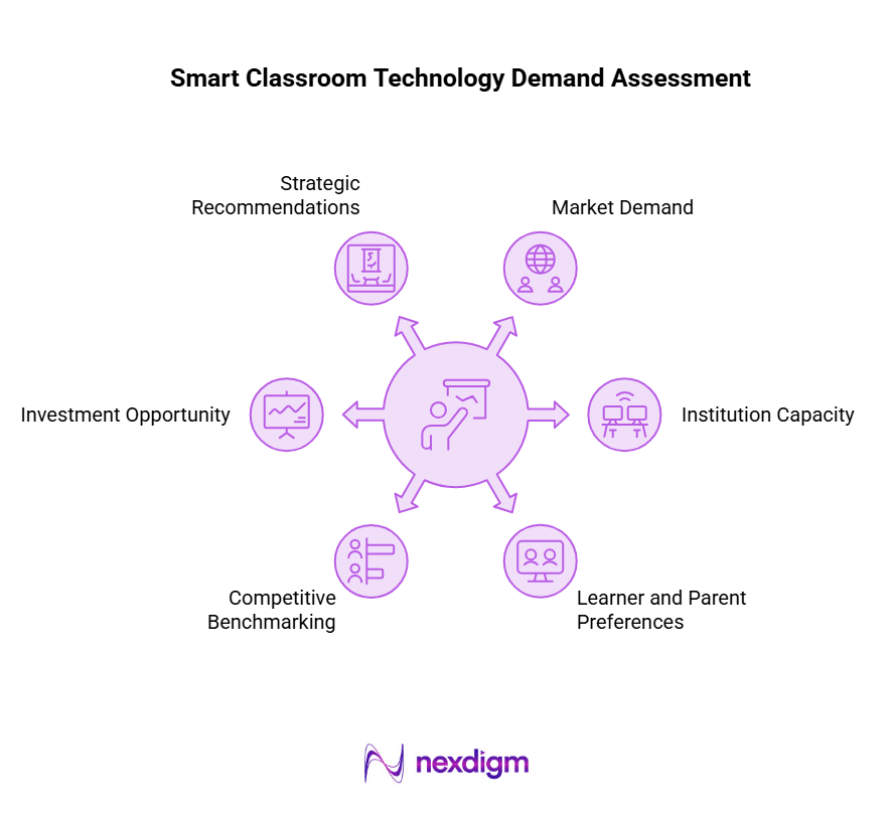
- Market Demand Assessment: Nexdigm analyzes demand across school types, curriculum formats, fee segments, and geographies to identify markets where smart classroom technologies demonstrate the strongest growth and adoption potential.
- Education Institution Capacity Assessment: Nexdigm evaluates infrastructure, connectivity, classroom readiness, teacher capabilities, and technology integration maturity to determine institutional preparedness for smart classroom implementation.
- Learner and Parent Preference Analysis: Nexdigm examines expectations around digital learning, engagement, personalization, learning outcomes, and technology-enabled education experiences to identify relevant solution requirements.
- Competitive Benchmarking and Technology Mapping: Nexdigm assesses competing technology providers, classroom solutions, feature sets, pricing models, and deployment approaches to highlight market gaps and differentiation opportunities.
- Investment Opportunity Assessment: Nexdigm evaluates adoption drivers, affordability considerations, commercial viability, scalability, and market attractiveness to identify high-potential investment opportunities.
- Strategic Recommendations: Based on research findings, Nexdigm develops actionable recommendations to support market entry, product positioning, technology prioritization, and long-term growth planning.
Together, these assessment stages provide a comprehensive view of market demand, institutional readiness, and commercial potential, enabling stakeholders to make informed smart classroom investment decisions.
Nexdigm’s Case
Nexdigm supported a leading digital skilling platform operating across Asia to improve learner engagement. After benchmarking 14 global competitors and redesigning its retention approach, the platform achieved a 34% increase in course completion and a 19% rise in paid conversions within five months, demonstrating measurable value from data-led digital learning interventions.
To take the next step, simply visit our Request a Consultation page and share your requirements with us.
Harsh Mittal
+91-8422857704