

Benchmarking ecosystem integration across smart device platforms helps businesses understand how well devices, apps, operating systems, cloud services, and third-party technologies work together. As consumers and enterprises increasingly prefer connected experiences, platform compatibility, interoperability, data sharing, voice assistant support, and seamless user control have become key differentiators.
Smart device ecosystem benchmarking supports competitive intelligence by comparing how competitors build integrated ecosystems, form technology partnerships, improve user experience, and retain customers. These insights help companies identify integration gaps, strengthen platform strategies, and create more connected, convenient, and competitive smart device offerings.
Recent market indicators show why ecosystem integration is becoming critical for smart device platforms. The global smart home market is projected to grow from USD 147.52 billion in 2025 to USD 848.47 billion by 2034, while connected IoT devices are expected to reach 39 billion by 2030. Wireless protocols held the largest smart home market share in 2024, highlighting the importance of interoperability, platform compatibility, and seamless device connectivity.
What are the Smart Device Platforms that Benchmark Integration Across Ecosystem?
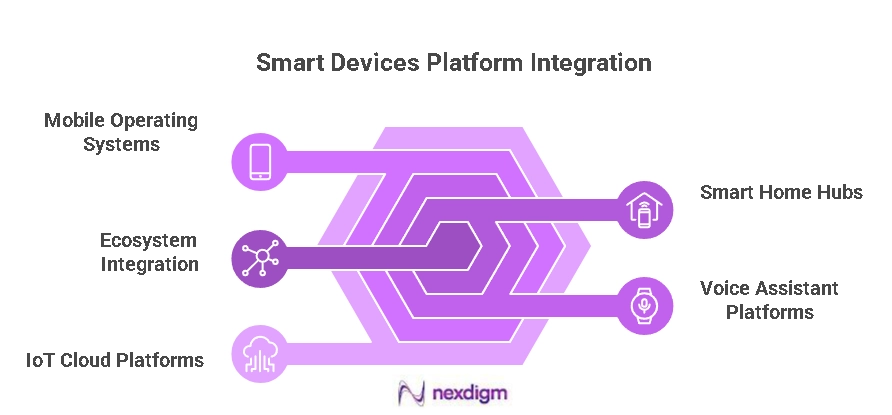
Smart device platforms that benchmark ecosystem integration include smart home hubs, mobile operating systems, voice assistants, IoT cloud platforms, wearable ecosystems, appliance platforms, and enterprise device management systems that connect devices, apps, and services:
-
Smart Home Hubs
Smart home hubs connect lighting, security, appliances, and sensors, helping benchmark interoperability and centralized device control.
-
Voice Assistant Platforms
Voice assistants enable hands-free control and reveal how well devices integrate with commands, routines, and third-party services.
-
Mobile Operating Systems
Mobile platforms benchmark app-based control, device pairing, notifications, automation, and user experience across connected ecosystems.
-
IoT Cloud Platforms
Cloud platforms support device data storage, analytics, remote monitoring, security, and integration across large-scale connected environments.
-
Wearable Ecosystems
Wearable platforms connect health devices, smartphones, apps, and cloud services to benchmark data sharing and user engagement.
Nexdigm’s Insights to Build Stronger Smart Device Platform Strategies
Nexdigm’s insights help businesses build stronger smart device platform strategies by analyzing ecosystem integration, competitor positioning, interoperability standards, user experience, pricing models, and technology partnerships. Through custom research and competitive intelligence, Nexdigm supports companies in identifying platform gaps, improving compatibility, strengthening value propositions, and creating connected experiences that align with customer expectations and market opportunities.
How Nexdigm Supports Competitor Analysis Across Smart Device Platform Ecosystems?
Nexdigm supports competitor analysis across smart device platform ecosystems by benchmarking integration capabilities, interoperability, app performance, cloud connectivity, partnerships, pricing, and user experience to identify gaps and strategic opportunities.
-
Benchmarking Integration Capabilities
Nexdigm compares how competing platforms connect devices, apps, cloud services, voice assistants, and third-party technologies.
-
Assessing Interoperability Standards
Nexdigm evaluates protocol support, platform compatibility, connectivity standards, and cross-device performance across smart device ecosystems.
-
Analyzing App and Cloud Performance
Nexdigm reviews app usability, remote control features, cloud reliability, data syncing, and platform responsiveness.
-
Mapping Technology Partnerships
Nexdigm tracks collaborations with chipset, cloud, telecom, AI, and device partners to understand ecosystem expansion strategies.
-
Comparing Pricing and Business Models
Nexdigm analyzes device pricing, subscriptions, bundles, platform fees, and service-based revenue models across competitors.
Nexdigm’s case:
Nexdigm assisted a smart device platform company that was struggling with weak ecosystem integration across third-party devices, apps, cloud platforms, and voice assistants. Nexdigm conducted smart device ecosystem benchmarking, competitor analysis, pricing review, and partnership mapping to identify integration gaps and growth opportunities.
With Nexdigm’s support, the company improved platform compatibility, strengthened its go-to-market approach, and expanded partner-led adoption. As a result, the company generated USD 12 million in additional revenue and improved operating profit by USD 2.4 million through better product positioning, ecosystem partnerships, and customer retention.
To take the next step, simply visit our Request a Consultation page and share your requirements with us.
Harsh Mittal
+91-8422857704