
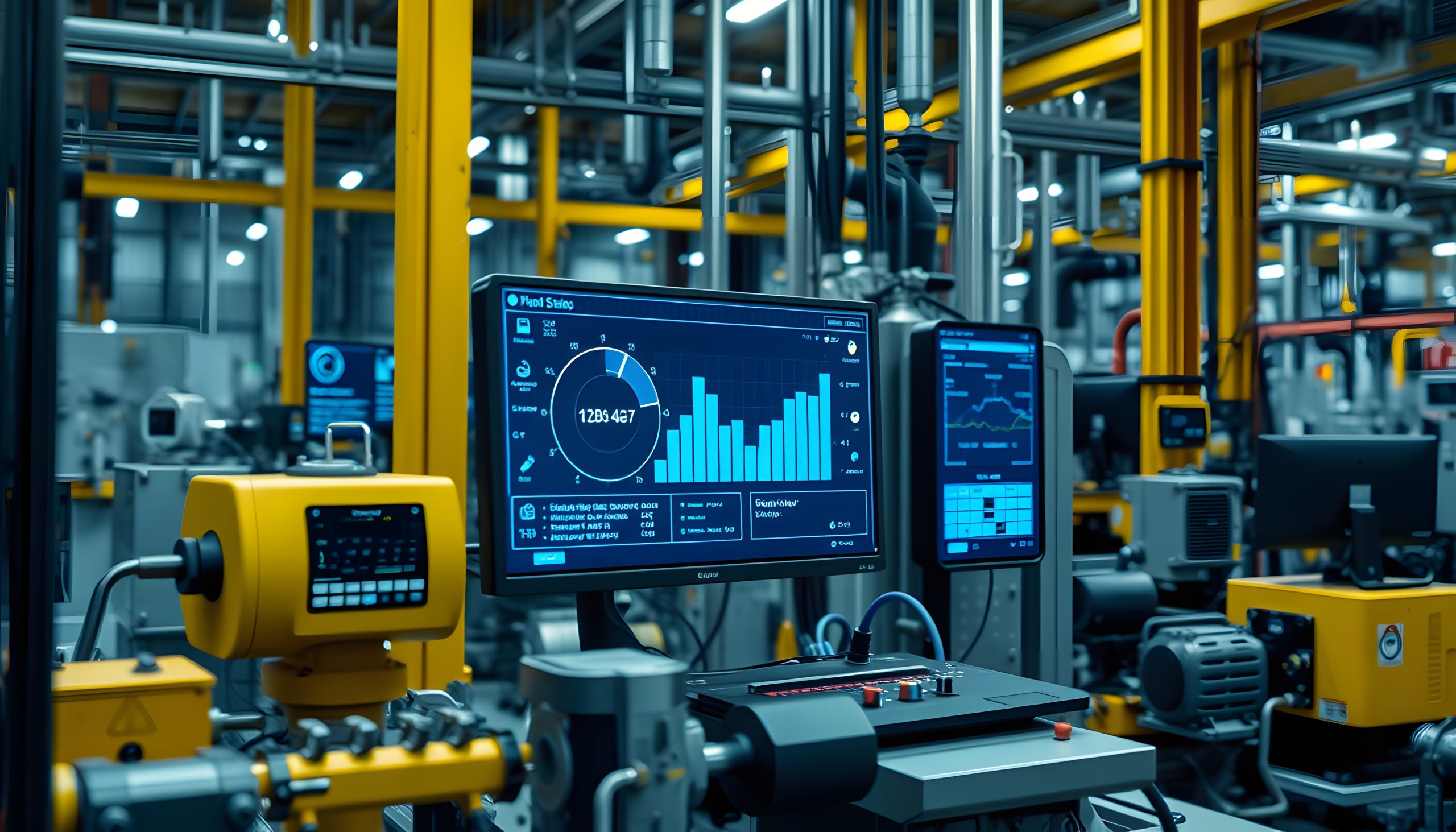
The commercial opportunity for smart factories extends beyond industrial robots and automated production lines. It includes sensors, industrial connectivity, manufacturing software, analytics, AI, systems integration and services that help factories turn operational data into better decisions. However, the addressable market is not equivalent to the value of every technology that could theoretically be installed in a factory. It depends on which facilities are ready to invest, which problems justify the expenditure and how quickly solutions can be deployed at scale.
The International Federation of Robotics reported 542,000 industrial robots installed worldwide in 2024, more than twice the number recorded a decade earlier. Asia accounted for 74% of new installations. This provides a useful indicator of automation adoption, although robotics represents only one component of the broader smart factory market.
For technology providers and manufacturers evaluating investment, the central task is to distinguish the total technology opportunity from the portion supported by funded projects and achievable returns.
Where Is Smart Factory Adoption Accelerating?
Adoption is advancing through several overlapping investment categories.
- Automation and robotics: Equipment that improves throughput, repeatability, material handling and production safety.
- Industrial IoT and connectivity: Sensors, gateways and industrial networks that provide reliable production data.
- Analytics and AI: Predictive maintenance, quality inspection, process optimisation, energy management and production planning.
- Connected manufacturing systems: Manufacturing execution systems, digital twins and integration between shop-floor operations and enterprise platforms.
- Implementation and lifecycle services: Systems integration, cybersecurity, workforce training, maintenance and ongoing optimisation.
The World Economic Forum’s Global Lighthouse Network provides evidence of what coordinated investment can achieve. In July 2026, the Forum reported that the network had expanded to 238 factories. Generative AI accounted for 23% of the leading solutions reported in 2025, reflecting growing interest in applications that support complex industrial decisions. These factories represent advanced adopters, so their results should be treated as evidence of potential rather than typical industry performance.
The distinction between technology interest and purchase readiness remains important. A plant may want predictive maintenance but lack reliable equipment data. Another may have connected machinery but no integration between production and maintenance systems. Each situation represents a different market opportunity, implementation cost and sales cycle.
Readiness Determines the Addressable Market
A realistic market estimate should segment factories according to their ability to adopt technology, not simply count manufacturing facilities.
Plants with modern equipment, established data infrastructure and defined performance targets may be ready for advanced analytics or AI. Facilities with older machinery may first need sensors, connectivity and systems integration. Smaller manufacturers may favour modular solutions that address one production constraint without requiring a major factory-wide transformation.
For Smart factory market potential analysis, Nexdigm can segment the market by manufacturing sector, plant maturity, technology requirements, investment readiness and expected project value. This makes it possible to estimate near-term demand separately from longer-term potential that depends on infrastructure upgrades or organisational change.
Market sizing should also account for overlapping budgets. A single factory transformation programme may include robotics, software and integration services, but these expenditures should not be counted as separate independent projects if they belong to the same investment package.
ROI Separates Deployable Demand From Technology Ambition
Smart factory investment is easiest to justify when it addresses a measurable operational cost. Predictive maintenance may reduce unplanned downtime, machine vision may lower defect-related losses, and connected scheduling may improve throughput or delivery performance.
The financial model should establish a baseline before estimating benefits. It should include equipment and software costs, integration, commissioning, training, cybersecurity, maintenance and production disruption during installation. Benefits should be measured through indicators such as downtime hours, first-pass yield, scrap rates, labour productivity, energy consumption and order lead times.
A useful investment screen asks four questions:
- What operating problem is being solved, and what does it currently cost?
- Can the technology deliver a measurable improvement under normal production conditions?
- What investment and organisational changes are required to capture that benefit?
- Can the solution be replicated across other lines or facilities without disproportionate integration costs?
This last question matters commercially. A successful pilot may demonstrate technical feasibility without proving that the solution can be deployed profitably across a large customer base.
Smart Factory Market Potential Assessment Framework
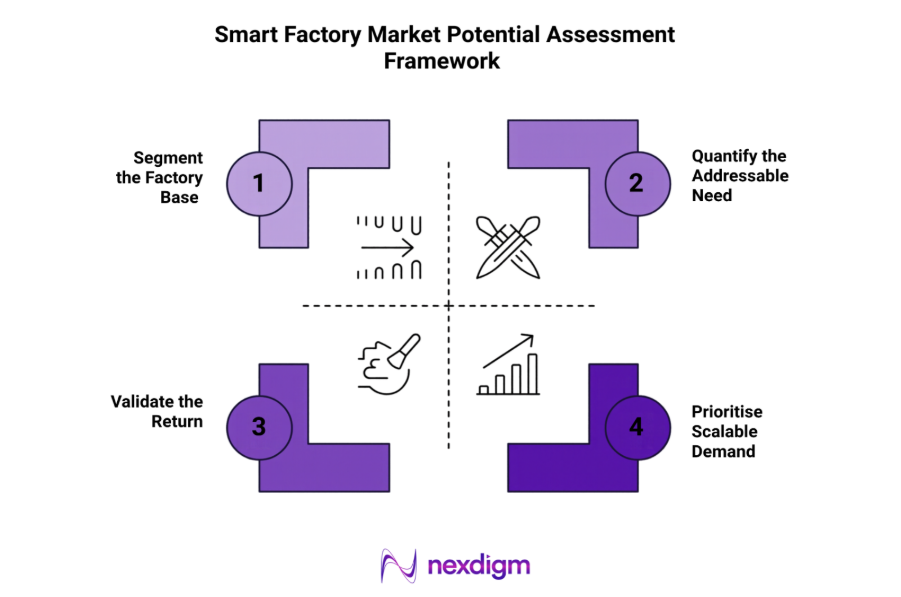
- Segment the Factory Base
Classify facilities by industry, production complexity, existing equipment, data maturity and investment readiness. - Quantify the Addressable Need
Identify priority use cases and estimate eligible production lines, potential deployments, project values and replacement cycles. - Validate the Return
Model implementation costs, operating benefits, payback periods and adoption barriers under realistic production scenarios. - Prioritise Scalable Demand
Rank opportunities by purchase readiness, repeatability, customer access, achievable margins and the cost of deployment.
Nexdigm Case Study: Separating Smart Factory Potential From Purchase-Ready Demand
Nexdigm assessed 210 manufacturing facilities across automotive components, industrial equipment and packaged goods. The team mapped 14 technology use cases and evaluated equipment connectivity, data maturity, capital budgets and projected returns. Sixty-three facilities had defined investment requirements, while 38 met the client’s readiness criteria for deployment within 18 months.
Predictive maintenance and machine-vision inspection represented a combined qualified opportunity of ₹46 crore. Nexdigm recommended prioritising these applications before expanding into factory-wide AI and digital-twin programmes.
To take the next step, simply visit our Request a Consultation page and share your requirements with us.
Harsh Mittal
+91-8422857704