
Smart home markets are expanding rapidly as consumers and businesses adopt connected devices that improve convenience, security, energy efficiency, and automation. From smart speakers and lighting systems to security cameras, thermostats, and AI-enabled appliances, connected ecosystems are reshaping how people interact with their living spaces. This growth makes Smart home technology intelligence essential for companies seeking to understand market trends, product innovation, competitor strategies, pricing models, and consumer preferences.
Through competitive intelligence, businesses can identify emerging opportunities, benchmark rivals, monitor technology partnerships, and anticipate shifts in demand, helping them make informed decisions in a fast-evolving smart home landscape.
Recent estimates show strong momentum in the smart home sector. The global market is projected to grow from USD 147.52 billion in 2025 to USD 633.20 billion by 2032, reflecting a strong CAGR of nearly 23.0%. This expansion is being driven by rising adoption of connected devices, wireless protocols, AI-enabled home automation, smart security systems, energy management solutions, and growing consumer demand for convenience, safety, and integrated digital living.
Using Competitive Intelligence to Spot Smart Home Growth Opportunities
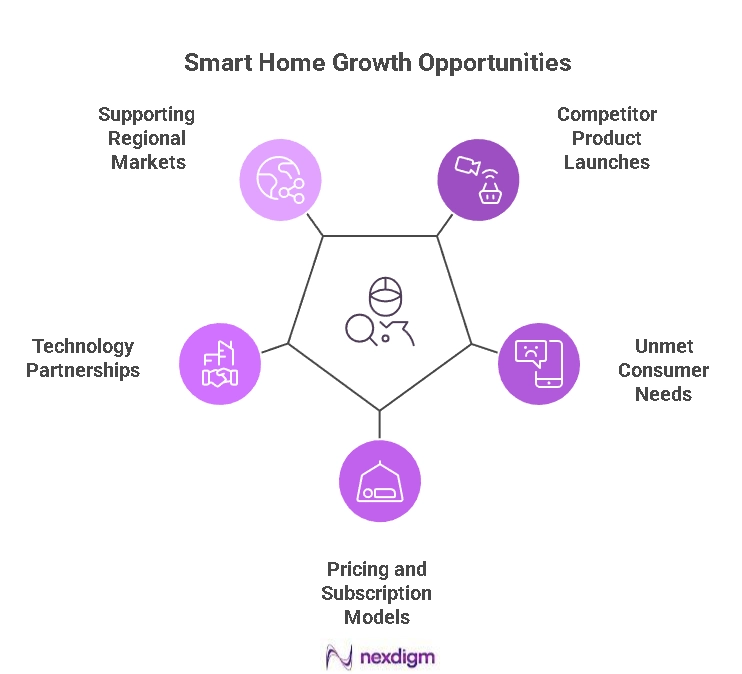
Competitive intelligence helps companies identify smart home growth opportunities by tracking competitor moves, emerging technologies, customer preferences, pricing strategies, and market gaps, enabling better decisions on product development and expansion:
-
Tracking Competitor Product Launches
Monitoring new smart home devices reveals innovation trends, feature gaps, and opportunities to develop differentiated products for evolving consumer needs.
-
Identifying Unmet Consumer Needs
Competitive intelligence highlights customer pain points, helping brands create solutions around convenience, security, energy efficiency, and seamless connectivity.
-
Analyzing Pricing and Subscription Models
Studying competitor pricing helps businesses position smart home products competitively while exploring bundles, service plans, and recurring revenue models.
-
Monitoring Technology Partnerships
Tracking collaborations with AI, IoT, and platform providers helps identify ecosystem expansion opportunities and potential strategic partnership areas.
-
Supporting Regional Growth Markets
Market intelligence shows where smart home adoption is rising, helping companies prioritize expansion in high-demand regions and consumer segments.
Nexdigm’s Custom Research Support for Smart Home Technology Intelligence
Nexdigm’s custom research support for smart home technology intelligence helps businesses understand market trends, competitor strategies, emerging technologies, product innovations, and consumer expectations. By delivering tailored insights on connected devices, automation, AI integration, pricing, and regional demand, Nexdigm enables companies to identify growth opportunities, reduce market uncertainty, and make informed strategic decisions in the evolving smart home ecosystem.
Nexdigm’s Help to Businesses in Evaluating Smart Home Innovation and Product Gaps
Nexdigm helps businesses evaluate smart home innovation and product gaps by benchmarking competitor offerings, identifying unmet customer needs, assessing technology trends, and highlighting opportunities for differentiated, market-ready connected home solutions.
-
Benchmarking Competitor Products
Nexdigm compares smart home offerings, features, pricing, and user experience to identify strengths, weaknesses, and differentiation opportunities.
-
Identifying Product Gaps
Research helps uncover missing features, unmet needs, and underserved segments where businesses can develop stronger smart home solutions.
-
Tracking Technology Innovation
Nexdigm monitors AI, IoT, automation, and interoperability trends to assess how innovation is shaping smart home product development.
-
Understanding Consumer Pain Points
Insights into customer expectations help businesses improve usability, security, convenience, energy efficiency, and connected device performance.
-
Evaluating Market Readiness
Nexdigm helps assess whether smart home products align with demand, pricing expectations, competitive standards, and regional adoption trends.
Nexdigm’s case:
Nexdigm supported an urban smart home device company by assessing competitor products, pricing, technology features, and regional demand to identify innovation gaps. The global smart home market has shown growth of USD 147.52 billion in 2025 such intelligence helps businesses prioritize high-growth areas like AI-enabled automation, wireless connectivity, smart security, and energy management.
To take the next step, simply visit our Request a Consultation page and share your requirements with us.
Harsh Mittal
+91-8422857704