
Smart home adoption is moving from individual connected products toward integrated systems, but the transition remains uneven. Consumers may own a smart television, security camera, connected plug, or appliance without ever creating an automated home environment. The gap is increasingly determined by setup complexity, interoperability, network reliability, privacy concerns, and whether multiple devices produce enough combined utility to justify the effort.
India illustrates this challenge. NIQ’s 2026 research identifies a gap between awareness and actual smart-home usage, with setup complexity, fragmented ecosystems, trust concerns, and unclear value propositions limiting adoption. The opportunity therefore lies in reducing the friction between buying a connected device and creating routines that operate across the home.
The First Device Often Determines the Rest of the Ecosystem
Households rarely automate an entire home simultaneously. Adoption tends to begin with a category that solves an immediate problem and then expands as consumers become comfortable with connected controls.
Security is one of the strongest anchors. Smart locks, video doorbells, cameras, and access sensors provide an easily understood benefit, while their data can support additional services such as cloud storage, alerts, monitoring, and remote access.
Energy management provides another route. Smart meters, plugs, thermostats, circuit controls, and environmental sensors can work together to monitor consumption and automate energy-intensive equipment. The economic proposition becomes stronger when households can see measurable savings rather than simply controlling appliances remotely.
Connected appliances add convenience, particularly when notifications, diagnostics, and maintenance information are integrated into broader household routines. Air purifiers, robotic vacuums, washing machines, refrigerators, and climate-control equipment can increasingly contribute data to a shared home environment.
Assisted living is a further opportunity, particularly for ageing households. Presence sensors, fall detection, emergency alerts, and non-invasive monitoring can provide families with information without requiring continuous camera surveillance.
Interoperability Determines Whether Devices Become a System
The historical smart-home problem has been fragmentation. Consumers could buy several connected products only to discover that each required its own application, account, hub, or control system.
Matter is designed to reduce this friction by providing an application-layer standard that enables compatible devices to communicate across major smart-home ecosystems. Thread complements it by providing a low-power mesh networking layer designed for connected-home devices. The combination can reduce dependence on proprietary ecosystems and make multi-brand deployments easier to manage.
Interoperability alone, however, does not guarantee adoption. Consumers still need reliable Wi-Fi or mesh connectivity, straightforward commissioning, privacy protections, intuitive interfaces, and clear automation benefits. A technically compatible device that repeatedly disconnects or requires several applications can still undermine the ecosystem.
This creates a progression from awareness to first-device purchase, protocol commissioning, multi-device integration, contextual automation, and eventually recurring services. Each additional step represents a potential point of consumer drop-off.
The Commercial Opportunity Moves Beyond Hardware
Hardware margins can become difficult to defend as connected-device components become standardized and lower-cost manufacturers enter the market. Smart-home providers therefore have an incentive to build revenue streams around the services enabled by the installed device base.
Security subscriptions can combine professional monitoring, cloud storage, intelligent alerts, and emergency response. Energy-management platforms can use connected devices to optimize consumption and potentially participate in demand-response programmes. Hardware-as-a-service models can bundle devices, installation, upgrades, maintenance, and monitoring into recurring contracts.
Predictive maintenance offers another opportunity for appliance manufacturers. Continuous equipment telemetry can identify abnormal behaviour before a component fails, allowing service providers to schedule maintenance and reduce unexpected breakdowns.
The commercial distinction is important. A smart plug sold once generates a hardware transaction. A connected home that continuously uses security, energy, maintenance, or care services can generate recurring revenue over several years.
A smart home technology market demand assessment should therefore measure more than device shipments. It needs to establish which categories create ecosystem expansion, where adoption friction occurs, how much consumers or enterprises will pay for associated services, and which technology standards allow the installed base to scale.
Nexdigm Framework for Assessing Smart Home Ecosystem Demand
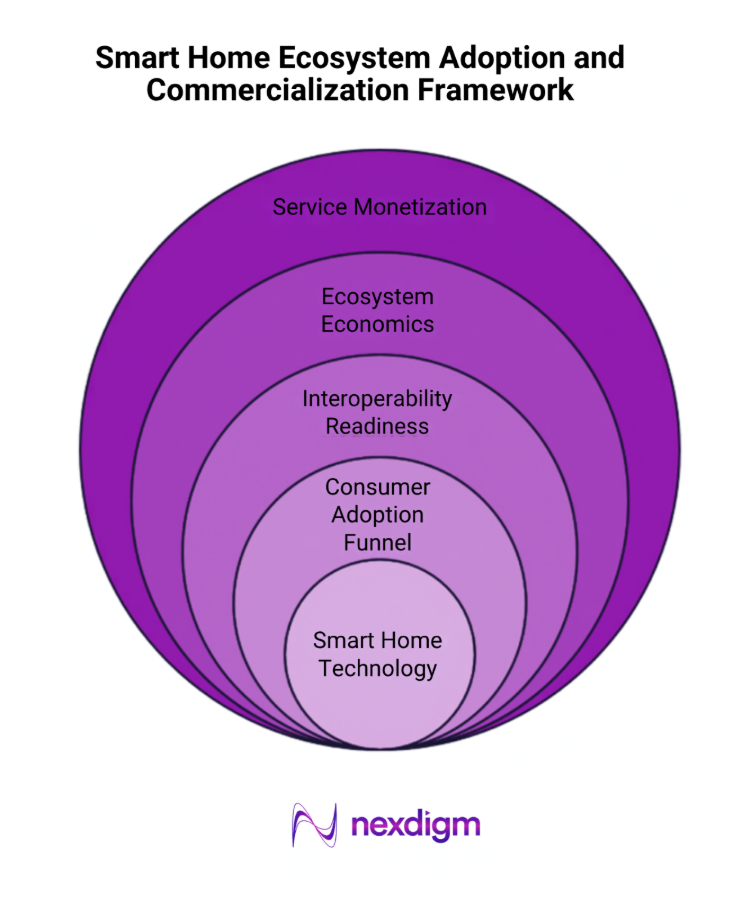
Nexdigm can evaluate smart-home opportunities across six connected dimensions:
- Anchor-category demand: Identify the devices most likely to initiate household adoption and generate follow-on purchases.
- Consumer adoption funnel: Measure awareness, first-device conversion, commissioning, multi-device adoption, and automation usage.
- Interoperability readiness: Assess Matter, Thread, Wi-Fi, Bluetooth, proprietary platforms, and compatibility requirements.
- Ecosystem economics: Model hardware margins, installation costs, customer acquisition, device retention, and recurring service revenue.
- Service monetization: Evaluate security, energy management, cloud services, maintenance, insurance, and assisted-living opportunities.
- Competitive and geographic fit: Compare brands, ecosystems, pricing, distribution, connectivity infrastructure, and household characteristics across target markets.
This approach helps determine whether an opportunity is primarily a connected-device market or has the characteristics required to become a scalable ecosystem.
Nexdigm Case: Benchmarking IoT Adoption to Improve Resource Efficiency
Nexdigm supported an agribusiness in benchmarking Agriculture IoT adoption across farms, identifying gaps in automation and analytics integration. Within eight months, the client improved water-use efficiency by 24%, strengthened crop-monitoring capabilities, and reduced operational resource wastage.Although the engagement was in agriculture rather than residential smart homes, the commercial principle is comparable: connected devices create greater value when their data feeds an integrated operating model.
The assessment demonstrates how Nexdigm can evaluate connected-technology adoption beyond hardware penetration and link deployment to measurable operational outcomes.
To take the next step, simply visit our Request a Consultation page and share your requirements with us.
Harsh Mittal
+91-8422857704